
What Tools Are Required For Basic Car Repairs
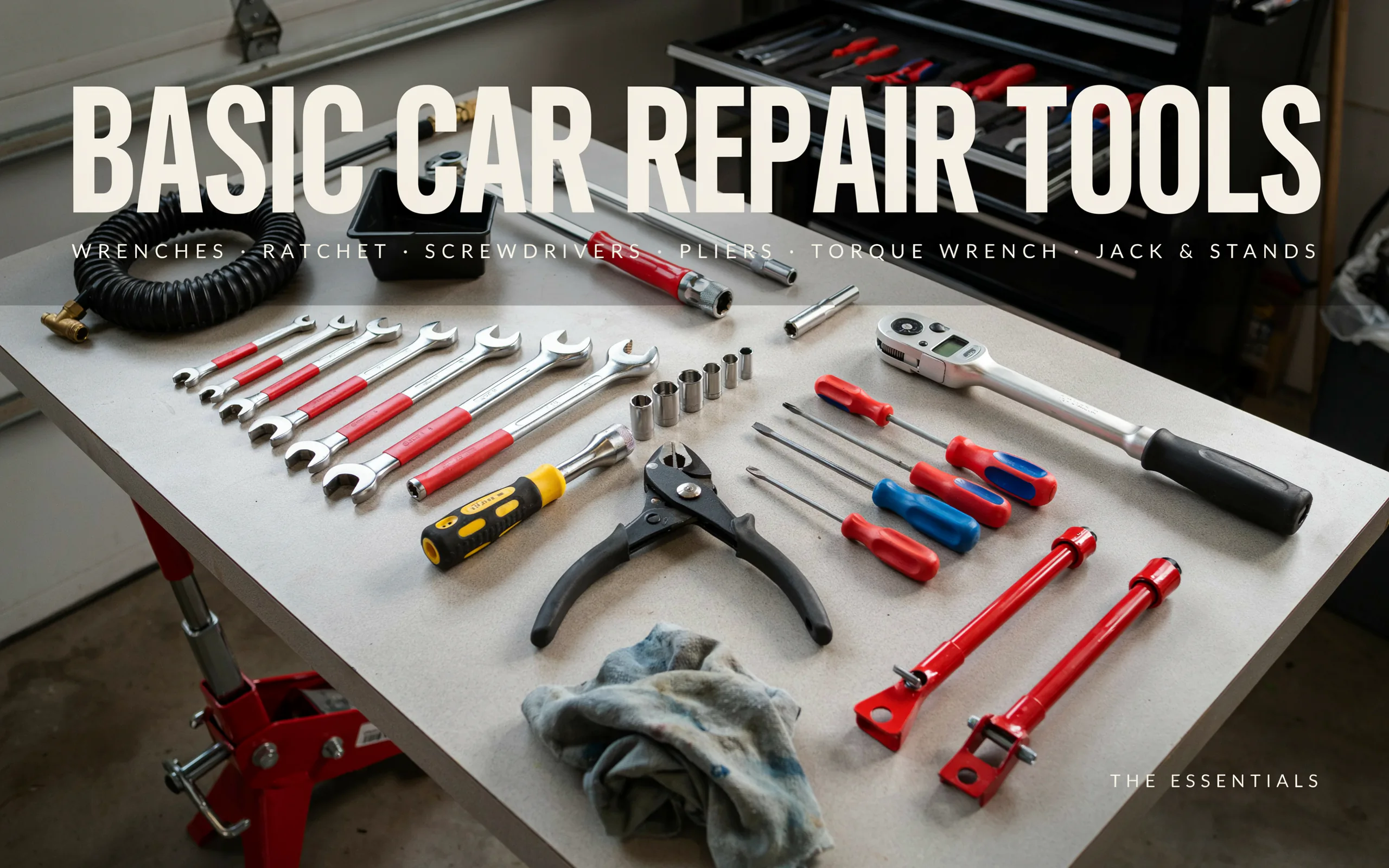
If you have ever wondered what tools are required for basic car repairs, this guide gives you a clear answer. From socket sets and wrenches to jacks and diagnostic scanners, we cover every essential tool for DIY car maintenance at home.
Have you ever looked at your car and thought, “I could probably fix that myself”? Maybe it was a strange noise, a warning light, or just the regular maintenance that always seems to cost more than you expect. The good news is that you can do a lot of the work yourself. The bad news is that you need the right equipment. So the real question is: what tools are required for basic car repairs? This is the first thing every new DIY mechanic asks, and it is the question we are going to answer fully.
You do not need a full professional garage to get started. You do not need to spend thousands of dollars on fancy equipment. What you need is a solid set of basic tools that will let you handle the most common jobs. These include oil changes, brake pad replacements, battery swaps, belt changes, and simple diagnostic work. With the right tools in your garage, you can save money, learn new skills, and keep your car running smoothly for years.
Let us walk through everything you need. We will cover hand tools, safety equipment, lifting gear, diagnostic devices, and some nice-to-have extras. By the end, you will know exactly what tools are required for basic car repairs and how to build your own toolkit step by step.
Why Having the Right Tools Changes Everything
Using the wrong tool for a job is frustrating. It can strip bolts, damage parts, and even cause injury. Using the right tool makes the work easier, faster, and safer. When you have the proper equipment, you feel more confident. You are less likely to give up halfway through a job.
Many people try to fix their cars with a basic household tool kit. But car repairs are different from hanging a picture or assembling furniture. Cars have bolts that are tightened to specific torque settings. They have electrical systems that need careful testing. They have heavy parts that must be lifted safely.
This is why knowing what tools are required for basic car repairs is so important. You need tools that are made for automotive work. They need to be durable, the right size, and designed for the conditions under the hood.
As Martynn Randall, technical editor at Haynes, puts it: “Yes, everyone still requires the basics of any toolbox, namely a good socket set, a set of quality spanners, various pliers, screwdrivers, Torx bits and Allen keys, plus a torque wrench and hammer.”
The Absolute Essentials: Hand Tools You Cannot Skip
Let us start with the hand tools. These are the items you will use for almost every repair. If you are wondering what tools are required for basic car repairs, this is your starting point.
Socket Set
A socket set is the most used tool in any mechanic’s box. Sockets fit over nuts and bolts, and a ratchet lets you turn them quickly. You will use sockets for everything from changing a tire to removing engine covers.
You need a set that includes both metric and standard (SAE) sizes. Most modern cars use metric fasteners, but older vehicles and some American models may use standard sizes. A good set will have 1/4-inch, 3/8-inch, and 1/2-inch drive sizes. This gives you flexibility for small and large jobs.
Look for sockets in both shallow and deep depths. Deep sockets are useful for reaching nuts on long studs. Extensions and universal joints are also helpful for getting into tight spaces.
Combination Wrenches
While sockets are great for most bolts, sometimes you need a wrench. Combination wrenches have an open end on one side and a box end on the other. The box end grips the bolt from all sides, which reduces the chance of stripping. The open end is good for quick work in open areas.
You need a set that covers the same sizes as your sockets. Again, get both metric and standard sizes. A good set of combination wrenches will last a lifetime if you buy quality ones.
Screwdrivers
Cars have many screws, especially inside the cabin and under the dash. You will need both flathead and Phillips head screwdrivers in various sizes. Get a set with different lengths, including some stubby ones for tight spaces.
Some modern cars also use Torx screws. These have a star-shaped pattern. You may want to add a set of Torx bits to your collection. Allen keys (hex keys) are also useful for certain bolts.
Pliers
Pliers are for gripping, bending, and cutting. You will use them for holding nuts, pulling hoses, and cutting wires. A basic set should include slip-joint pliers, needle-nose pliers, and diagonal cutters.
Locking pliers, often called Vise-Grips, are also very useful. They clamp onto a bolt or part and hold it firmly. This is great for removing stripped or stuck bolts.
Hammer
A hammer is useful for persuading stuck parts to move. A dead blow hammer is better than a regular hammer for car work. It has a soft face that does not damage parts. You can use it to tap on suspension components, brake drums, and other stubborn parts.
Safety and Lifting Equipment
Safety comes first. Before you even think about turning a bolt, you need to make sure you can work safely. This part of what tools are required for basic car repairs is often forgotten, but it is the most important.
Floor Jack and Jack Stands
You cannot work under a car that is only supported by a jack. Jacks are for lifting, not for holding. Once the car is up, you must put jack stands under it. These are sturdy metal supports that hold the vehicle securely.
Get a floor jack that is rated for your vehicle’s weight. Most cars weigh between 3,000 and 5,000 pounds, so a 3-ton jack is a good choice. Jack stands should also be rated for the weight. Always use them in pairs and place them on the recommended lift points.
As one expert notes: “A sturdy jack and a pair of jack stands are necessary for raising and supporting the vehicle securely while working underneath it.”
Wheel Chocks
These are wedges that go behind the wheels to stop the car from rolling. Even with jack stands, it is a good idea to chock the wheels. This adds an extra layer of safety.
Safety Glasses and Gloves
Fixing cars is dirty work. Fluids can splash, debris can fly, and sharp edges are everywhere. Safety glasses protect your eyes. Gloves protect your hands from cuts, chemicals, and grease.
Mechanics gloves are better than basic work gloves. They are thinner, so you can still feel what you are doing. They also provide good grip, even when your hands are oily.
Fire Extinguisher
A small fire extinguisher in your garage is a good idea. Cars have fuel, oil, and electrical systems. If something goes wrong, you want to be able to put out a fire quickly.
Diagnostic Tools
Modern cars are full of electronics. Sometimes the problem is not a loose bolt but a faulty sensor. This is where diagnostic tools come in. If you want to know what tools are required for basic car repairs in the modern age, these are essential.
OBD-II Scanner
Every car made after 1996 has an OBD-II port. This is a diagnostic connector under the dashboard. When your check engine light comes on, the car stores a fault code. An OBD-II scanner reads these codes and tells you what is wrong.
A basic scanner is affordable and easy to use. You plug it in, turn on the ignition, and read the code. Then you can look up what the code means. This saves you from guessing or taking the car to a shop for a simple diagnostic.
Martynn Randall from Haynes says: “One of the most important tools in a DIY mechanic’s armoury is an OBD reader. If you have one of these, modern cars can tell you what’s wrong with them, even before you’ve raised the bonnet.”
Multimeter
A multimeter measures voltage, resistance, and current. You use it to test batteries, alternators, and electrical circuits. If your car has an electrical problem, a multimeter helps you find it.
Get a digital multimeter. It is easier to read than an analog one. You do not need an expensive professional model. A basic one from a hardware store will do the job.
Tools for Specific Jobs
Some jobs need special tools. As you do more repairs, you will add these to your collection. But for now, here are a few that are worth having from the start.
Oil Filter Wrench
When you change your oil, you need to remove the old oil filter. It is often on very tight. An oil filter wrench gives you the grip you need to twist it off.
There are different types. Some are strap wrenches that wrap around the filter. Others are cap wrenches that fit over the end. Choose one that works with your car’s filter.
Oil Drain Pan and Funnel
Changing oil is one of the most common DIY jobs. You need a pan to catch the old oil and a funnel to pour in the new oil. A drain pan with a spout makes it easier to transfer the old oil to a container for recycling.
Tire Pressure Gauge
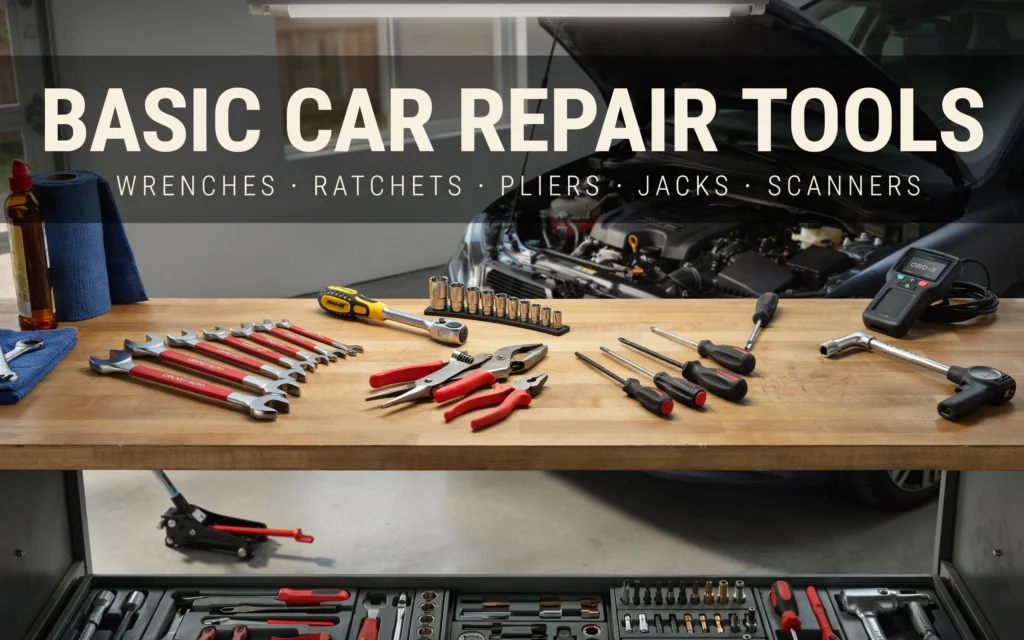
Keeping your tires at the right pressure is important for safety and fuel economy. A tire pressure gauge is a small, cheap tool that every driver should own.
Torque Wrench
This is a special wrench that measures how tight you are turning a bolt. Many car parts need to be tightened to a specific torque. Too loose and the part can fall off. Too tight and you can strip the threads or break the bolt.
A torque wrench is especially important for wheels, spark plugs, and engine parts. A click-type torque wrench is the most common. It makes a clicking sound when you reach the right torque.
Nice-to-Have Extras
These tools are not essential for basic repairs, but they make life much easier. As you grow your skills, you will probably want to add them.
Impact Wrench
An impact wrench is a power tool that uses bursts of force to turn bolts. It is great for removing lug nuts and other tight fasteners. Cordless impact wrenches are very popular now.
Work Light
Good lighting is often overlooked. Many garages are dark, and working under a car is even darker. A bright LED work light or headlamp helps you see what you are doing.
Breaker Bar
This is a long bar that fits onto a socket. It gives you extra leverage for breaking loose very tight bolts. Sometimes a ratchet is not strong enough, and you need a breaker bar.
Magnetic Parts Tray
When you take things apart, you end up with lots of small bolts and nuts. A magnetic tray holds them in one place so they do not roll away or get lost.
Wire Brush
A wire brush is useful for cleaning rust and dirt off parts. You can use it on battery terminals, brake components, and suspension parts.
Building Your Toolkit Over Time
You do not need to buy everything at once. Start with the basics and add more tools as you need them. This is a smart way to build your collection without spending too much money.
Start with a socket set, a set of combination wrenches, screwdrivers, pliers, and a hammer. Add a floor jack and jack stands for safety. Then get an OBD-II scanner and a multimeter for diagnostics. As you tackle specific jobs, buy the special tools you need for those jobs.
Eric Garbe from TechShop gives this advice: “Most daily repairs use a small core set of tools. Focus first on wrenches, ratchets and sockets, screwdrivers, pliers and cutters, hammer and punches, tire pressure gauge and basic hand tools. 90% of your day-to-day work uses about 10% of your toolbox. Start with quality basics rather than chasing every specialty item.”
What Tools Are Required for Basic Car Repairs: A Quick Reference Table
Here is a simple table to help you see the essentials at a glance.
| Tool Category | Essential Items | Why You Need Them |
|---|---|---|
| Hand Tools | Socket set, combination wrenches, screwdrivers, pliers, hammer | For turning bolts, gripping parts, and general mechanical work |
| Lifting Equipment | Floor jack, jack stands, wheel chocks | To raise and safely support the vehicle |
| Safety Gear | Safety glasses, gloves, fire extinguisher | To protect yourself from injury |
| Diagnostic Tools | OBD-II scanner, multimeter | To read fault codes and test electrical systems |
| Job-Specific Tools | Oil filter wrench, drain pan, funnel, tire pressure gauge, torque wrench | For oil changes, tire maintenance, and proper tightening |
Common Repairs and the Tools You Need
Let us look at some common car repairs. This will show you exactly what tools are required for basic car repairs for each job.
Oil Change
For an oil change, you need a socket set or wrench to remove the drain plug. You need an oil filter wrench to remove the old filter. You need a drain pan to catch the old oil. And you need a funnel to pour in the new oil.
Brake Pad Replacement
Brake jobs need a socket set and wrenches to remove the caliper bolts. You may need a C-clamp or brake caliper tool to push the piston back. A torque wrench is important for tightening the caliper bolts to the right specification.
Battery Replacement
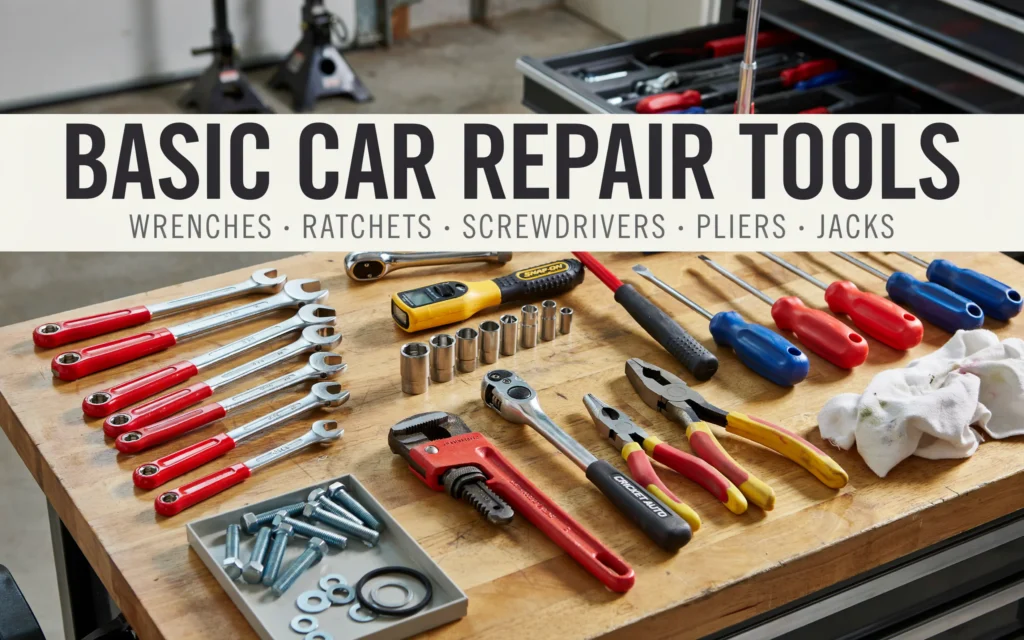
A battery swap needs a socket set or wrench to remove the terminal bolts. You may also need a wire brush to clean the terminals. Safety glasses are a good idea because batteries can have acid.
Tire Rotation
To rotate tires, you need a jack and jack stands, a lug wrench or impact wrench, and a torque wrench to tighten the lug nuts properly.
Spark Plug Replacement
Spark plugs need a socket set with a spark plug socket. These sockets have a rubber insert that holds the plug. You also need a torque wrench and sometimes a gap gauge to set the gap on the plugs.
Budgeting for Your Tool Kit
One of the biggest questions people have is how much to spend. You can get a basic mechanic’s tool set for around $100 to $200. This will include sockets, wrenches, screwdrivers, and pliers. Add a floor jack and stands for another $100 to $150.
You do not need to buy the most expensive tools. Many entry-level sets are good quality and will last for years. As you use them more, you will learn which tools you use most. Then you can upgrade those specific items to better quality.
Here is a rough budget guide for getting started:
| Item | Estimated Cost |
|---|---|
| Socket set (100+ pieces) | $50 – $150 |
| Combination wrench set | $30 – $80 |
| Screwdriver set | $15 – $40 |
| Pliers set | $20 – $50 |
| Hammer | $15 – $30 |
| Floor jack and jack stands | $100 – $200 |
| OBD-II scanner | $20 – $100 |
| Multimeter | $20 – $50 |
| Oil change kit (filter wrench, drain pan, funnel) | $20 – $40 |
| Torque wrench | $30 – $100 |
| Safety gear (glasses, gloves) | $15 – $30 |
Tips for Choosing Quality Tools
Not all tools are made the same. Here are some tips to help you choose good ones.
Buy Sets, Not Individual Tools
Buying a set is usually cheaper than buying tools one by one. A mechanic’s tool set gives you a wide range of sizes and types. This is the easiest way to get started.
Look for Chrome Vanadium or Chrome Molybdenum Steel
These are strong metals that resist rust. Good sockets and wrenches are made from these materials. They will last longer and are less likely to break.
Check the Warranty
Many tool brands offer a lifetime warranty. If a tool breaks, they replace it for free. This is a good sign of quality.
Consider Your Vehicle
If you have a newer car, you may need more metric tools. If you have an older American car, you may need more standard sizes. Some cars use special fasteners like Torx or E-Torx. Check what your car needs before you buy.
Organizing Your Tools
Once you have your tools, you need to keep them organized. This saves time and prevents you from losing things.
A tool chest or box is a good investment. It keeps your tools clean and in one place. Foam organizers are also popular. They have cutouts for each tool, so you can see at a glance if something is missing.
Hanging your tools on a pegboard is another option. This keeps them visible and easy to reach.
Frequently Asked Questions
1. What tools are required for basic car repairs for a complete beginner?
For a complete beginner, the essentials are a socket set, combination wrenches, screwdrivers, pliers, a hammer, a floor jack, jack stands, an OBD-II scanner, and safety glasses. These tools let you handle oil changes, battery swaps, tire rotations, and basic diagnostics.
2. How much does it cost to buy basic car repair tools?
You can get started for about $300 to $500. This includes a mechanic’s tool set, a floor jack with stands, and some diagnostic tools. You can add more tools over time as you need them.
3. Can I use regular household tools for car repairs?
Some household tools can work, but they are not ideal. Car bolts are often tight and need the right fit. Using the wrong size can strip the bolt. It is better to invest in proper automotive tools.
4. Do I need both metric and standard tools?
Yes, you should have both. Most modern cars use metric fasteners, but you will still find standard sizes on some parts. Having both sets means you are ready for anything.
5. What is the most important safety tool for car repairs?
Jack stands are the most important safety tool. Never work under a car that is only supported by a jack. Jack stands are designed to hold the weight of the vehicle safely.
6. Do I need a torque wrench for basic repairs?
A torque wrench is very helpful. Many parts, like wheels and spark plugs, need to be tightened to a specific torque. Using a torque wrench prevents over-tightening or under-tightening.
7. What is an OBD-II scanner and do I need one?
An OBD-II scanner reads fault codes from your car’s computer. When your check engine light comes on, the scanner tells you what is wrong. It is a very useful tool for diagnosing problems.
8. How do I know which tools to buy first?
Start with the tools you need for the repairs you plan to do. If you are changing oil, get an oil filter wrench and drain pan. If you are rotating tires, get a jack and torque wrench. Build your kit around your needs.
9. Are cheap tools good enough for basic car repairs?
Yes, many affordable tools are good quality. Entry-level sets from reputable brands work well for home mechanics. As you gain experience, you can upgrade the tools you use most.
10. Where should I store my car repair tools?
A tool chest or box is the best option. It keeps your tools organized and protected. You can also use a pegboard or shelf system in your garage.
Conclusion
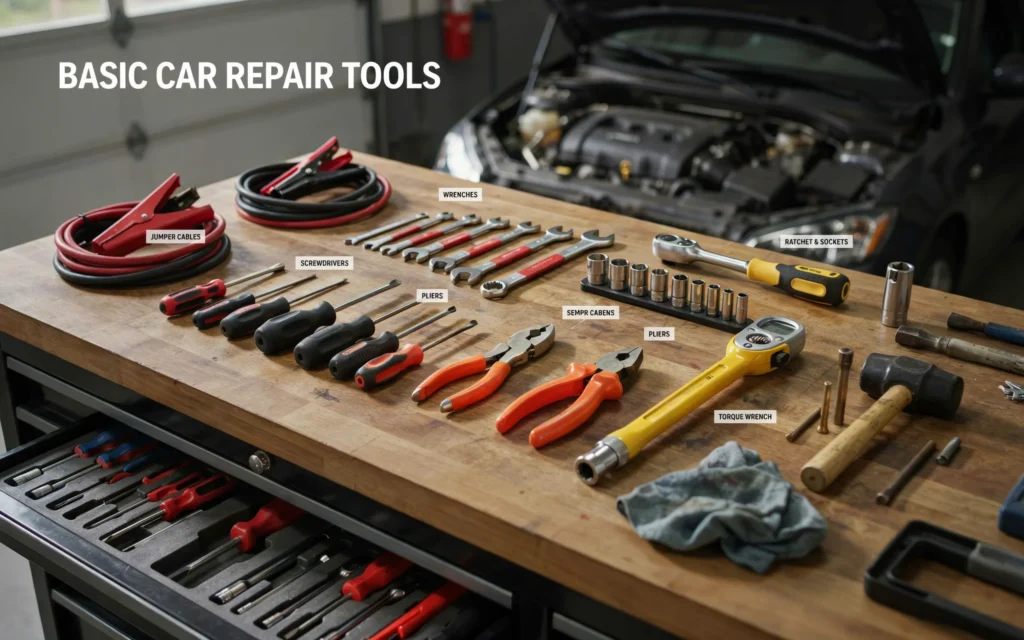
So, what tools are required for basic car repairs? The answer is a solid set of hand tools, safety equipment, lifting gear, and diagnostic devices. You do not need a full professional workshop. You need quality basics that let you handle the most common jobs.
Start with a socket set, combination wrenches, screwdrivers, pliers, and a hammer. Add a floor jack and jack stands so you can work safely. Get an OBD-II scanner and a multimeter for diagnostics. As you do more repairs, add specialty tools like an oil filter wrench, torque wrench, and impact wrench.
Building your toolkit is a journey. You do not have to buy everything at once. Start small, learn as you go, and add tools when you need them. Every repair you do will teach you something new and build your confidence.
The best part is the freedom. When you have the right tools, you are not dependent on a shop for every little thing. You can change your own oil, swap your own brakes, and diagnose your own problems. You save money, you learn new skills, and you gain a deeper understanding of your car.
So go ahead. Get your tools together. Pick a simple job and give it a try. You might be surprised at what you can do. And remember, every expert mechanic started exactly where you are right now.
Related posts
 Which Tool Kit Is Worth Buying? How to Choose the Right Set for Your Home
Wondering which tool kit is worth buying? Compare basic household sets, mechanic kits, and power tool combos to find the best tools for your budget and…
 Which Hand Tools Are Made in the USA? Reliable Brands and Buying Rules
Discover which hand tools are still made in the USA. Compare top domestic brands, tool categories, and learn how to verify origin labels before buying. Several…
 Why Do Campers Carry Multi Tools? Practical Uses in the Field
Why do Campers carry multi tools to handle gear repairs, campsite setup, food prep, and field fixes with minimal weight. Here is why one belongs in…