
What Is A Breaker Bar
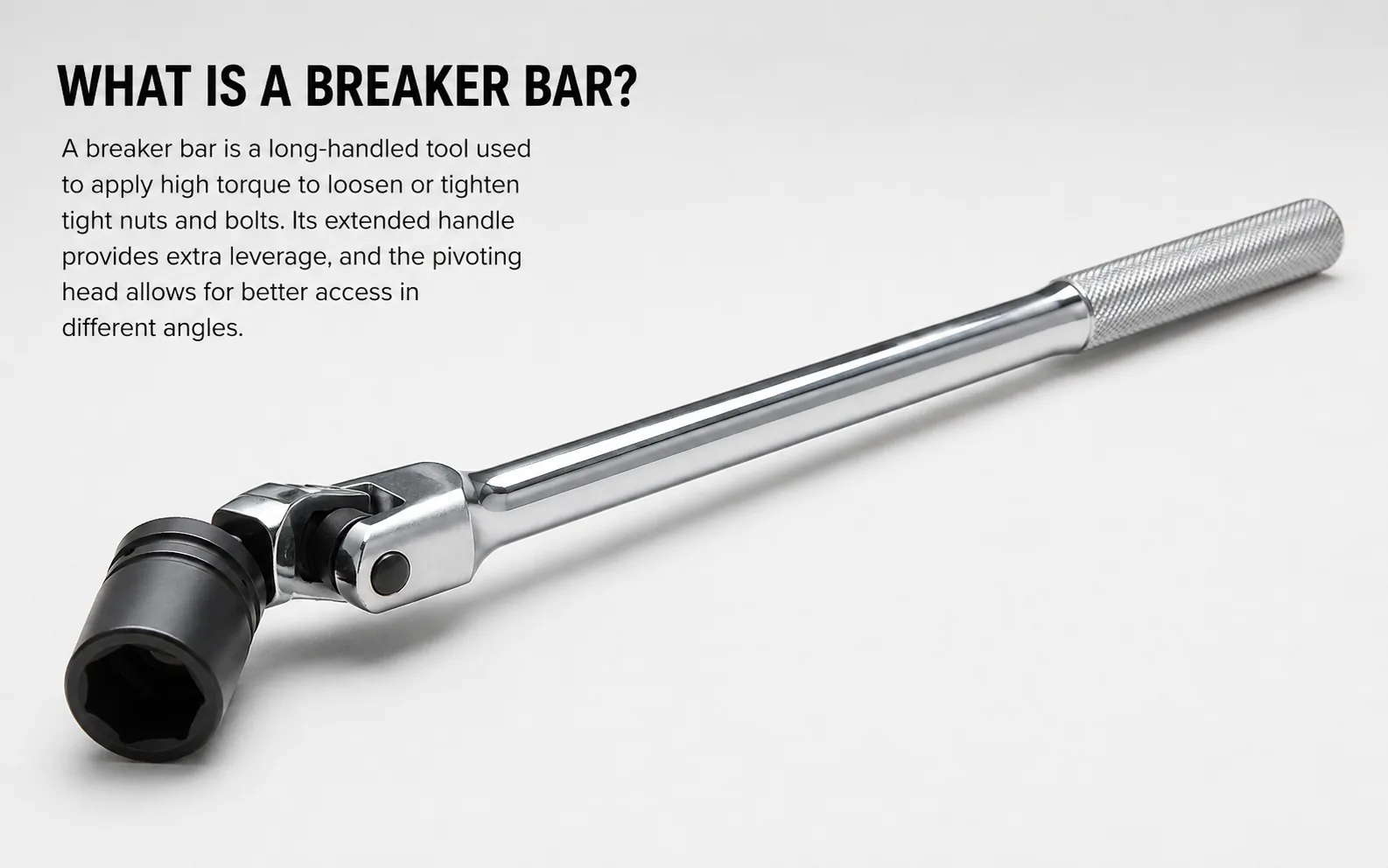
Learn exactly what a breaker bar is, how this long non-ratcheting tool helps you loosen stuck bolts with extra leverage. This guide covers types, uses, and safety tips for using a breaker bar effectively in any garage or workshop.
Have you ever faced a rusted bolt that just would not move? Maybe you tried every wrench in your toolbox, put your full weight behind it, and still nothing happened. That is exactly when you need a breaker bar. This simple yet powerful hand tool can save you from hours of frustration and prevent damage to your other tools.
I remember the first time I used one. I was trying to change a flat tire on an old truck, and the lug nuts had not been removed in years. My standard ratchet was bending under the pressure, and I was about to give up. A friend handed me a breaker bar, and within seconds, those stubborn nuts came loose. That experience showed me just how valuable this tool can be.
In this guide, we will cover everything you need to know about breaker bars. You will learn what a breaker bar is, how it works, the different types available, and when to use one. We will also compare it to other tools like ratchets and torque wrenches. By the end, you will feel confident choosing and using a breaker bar for your own projects.
What Is a Breaker Bar?
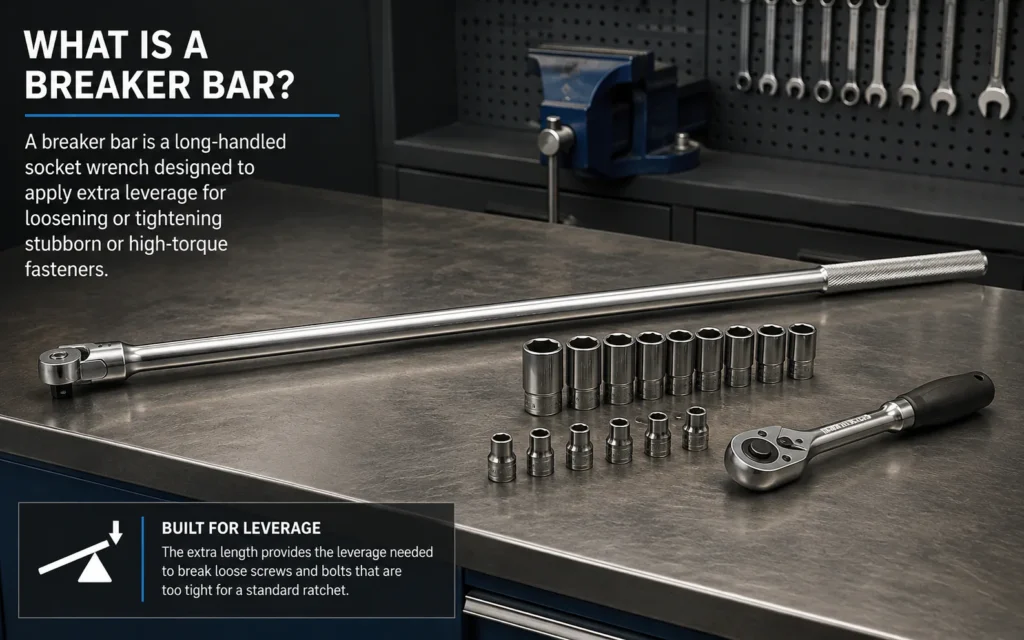
So, what is a breaker bar exactly? A breaker bar is a long, non-ratcheting hand tool that works with socket wrench sockets. Its main job is to break loose very tight, rusted, or overtightened fasteners. The name comes from its primary function: it “breaks” stubborn nuts and bolts free.
Unlike a regular ratchet, a breaker bar has no moving parts inside the head. This simple design makes it much stronger. You can apply a lot of force without worrying about breaking internal gears or springs.
The long handle is the secret to its power. It works like a lever. The longer the handle, the more torque you can generate with the same amount of effort. For example, if you apply 50 pounds of force to a 24-inch breaker bar, you get about 100 foot-pounds of torque. That is often enough to free even the most stubborn lug nuts.
A standard breaker bar can handle up to 2,500 foot-pounds of torque without breaking. In comparison, a high-end 1/2-inch ratchet maxes out around 500 foot-pounds. That is a huge difference. This extra strength is why mechanics and DIY enthusiasts keep a breaker bar in their toolbox.
How a Breaker Bar Works
The science behind a breaker bar is simple physics. It uses the principle of leverage. When you pull or push on the long handle, the force multiplies at the fastener. The distance from the pivot point (the fastener) to where you apply force determines the torque.
Torque equals force times distance. So, a longer bar gives you more torque for the same effort. This is why breaker bars are so effective for stuck bolts. You do not need to be incredibly strong. The tool does the hard work for you.
Another key feature is the absence of a ratcheting mechanism. Ratchets have small gears and pawls that can break under high stress. A breaker bar has a solid head. This means all the force goes straight into turning the fastener, not into fragile internal parts.
After you break the fastener loose, you usually only need a half-turn or so. Then, you can switch to a ratchet or wrench to finish the job quickly. This two-step process saves your ratchet from unnecessary wear and tear.
Breaker Bar vs. Standard Ratchet
| Feature | Breaker Bar | Standard Ratchet |
|---|---|---|
| Mechanism | Non-ratcheting, solid head | Ratcheting with gears and pawls |
| Maximum Torque | Up to 2,500 ft-lbs | Around 500 ft-lbs |
| Durability | Very high, no moving parts | Moderate, gears can fail |
| Best Use | Breaking loose stuck fasteners | General tightening and loosening |
| Price | Usually more affordable | Can be expensive for high-quality ones |
Types of Breaker Bars
Breaker bars come in several designs. Each type serves a specific purpose. Knowing the differences helps you pick the right one for your job.
Standard Breaker Bar
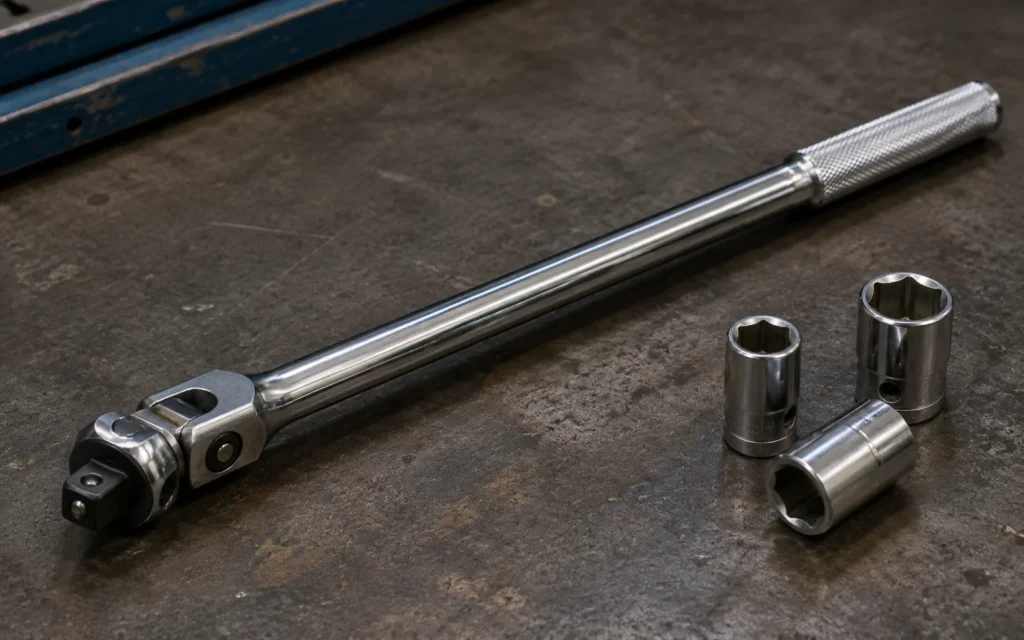
This is the most common type. It has a straight, non-ratcheting handle with a square drive head at one end. Standard bars usually range from 12 to 24 inches in length. They are great for general use in automotive repair, construction, and home workshops.
Flex-Head Breaker Bar
A flex-head breaker bar has a hinged head that swivels. This lets you access fasteners at different angles. It is useful when working in tight spaces where a straight bar cannot fit. The head can pivot up to 180 degrees in some models.
Sliding T-Style Breaker Bar
This type has a movable drive head that slides along the bar. You can position the head in the center for balance or toward either end for more leverage. This adjustability makes it versatile for different tasks and fastener locations.
Slugging Breaker Bar
Also called a striking breaker bar, this tool has a striking block or anvil at the end of the handle. You can hit it with a hammer for extra force. This is useful for the most stubborn fasteners that even a long bar cannot budge.
Ratcheting Breaker Bar
Some breaker bars include a ratcheting mechanism. This combines the leverage of a breaker bar with the convenience of a ratchet. You can loosen or tighten without removing the socket from the fastener. However, the ratcheting parts can be a weak point under extreme force.
Adjustable Breaker Bar
These bars let you change the handle length. They work like telescoping poles with a locking mechanism. You can extend them for more torque or shorten them for better control in tight spaces.
Breaker Bar Sizes and Drive Types
Breaker bars come in different drive sizes. The drive size refers to the square fitting that holds the socket. Common sizes include:
- 1/4-inch drive: Used for small, light-duty tasks.
- 3/8-inch drive: A versatile size for general automotive and household work.
- 1/2-inch drive: The most common size for automotive repair.
- 3/4-inch drive: Heavy-duty option for industrial and large equipment work.
- 1-inch drive: Used in heavy industry for very large fasteners.
Length also varies. Breaker bars can be as short as 10 inches or as long as 40 inches or more. Longer bars give more torque but can be harder to control. Choose a length that fits your typical jobs and workspace.
Common Breaker Bar Drive Sizes and Uses
| Drive Size | Typical Use | Common Length Range |
|---|---|---|
| 1/4 inch | Small engines, electronics, light assembly | 6-10 inches |
| 3/8 inch | General automotive, household repairs | 10-18 inches |
| 1/2 inch | Automotive, tire changes, suspension work | 15-30 inches |
| 3/4 inch | Heavy equipment, trucks, industrial | 24-40 inches |
| 1 inch | Very heavy machinery, construction | 30+ inches |
How to Use a Breaker Bar Safely
Using a breaker bar is straightforward, but safety matters. Here are some tips to keep in mind.
Choose the Right Socket
Always use the correct size socket for your fastener. A loose socket can slip and cause injury. Make sure the socket fits snugly on the fastener and the breaker bar drive.
Position Yourself Correctly
Stand in a stable position. Pull or push the bar in a smooth, controlled motion. Avoid jerky movements that could cause the socket to slip or the bar to bounce back.
Apply Force Gradually
Do not use sudden, explosive force. Apply steady pressure. If the fastener does not move, try repositioning the bar or using a penetrating oil. Sometimes, a few gentle taps with a hammer on the fastener head can help break the corrosion seal.
Use Two Hands When Needed
Longer breaker bars may require two hands. Keep a firm grip on the handle. Make sure your hands are clean and dry to prevent slipping.
Watch for Over-Torquing
A breaker bar can generate tremendous force. Be careful not to over-tighten fasteners with it. Use a torque wrench for final tightening to manufacturer specifications.
Never Use a Torque Wrench as a Breaker Bar
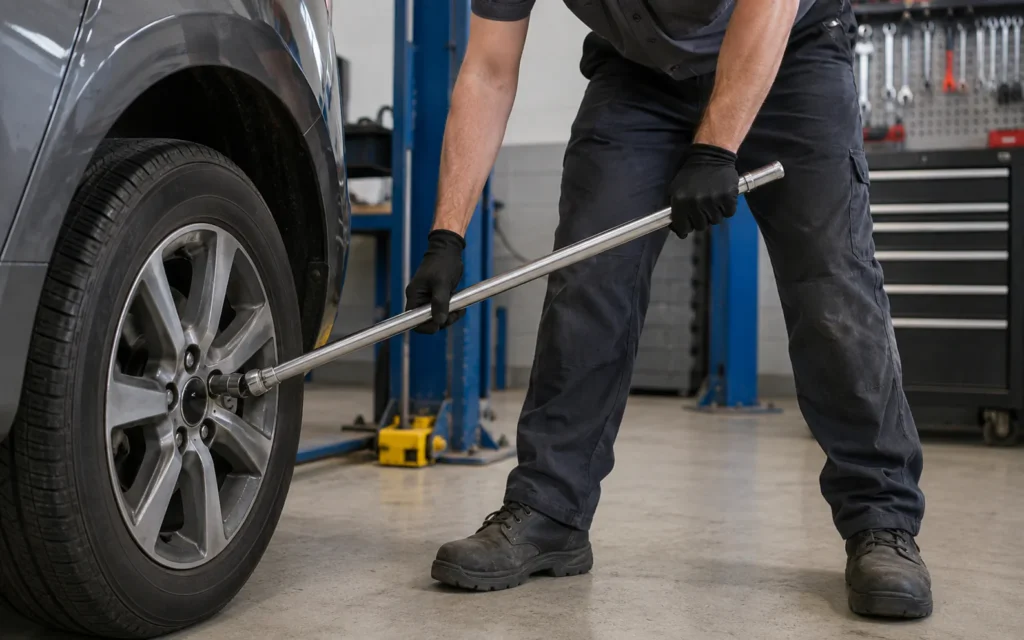
This is a common mistake. Torque wrenches are precision instruments. Using one to break loose a stuck bolt can damage the internal mechanism and ruin its calibration. Always use a proper breaker bar for breaking loose, and save your torque wrench for tightening.
A breaker bar is one of those specialty tools that every home mechanic wishes they had sooner or later.” – Slashgear Automotive Team
Breaker Bar vs. Other Tools
Understanding how a breaker bar compares to other tools helps you know when to use each one.
Breaker Bar vs. Ratchet
A ratchet is great for speed and convenience. It lets you turn fasteners without removing the tool. However, ratchets have internal gears that can break under high torque. A breaker bar has no such weakness. It is the better choice for initial loosening of stuck fasteners.
Breaker Bar vs. Torque Wrench
A torque wrench measures and applies precise force. It is used for tightening fasteners to specific values. A breaker bar provides maximum leverage for loosening. They solve opposite problems. Never use one in place of the other.
Breaker Bar vs. Impact Wrench
An impact wrench uses power to deliver rapid, high-torque blows. It is fast and efficient for many jobs. However, impact wrenches can be expensive and require air or battery power. A breaker bar is simple, cheap, and always ready to use. It also gives you more control over the force applied.
“The main difference between a torque wrench and a breaker bar is their function and construction. Torque wrenches and breaker bars solve opposite problems.” – Olsa Tools
Benefits of Using a Breaker Bar
Breaker bars offer several advantages that make them a must-have tool.
Increased Leverage
The long handle gives you more torque with less effort. This is the primary benefit. You can loosen fasteners that would be impossible with a standard wrench.
Durability
With no moving parts, a breaker bar is incredibly strong. It can withstand extreme force without breaking. This makes it a reliable tool for tough jobs.
Cost-Effective
Breaker bars are generally less expensive than high-quality ratchets or torque wrenches. They offer great value for the power they provide.
Versatility
You can use a breaker bar with any standard socket. This makes it useful for a wide range of applications, from automotive repair to construction.
Prevents Tool Damage
Using a breaker bar protects your ratchets and torque wrenches from damage. It takes the stress so your more delicate tools do not have to.
Common Applications
Breaker bars are used in many fields and situations.
Automotive Repair
This is the most common use. Mechanics use breaker bars to remove lug nuts, suspension bolts, brake caliper bolts, and engine accessory fasteners. They are essential for tire changes and brake jobs.
Construction
Construction workers use breaker bars on heavy machinery and scaffolding. They help disassemble large structures and maintain equipment.
Industrial Maintenance
Factories and plants use breaker bars for maintaining heavy equipment. They are useful for loosening large bolts on machinery.
Home Workshops
DIY enthusiasts find breaker bars helpful for various projects. From assembling furniture to repairing lawn equipment, a breaker bar can make tough jobs easier.
Off-Road and Heavy Equipment
Off-road vehicles and heavy equipment often have very tight fasteners. Breaker bars provide the necessary torque for maintenance and repairs.
“Breaker bars are widely used in automotive applications. They are also used in the construction industry for maintaining heavy plants and machinery.” – RS Components
How to Choose the Right Breaker Bar
Selecting the right breaker bar depends on your needs and the jobs you do.
Consider the Drive Size
Think about the most common fastener sizes you work with. For most automotive work, a 1/2-inch drive is a good choice. For lighter tasks, 3/8-inch may suffice. For heavy equipment, consider 3/4-inch or larger.
Think About Length
Longer bars give more torque but can be harder to handle. A 24-inch bar is a good balance for most users. Shorter bars are better for tight spaces.
Look at the Head Type
Standard heads are fine for most jobs. Flex-head bars offer more access in tight spots. Sliding T-style bars provide adjustability.
Check the Material
High-quality breaker bars are made from chromium-vanadium steel. This material is strong and durable. It resists bending and breaking under high torque.
Consider Your Budget
Breaker bars are generally affordable. However, prices vary based on size, material, and brand. Choose a reputable brand for quality and reliability.
Maintenance and Care
Breaker bars are low-maintenance tools. However, a little care extends their life.
Keep It Clean
Wipe off dirt, grease, and grime after each use. This prevents corrosion and keeps the tool looking good.
Lubricate the Head
Apply a few drops of oil to the drive head occasionally. This keeps it moving smoothly and prevents rust.
Store Properly
Store your breaker bar in a dry place. Hanging it on a tool rack or keeping it in a toolbox drawer prevents damage.
Inspect Regularly
Check for signs of wear or damage. Look for bends, cracks, or excessive wear on the drive head. Replace the tool if you find any issues.
Frequently Asked Questions
What is a breaker bar used for?
A breaker bar is used to loosen very tight, rusted, or overtightened fasteners. It provides extra leverage to break them loose.
Can I use a breaker bar to tighten bolts?
It is not recommended. A breaker bar can generate too much torque, leading to over-tightening and damage. Use a torque wrench for tightening.
Is a breaker bar the same as a torque wrench?
No. A breaker bar provides leverage for loosening. A torque wrench measures and applies precise force for tightening.
What size breaker bar should I buy?
For most automotive work, a 1/2-inch drive breaker bar around 24 inches long is a good choice. Adjust based on your specific needs.
Can I use a breaker bar with any socket?
Yes, as long as the socket matches the drive size of the breaker bar. For example, use a 1/2-inch drive socket with a 1/2-inch drive breaker bar.
How much torque can a breaker bar handle?
A standard breaker bar can handle up to 2,500 foot-pounds of torque. This is much more than a typical ratchet.
What is a cheater bar?
A cheater bar is a length of pipe used to extend a wrench or breaker bar for more leverage. It is an improvised tool.
Are breaker bars safe to use?
Yes, when used properly. Always use the correct socket, apply force gradually, and stand in a stable position.
What materials are breaker bars made of?
High-quality breaker bars are typically made of chromium-vanadium steel. This material is strong and shock-resistant.
Can I use a breaker bar on an impact socket?
Yes, impact sockets are designed to handle high torque and work well with breaker bars.
Conclusion
A breaker bar is a simple but powerful tool that belongs in every workshop. Whether you are a professional mechanic or a weekend DIY enthusiast, you will eventually face a fastener that refuses to move. That is when you will be glad you have a breaker bar.
We have covered what a breaker bar is, how it works, and the different types available. You now know how to choose the right one for your needs and how to use it safely. Remember, the key to success with a breaker bar is leverage. The long handle multiplies your force, making tough jobs easy.
Do not make the mistake of using your torque wrench as a breaker bar. That can damage a valuable tool. Instead, invest in a good-quality breaker bar. It will save you time, frustration, and money in the long run.
Next time you face a stubborn bolt, reach for a breaker bar. You will be amazed at how easily it gets the job done. Happy wrenching!
Related posts
 Which Tool Kit Is Worth Buying? How to Choose the Right Set for Your Home
Wondering which tool kit is worth buying? Compare basic household sets, mechanic kits, and power tool combos to find the best tools for your budget and…
 Which Hand Tools Are Made in the USA? Reliable Brands and Buying Rules
Discover which hand tools are still made in the USA. Compare top domestic brands, tool categories, and learn how to verify origin labels before buying. Several…
 Why Do Campers Carry Multi Tools? Practical Uses in the Field
Why do Campers carry multi tools to handle gear repairs, campsite setup, food prep, and field fixes with minimal weight. Here is why one belongs in…