
Why Should Mechanics Label Their Tools? Loss Prevention and Shop Efficiency
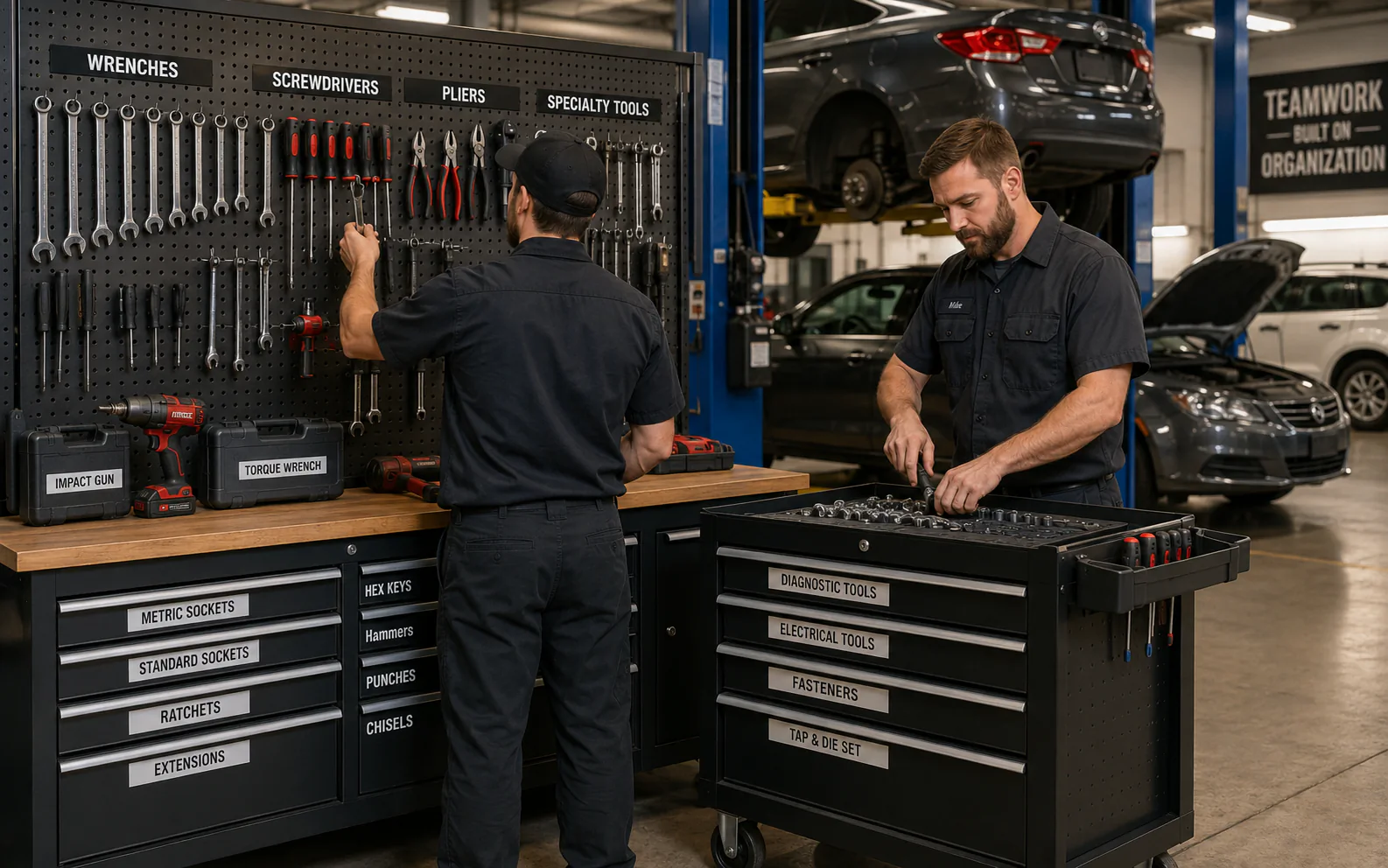
Mechanics should label their tools primarily to prevent accidental loss, deter theft, and protect significant personal financial investments. In professional automotive and diesel shops, technicians usually purchase their own hand tools, power equipment, and specialty items. When multiple technicians work near each other, loose sockets, ratchets, and impact wrenches frequently mix together during complex jobs.
Labeling tools clearly establishes undisputed ownership and speeds up daily workflow. Beyond keeping personal gear from wandering into neighboring toolboxes, clear markings ensure fast inventory sweeps at the end of a shift, reducing the risk of leaving expensive tools inside customer engine bays or under chassis.
Preventing tool mix-ups in shared
- Mechanics buy their own tools, making individual identification vital to safeguard high financial investments.
- Tool marking prevents accidental mix-ups when multiple technicians work on adjacent repair bays.
- Labeled tools make daily drawer inventory fast, ensuring no ratchets or sockets are left in customer vehicles.
- Etching or stamping initials creates immediate ownership clarity without ruining tool grip.
| Topic | When it helps | What to keep in mind |
|---|---|---|
| Reason 1 | Busy commercial auto shops, dealership service centers, and fleet maintenance garages. | Relying solely on memory instead of physical marks when borrowing specialty pullers. |
| Reason 2 | Professional mechanics building or maintaining a complete personal tool collection. | Unmarked premium tools that look identical to a co-worker’s equipment. |
| Reason 3 | Flat-rate mechanics who need to clean up efficiently without wasting billable time. | Faded paint bands that rub off in solvent tanks, slowing down identification. |
| Reason 4 | Mechanics working in open-access garages or multi-shift facilities. | Shallow surface marks that can easily be buffed off with an angle grinder. |
| Reason 5 | Shops that share expensive specialty service kits, torque wrenches, and pullers. | Forgetting which technician borrowed a tool during complex multi-day engine rebuilds. |
How Tool Identification Improves Shop Efficiency and Work Safety
Why Should Mechanics Label Their Tools. In a fast-paced garage environment, spent time searching for a missing socket or ratchet translates directly into lost flat-rate earnings. When mechanics label their tools with consistent color codes or engraved markings, drawer organization becomes second nature. Technicians can identify missing items instantly before closing a hood or finishing a job.
Tool identification also plays a direct role in vehicle safety. Foreign object debris left behind in engine bays, brake assemblies, or subframes can cause severe mechanical failure. A simple visual check made easy by distinct tool markings ensures every tool returns to its tray before the vehicle leaves the service bay.
A technician finishing a brake job notices a missing socket during a quick visual check. Because all tools are color-coded, they spot the bright green band sitting near the lower control arm before test driving the car.
Assuming fellow technicians will remember who owns unlabelled chrome sockets during major shop teardowns.
- Eliminates time spent asking co-workers if they picked up a loose ratchet.
- Prevents tool contamination and accidental drop-ins inside intake manifolds or transmission housings.
- Encourages cleaner workspace habits during multi-stage engine or suspension repairs.
Comparing Popular Tool Labeling Methods for Hard Steel and Plastic
Selecting the right tool marking method depends on the material, tool shape, and exposure to solvents. Chrome-plated steel, bare alloy, impact-grade black oxide, and plastic tool housings each respond differently to identification techniques.
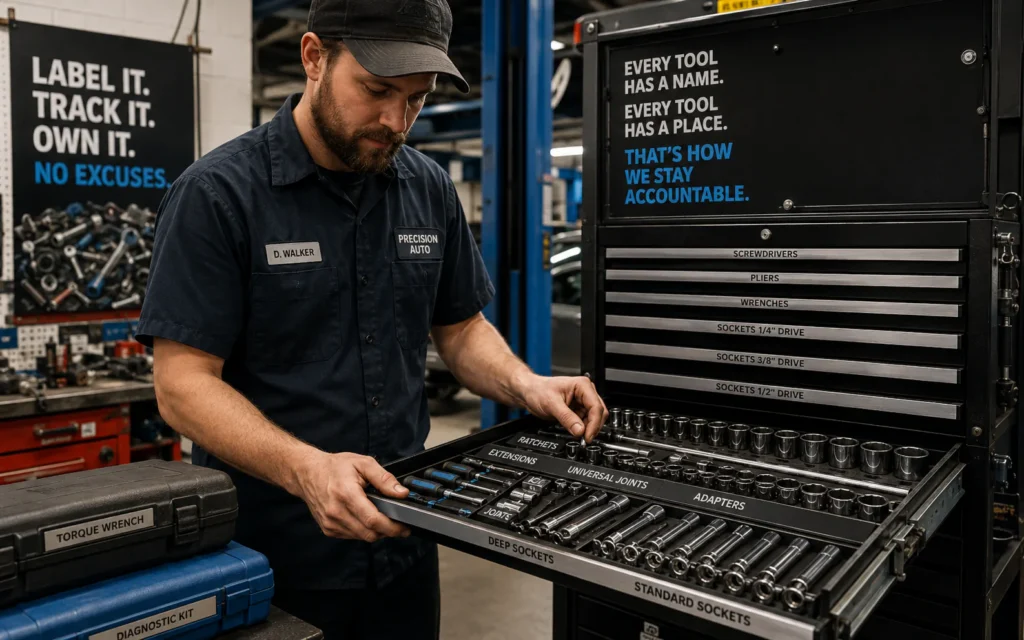
Combining two approaches often works best: a permanent mark like an engraved initial for undisputed ownership, combined with a quick-glance visual indicator like color-coded heat-shrink tubing.
Choosing an electric carbide scribe to engrave initials into hard chrome sockets, while using oil-resistant heat-shrink tubing on wrench handles for rapid color identification.
Using standard vinyl electrical tape that dissolves when exposed to brake cleaner or gear oil.
| Marking Method | Durability | Solvent Resistance | Best Tool Material | Main Advantage |
|---|---|---|---|---|
| Carbide Micro-Engraving | Permanent | High | Chrome Steel & Hard Plastics | Unalterable proof of ownership |
| Heat-Shrink Tubing | Moderate to High | Moderate | Wrench shafts & Ratchet handles | Instant visual color matching |
| Chemical Metal Etching | Permanent | High | Polished Chrome Vanadium | Clean look with zero metal stress |
| Metal Stamping Dies | Permanent | High | Soft steel & Unplated tools | Deep indentations that last decades |
| Paint Pens / Paint Bands | Low to Moderate | Low | Impact Sockets & Cases | Inexpensive and simple to apply |
Critical Mistakes Mechanics Should Avoid When Marking Tools
While labeling tools is highly beneficial, improper technique can structural ruin or weaken high-stress equipment. Heavy steel punch stamps should never be struck into thin-walled sockets or highly stressed torque wrench bodies, as deep stress points invite metal cracking under heavy loads.
Avoid using standard adhesive stickers or basic electrical tape. Chemical solvents like brake cleaner, degreasers, and automatic transmission fluid quickly dissolve weak adhesives, leaving behind gummy residues that attract dirt and obscure drawer organization.
Take extra care with specialized high-voltage hybrid or EV hand tools. Engraving or cutting into VDE-rated insulation breaks the dielectric barrier, exposing the technician to extreme electrical safety hazards.
Deeply stamping metal initials into the thin wall of a thin-wall chrome socket, causing it to crack under high torque loading.
Engraving across insulated handles on high-voltage hybrid electrical service tools.
- Never stamp or deeply engrave impact sockets near high-stress drive squares.
- Do not scratch or cut protective rubberized insulation on electrical safety tools.
- Avoid placing heavy paint layers over socket size callouts, which makes reading measurements difficult.
Covers financial loss prevention shop
Reason 1. Preventing Accidental Shop Mix-Ups
When multiple mechanics work on adjacent lifts, tools are frequently set down on shared workbench surfaces or cart tops. Clear labels quickly clarify who owns which socket set.
- Busy commercial auto shops, dealership service centers, and fleet maintenance garages.
- Relying solely on memory instead of physical marks when borrowing specialty pullers.
- Mark common high-use tools first, such as 10mm sockets, 3/8-inch ratchets, and pry bars.
- Primary Risk – Accidental swap
- Marking Priority – High
- Solution – Color coding or laser etching
Reason 2. Protecting Substantial Financial Investments
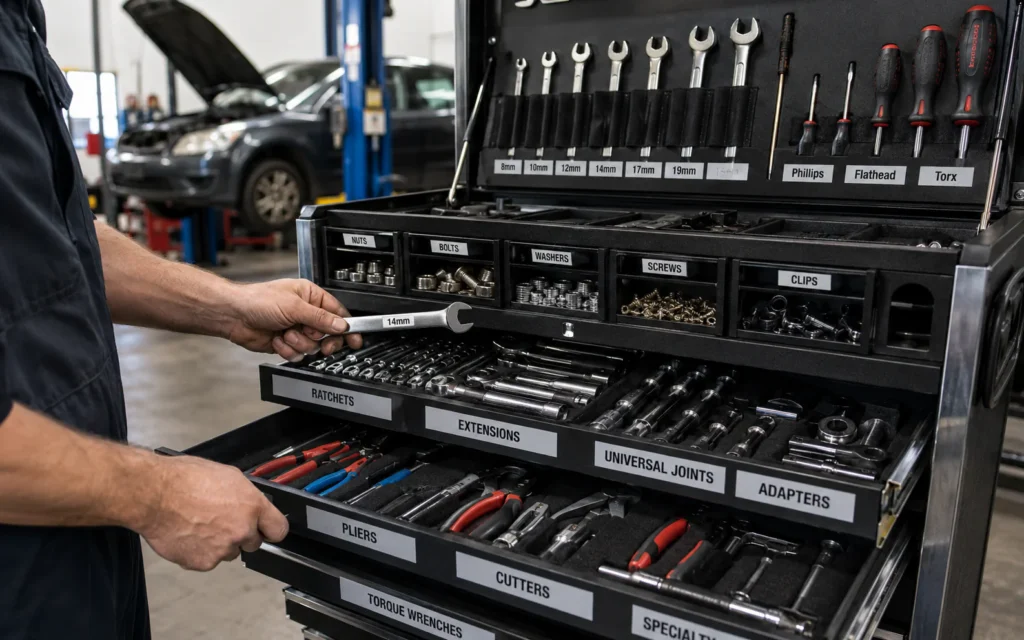
Professional technicians often invest tens of thousands of dollars into personal tool sets. Identification marks discourage walk-offs and assist insurance claims if a toolbox is compromised.
- Professional mechanics building or maintaining a complete personal tool collection.
- Unmarked premium tools that look identical to a co-worker’s equipment.
- Log serial numbers alongside personal initials engraved on high-value diagnostic scanners and impact guns.
- Primary Risk – Financial loss or theft
- Marking Priority – Essential
- Solution – Permanent micro-engraving or chemical etching
Reason 3. Shortening End-of-Day Tool Audits
Labeled tools allow mechanics to rapidly inventory their rolling carts and drawer foam shadow boards before closing up, ensuring every piece is accounted for.
- Flat-rate mechanics who need to clean up efficiently without wasting billable time.
- Faded paint bands that rub off in solvent tanks, slowing down identification.
- Combine distinct visual color rings for fast visual scanning with small engraved initials for verification.
- Primary Risk – Missing tools left in vehicles
- Marking Priority – High
- Solution – High-visibility color bands
Reason 4. Deterring Opportunistic Theft
Tools marked with permanent initials, laser engravings, or custom stampings are difficult to resell or claim as personal property, significantly lowering theft risk.
- Mechanics working in open-access garages or multi-shift facilities.
- Shallow surface marks that can easily be buffed off with an angle grinder.
- Apply markings on recessed or non-contact parts of the tool handle or body.
- Primary Risk – Intentional theft
- Marking Priority – High
- Solution – Vibro-engraving or deep stampings
Reason 5. Simplifying Tool Borrowing Accountability
Co-workers occasionally need to borrow specialized service equipment. Distinct labels remind everyone where the borrowed item belongs once the job is complete.
- Shops that share expensive specialty service kits, torque wrenches, and pullers.
- Forgetting which technician borrowed a tool during complex multi-day engine rebuilds.
- Establish a shop rule where borrowed tools are inspected and returned to the owner’s labeled drawer immediately.
- Primary Risk – Unracked missing gear
- Marking Priority – Medium
- Solution – Initials near brand stampings
FAQs
What is the best permanent way to mark chrome mechanics tools?
Electric carbide engravers and chemical metal etching kits are the most reliable methods. They create permanent initials without compromising the structural integrity of the chrome-vanadium steel.
Does engraving a hand tool void its lifetime warranty?
Warranty policies vary by manufacturer. Most major hand tool brands allow light surface engraving for ownership identification, provided the marking did not cause the structural crack or mechanical defect.
How do mechanics label tiny sockets and bit drivers?
For small sockets under 8mm, micro-engraving on the smooth drive end or color-coding the socket rail tray is ideal. Avoid deep mechanical stamping on tiny socket walls.
Why use color-coding tubing instead of just engraving initials?
Engraved initials prove precise ownership up close, but color-coded heat-shrink tubing allows you to spot your tool across a busy shop floor or at the bottom of an engine bay in a split second.
Should mechanics mark their toolboxes and rolling carts as well?
Yes. Labeling toolboxes, service carts, and storage drawers helps maintain professional shop organization and ensures personal gear remains clearly distinguished during facility cleanups.
Conclusion
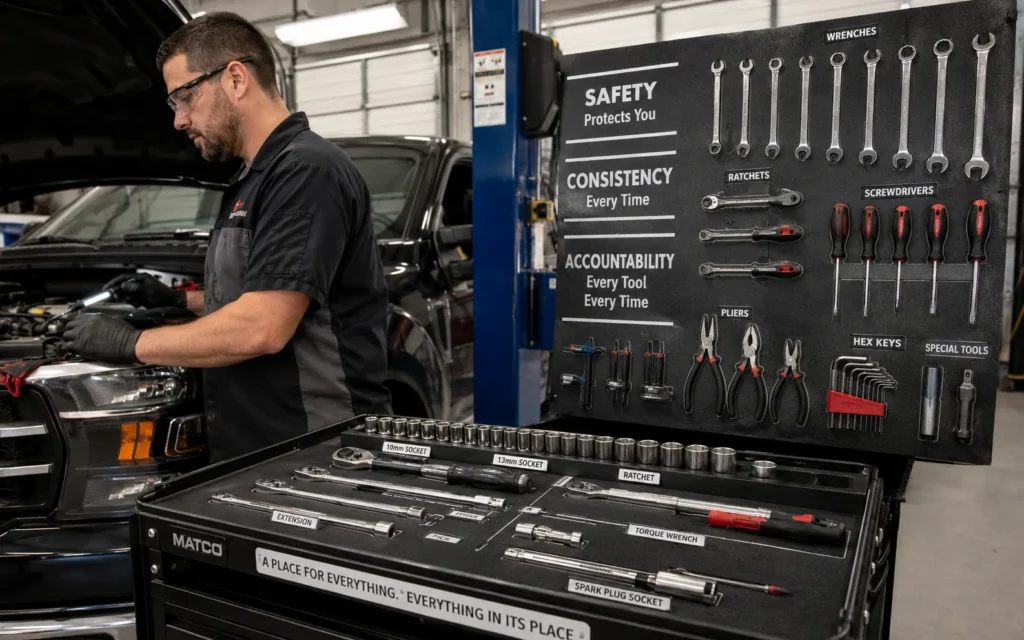
Labeling tools is a simple practice that pays massive dividends for professional mechanics and serious hobbyists alike. Clear identification marks protect hard-earned tool investments, discourage theft, and keep shared shop floors running without unnecessary friction.
By selecting safe, solvent-resistant marking techniques-such as electric scribing or chemical etching paired with color bands-technicians can safeguard their gear without compromising tool strength or safety. Take time to audit and mark your kit before your next major overhaul job.
Related posts
 Which Tool Kit Is Worth Buying? How to Choose the Right Set for Your Home
Wondering which tool kit is worth buying? Compare basic household sets, mechanic kits, and power tool combos to find the best tools for your budget and…
 Which Hand Tools Are Made in the USA? Reliable Brands and Buying Rules
Discover which hand tools are still made in the USA. Compare top domestic brands, tool categories, and learn how to verify origin labels before buying. Several…
 Why Do Campers Carry Multi Tools? Practical Uses in the Field
Why do Campers carry multi tools to handle gear repairs, campsite setup, food prep, and field fixes with minimal weight. Here is why one belongs in…