
What Is the Difference Between 6-Point And 12-Point Sockets
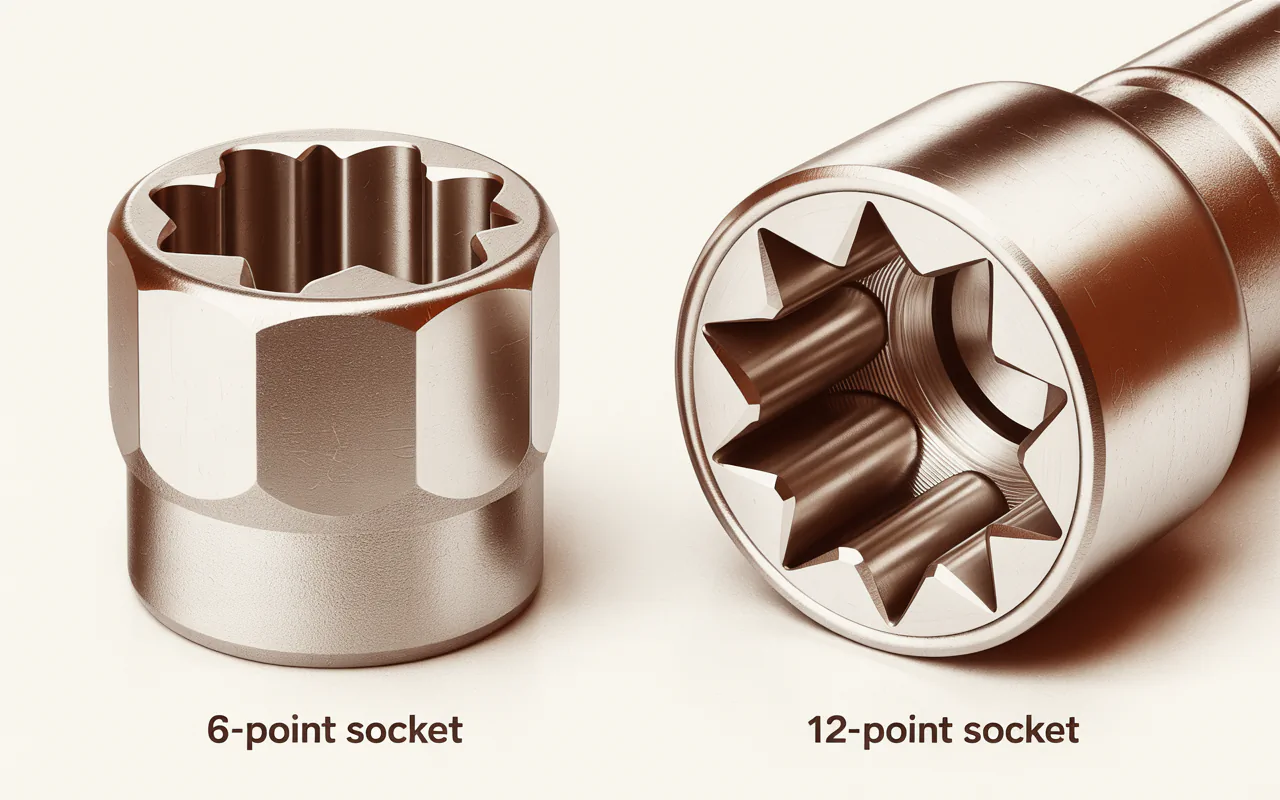
Curious about the difference between 6-point and 12-point sockets? 6-point sockets grip bolt heads tighter and stop rounding. 12-point sockets let you turn bolts in tight spots faster. Pick the right one for your work.
If you have ever opened a toolbox or shopped for a new socket set, you saw sockets with 6 points and others with 12 points. At first look, they seem almost the same. But they work very differently. Knowing the difference between 6-point and 12-point sockets can save you from broken bolts, round edges, and wasted time.
I still recall my first year as a weekend mechanic. I grabbed a 12-point socket because it looked easier to put on. Then I ruined a rusty bolt on my old truck. That day taught me to respect socket design. So let me share what I learned. By the end of this guide, you will know exactly which socket to use for each job.
What Are Socket Points?
A socket point is one of the internal corners inside a socket. These corners match the points on a bolt head or a nut. Most bolt heads have 6 points (hexagonal shape). A 6-point socket has 6 internal corners. A 12-point socket has 12 internal corners.
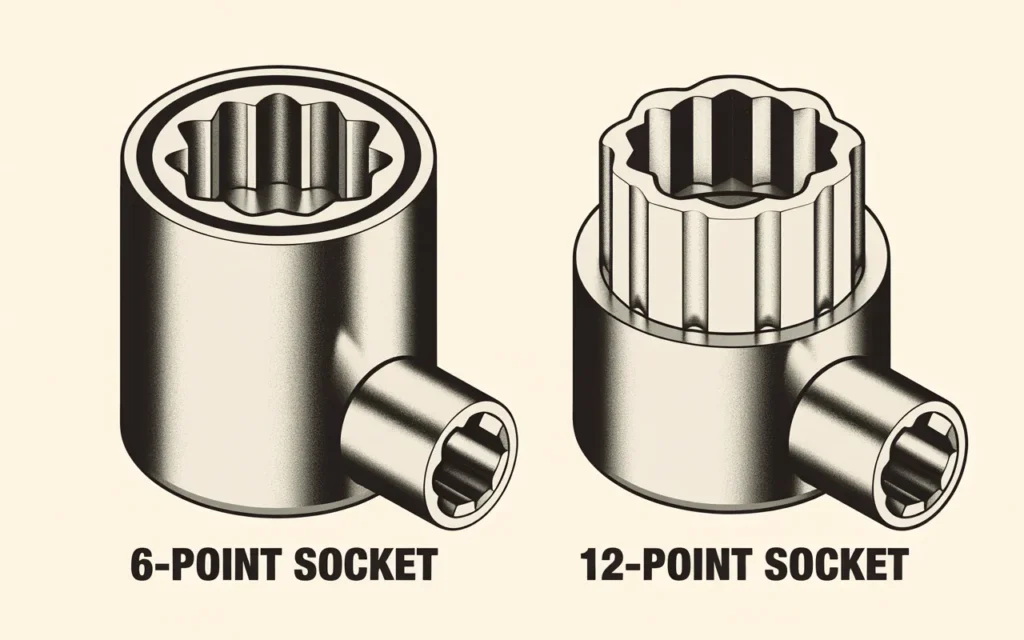
Think of it like this. A 6-point socket is a perfect hexagon. A 12-point socket looks like a hexagon with each flat side pushed inward to make two smaller flats. That gives you 12 contact points instead of 6.
The main job of any socket is to turn a fastener without slipping. The more surface contact you have, the less chance of damage. This simple fact sits at the heart of the difference between 6-point and 12-point sockets.
The Main Difference Between 6-Point and 12-Point Sockets
Let me state the core difference in plain words. A 6-point socket touches the bolt near its corners. A 12-point socket touches the bolt more on its flat sides. Because the 12-point socket has extra cuts, it loses contact area.
That smaller contact area means the 12-point socket can slip or round the bolt edges when you apply high force. The 6-point socket holds the bolt more securely. It spreads the force across wider surfaces.
But the 12-point socket has one big win. You can place it on a bolt in twice as many positions. In tight engine bays or crowded spaces, that matters a lot. You do not need to turn the socket as much to find a match.
So the difference between 6-point and 12-point sockets is a trade off. More grip versus easier placement. Strong hold versus quick access.
“A 6-point socket is your best friend for stuck bolts. A 12-point socket is your helper for fast work in tight places.” – Frank Morrison, auto repair instructor for 25 years
Grip and Contact Area
Let me break down the grip factor because this is where most people make mistakes.
6-point socket grip:
- Each flat side of the socket touches a full flat side of the bolt.
- The force spreads evenly across the whole face.
- The corners of the bolt stay safe from pressure.
12-point socket grip:
- Each flat side has a notch cut out.
- Only about half of each flat makes contact.
- The force pushes more toward the bolt corners.
This means when you really pull hard on a wrench, the 12-point socket can start to round the bolt. Once the edges round, the socket spins freely. Now you have a real problem. You might need a bolt extractor or a drill.
I once helped a neighbor who used a 12-point socket on a brake caliper bolt. He pushed so hard that the bolt head turned into a circle. We spent two hours removing that bolt. A 6-point socket would have taken it off in one minute.
So the difference between 6-point and 12-point sockets in terms of grip is huge. For high torque jobs, the 6-point socket wins every time.
Ease of Alignment
Now let’s talk about why 12-point sockets still exist. Nobody would sell them if they only caused harm.
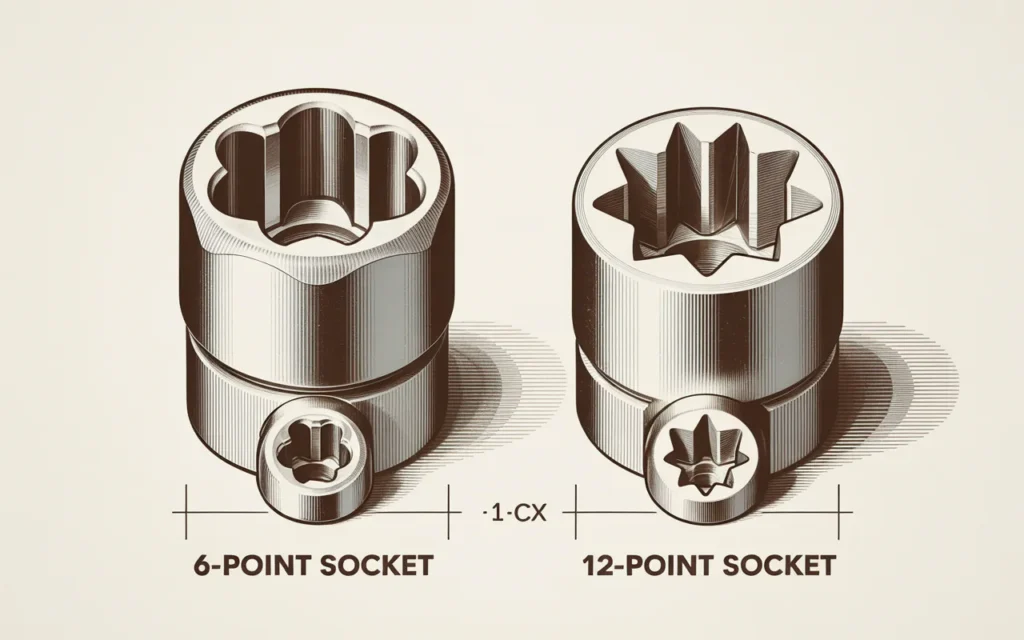
A 12-point socket has 12 internal corners. That means you only need to rotate the socket 30 degrees to line up with the bolt. A 6-point socket needs a 60 degree turn to line up.
Picture this. You are working under a car dashboard. Your arm is bent. You cannot see the bolt. You feel around with the socket. With a 12-point socket, you find the match twice as fast. This saves seconds on each bolt. Over a whole job, those seconds add up.
Also on ratchets with small teeth (like coarse 36-tooth ratchets), the 12-point socket gives you more chances to click into place. You do not need to swing the ratchet handle as far.
But here is a truth many ignore. In most modern ratchets with fine teeth (72 tooth or more), the alignment advantage of 12-point sockets becomes smaller. You can already move the ratchet handle a tiny bit to engage the next tooth.
Still, many pros keep both types in their toolboxes. They use each one for its strength.
“My rule is simple. 6-point for rust, high torque, and large bolts. 12-point for small bolts, interior work, and tight engine bays.” – Linda Chen, heavy equipment mechanic
Quick Comparison Table: 6-Point vs 12-Point Sockets
| Feature | 6-Point Socket | 12-Point Socket |
|---|---|---|
| Contact points on bolt | 6 full flats | 6 half-flats (12 edges) |
| Grip strength | Very high, resists slipping | Moderate, can slip under high torque |
| Risk of rounding bolt | Low | Higher on old or soft bolts |
| Ease of placement | Needs 60° rotation to align | Needs 30° rotation to align |
| Best for | Rusted bolts, high torque, large fasteners | Tight spaces, light duty, fast assembly |
When to Use Each Type
Now you know the difference between 6-point and 12-point sockets in theory. Let me give you real world examples so you never guess again.
Best Uses for 6-Point Sockets
Rusted bolts and nuts
Rust eats away metal. The bolt corners become weak. A 12-point socket will finish the job of rounding them. A 6-point socket grabs the good parts of the flats.
High torque applications
Think lug nuts, axle nuts, suspension bolts, and engine mount bolts. These need 100 foot pounds or more. A 6-point socket transfers that force without slipping.
Soft metal fasteners
Aluminum or brass bolts round very easily. Always use 6-point on these.
Damaged or worn fasteners
If a bolt head already looks bad, a 12-point socket will make it worse. The 6-point socket offers your last chance to remove it.
Impact wrench use
Impact tools deliver sudden hammer blows. A 6-point socket handles this force much better. Many impact socket sets are only 6-point for this reason.
Best Uses for 12-Point Sockets
Tight spaces with limited swing
When you can only move your ratchet handle a little, the 12-point socket lets you catch the next position.
Interior and dash work
Small bolts under 10mm. Low torque. Quick access matters more than extreme grip.
12-point bolt heads
Some special bolts (often on race cars or aircraft) have 12-point heads. You need a 12-point socket for those. But those are rare. Most cars and trucks use standard 6-point bolts.
Assembly line or production work
If you are putting together new parts quickly, the fast alignment of 12-point sockets speeds you up.
When working with small ratchets
Tiny 1/4″ drive ratchets often have coarse teeth. A 12-point socket helps them engage easier.
“In 30 years of fixing cars, I have seen hundreds of rounded bolts. Every single one came from a 12-point socket or the wrong size. Never from a good 6-point socket.” – Ray Thompson, retired master technician
Torque and Rounding Risks
Let me give you numbers to make the difference between 6-point and 12-point sockets crystal clear.
A standard 6-point socket contacts about 90% of each bolt flat. A 12-point socket contacts only about 50% of each flat. That is nearly half the contact area.
Now think about torque. Torque is force times distance. When you apply 100 foot pounds with a 6-point socket, that force spreads across 6 large contact zones. Each zone takes about 16-17 foot pounds.
With a 12-point socket, the same 100 foot pounds pushes through 6 smaller zones. Each zone takes the same 16-17 foot pounds but on a smaller area. That means higher pressure per square inch on the bolt corners. That pressure deforms the metal. Then the edges round.
Here is a simple rule. If you feel the socket slip once, stop immediately. That bolt is starting to round. Switch to a 6-point socket or use a bolt extractor.
I keep a set of 6-point impact sockets for all my heavy work. My 12-point sockets only come out for small jobs where I know the bolts are clean and not tight.
Second Comparison Table: Quick Reference by Bolt Condition
| Bolt Condition | Best Socket Type | Why |
|---|---|---|
| New, clean, light torque | Either, but 12-point faster | Low risk of damage |
| Rusty or corroded | 6-point only | Prevents rounding |
| High torque needed (over 50 ft-lbs) | 6-point | Better force transfer |
| Very tight space, low torque | 12-point | Easier to position |
| Already slightly damaged | 6-point | May still grip good flats |
| 12-point bolt head | 12-point | Must match the bolt design |
| Impact wrench use | 6-point | Handles shock loads better |
What Do Professionals Say?
I asked several mechanics and tool experts about the difference between 6-point and 12-point sockets. Their answers were almost the same.
Most pros keep a full set of 6-point sockets for daily work. They use 12-point sockets only for specific tasks. Many tool truck brands like Snap-on and Mac sell mostly 6-point sets to professionals. The 12-point sets go to hobbyists or as budget options.
But some pros love 12-point sockets for certain jobs. Engine builders use them on rod bolts and main caps because those bolts are often 12-point designs. Transmission work also uses 12-point fasteners sometimes.
The key is knowing what fastener you have. Look at the bolt head. Count the points. If it has 6 points, you can use either socket but with different results. If it has 12 points, you must use a 12-point socket.
A common myth says 12-point sockets are stronger because they have more metal. That is false. The extra cuts remove metal. A 6-point socket is actually stronger and less likely to crack under heavy use.
Common Myths and Facts
Let me clear up some confusion about the difference between 6-point and 12-point sockets.
Myth 1: 12-point sockets work on 6-point bolts just as well.
Fact: They work, but not as well. The reduced contact area makes them more likely to slip and round the bolt.
Myth 2: 6-point sockets are old technology.
Fact: 6-point sockets are the original and still the best for most jobs. 12-point came later as a convenience feature.
Myth 3: Expensive 12-point sockets grip better than cheap 6-point.
Fact: No. The design difference matters more than price. A cheap 6-point socket still out-grips an expensive 12-point.
Myth 4: You need both types for basic car repair.
Fact: For most home mechanics, a good set of 6-point sockets covers 95% of jobs. Buy 12-point only if you work in tight spaces often.
Myth 5: Impact sockets are always 6-point.
Fact: Most are, but some brands make 12-point impact sockets. Avoid those. Impact force plus reduced contact equals broken bolts.
How to Build Your Socket Collection
If you are starting a tool set, here is my advice based on the difference between 6-point and 12-point sockets.
Buy a 6-point socket set first. Get 1/4″, 3/8″, and 1/2″ drive sizes. Make sure the set includes common metric sizes (8mm to 19mm) and standard sizes (1/4″ to 3/4″). This will handle almost everything on a car, motorcycle, or home repair.
Then buy a separate small set of 12-point sockets in the sizes you use most. For me, that is 10mm, 12mm, 13mm, 14mm, and 15mm in 3/8″ drive. Keep these in a separate rail or tray.
Never mix them in your tool drawer without labels. You do not want to grab a 12-point by mistake for a tough bolt.
Also buy a set of bolt extractors. Even with good habits, you may still round a bolt someday. Extractors are cheap insurance.
Frequently Asked Questions
Q: Can I use a 12-point socket on a 6-point bolt?
Yes, you can. But be careful with high torque or rusty bolts. The 12-point socket has less contact area. That means higher risk of rounding the bolt edges. For light duty work, it is fine.
Q: Why do 12-point sockets exist if 6-point are better?
Because 12-point sockets let you align to a bolt faster. In tight spaces, you may not be able to turn the ratchet handle a full 60 degrees. A 12-point socket only needs 30 degrees. That small difference matters in crowded engine bays.
Q: Which socket is stronger?
A 6-point socket is stronger. The walls are thicker because there are no extra cuts. A 12-point socket has thinner walls near the corners. That makes it more likely to crack under extreme force.
Q: Do I need both types for working on my car?
Not at first. Start with a good 6-point set. As you gain experience, you may want 12-point sockets for certain jobs. But many home mechanics never need 12-point sockets.
Q: What about 8-point or 4-point sockets?
Those are for square fasteners like pipe plugs or some drain bolts. They are not common in general repair. Stick with 6-point and 12-point for hex bolts.
Q: How do I know if a bolt is 12-point before using a socket?
Look closely at the bolt head. A 6-point head has six sharp corners. A 12-point head has a star like look with twelve small points. If you are not sure, shine a light and count the corners.
Q: Can I mix socket types on an impact wrench?
Only use 6-point sockets on impact tools. A 12-point impact socket will damage bolts and the socket itself may crack. The hammering action makes the contact area problem worse.
Q: Why are many cheap socket sets all 12-point?
Because 12-point sockets are easier for beginners to place on bolts. Tool makers assume beginners do not know the difference between 6-point and 12-point sockets. They sell what feels convenient. But cheap 12-point sets often round bolts, leading to frustration.
Q: What size bolts need a 6-point socket the most?
Any bolt larger than 10mm (3/8″) that requires more than 30 foot pounds of torque. Small bolts under 6mm (1/4″) are less risky because they break before they round.
Q: Will a 6-point socket work on a 12-point bolt?
No. A 6-point socket will not fit over a 12-point bolt head. The points do not align. You must use a 12-point socket for 12-point bolts.
Final Summary of the Difference Between 6-Point and 12-Point Sockets
Let me put everything into one clear summary.
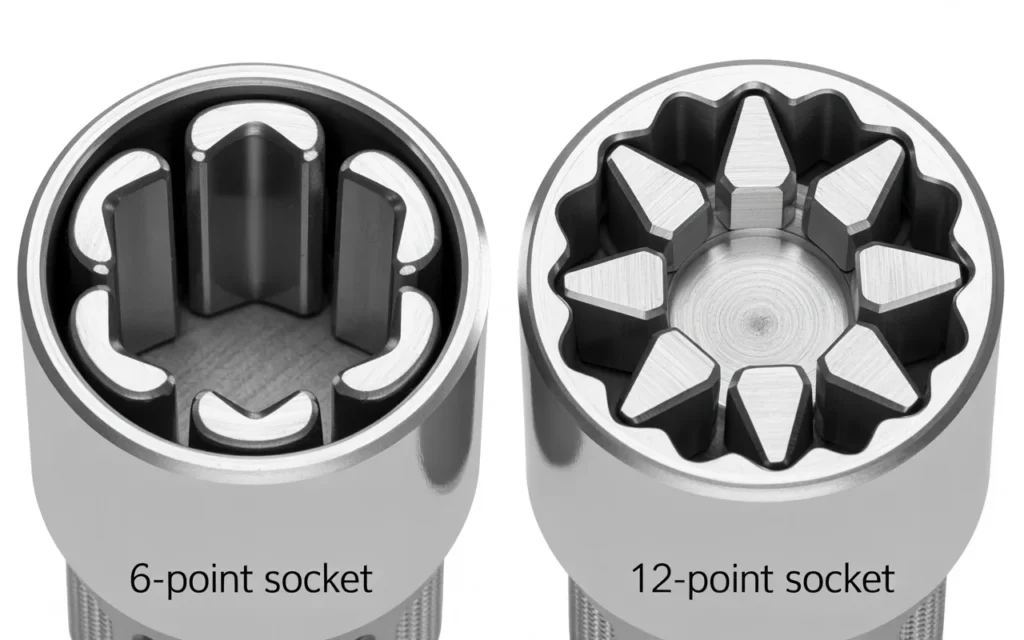
The difference between 6-point and 12-point sockets comes down to two things: contact area and placement ease.
A 6-point socket touches nearly the whole flat side of a bolt. It gives you maximum grip and lowest risk of rounding. Use it for rusty bolts, high torque, impact tools, and any job where failure is not an option.
A 12-point socket touches only about half of each flat. It has less grip but lets you align to the bolt twice as fast. Use it in tight spaces, for low torque bolts, and when you need to work quickly.
Do not let anyone tell you one is always better. Both have their place. But if you could only own one type, buy 6-point. It will save you from the heartbreak of a rounded bolt on a Saturday afternoon when all the stores are closed.
Now you know the difference between 6-point and 12-point sockets. Go look at your tool set. See what you have. Then go fix something with confidence.
Conclusion
Socket points are not just a design detail. They affect how well you work and whether you damage your fasteners. After reading this guide, you understand the difference between 6-point and 12-point sockets at a deep level.
Remember the simple rule. More contact equals more grip. Fewer contact points equal faster alignment. Choose your socket based on the bolt condition and the space you have.
I hope you never round another bolt. And if you do, at least you will know why it happened. Keep a set of 6-point sockets close. Use 12-point sockets only when the job really needs them. Your bolts will thank you.
Related posts
 Top Starter Mechanic Tool Kits for Apprentices: Essential Sets for Your Trade
Explore top starter mechanic tool kits for apprentices. Compare sets for mechanics, electricians, and other trades to find your essential tools. Starting an apprenticeship is an…
 Automotive Tool Kits vs. Mechanic Tool Sets: What’s the Difference?
Understand the key differences between automotive tool kits vs. mechanic tool sets. Learn which is best for your car maintenance needs. When looking for tools to…
 Top Automotive Tool Kits for Garage Workshops: A Buyer’s Guide
Find the top automotive tool kits for garage workshop. Compare versatile sets for car maintenance, home repairs, and DIY projects to choose the best fit. Setting…