
How To Organize Socket Sets
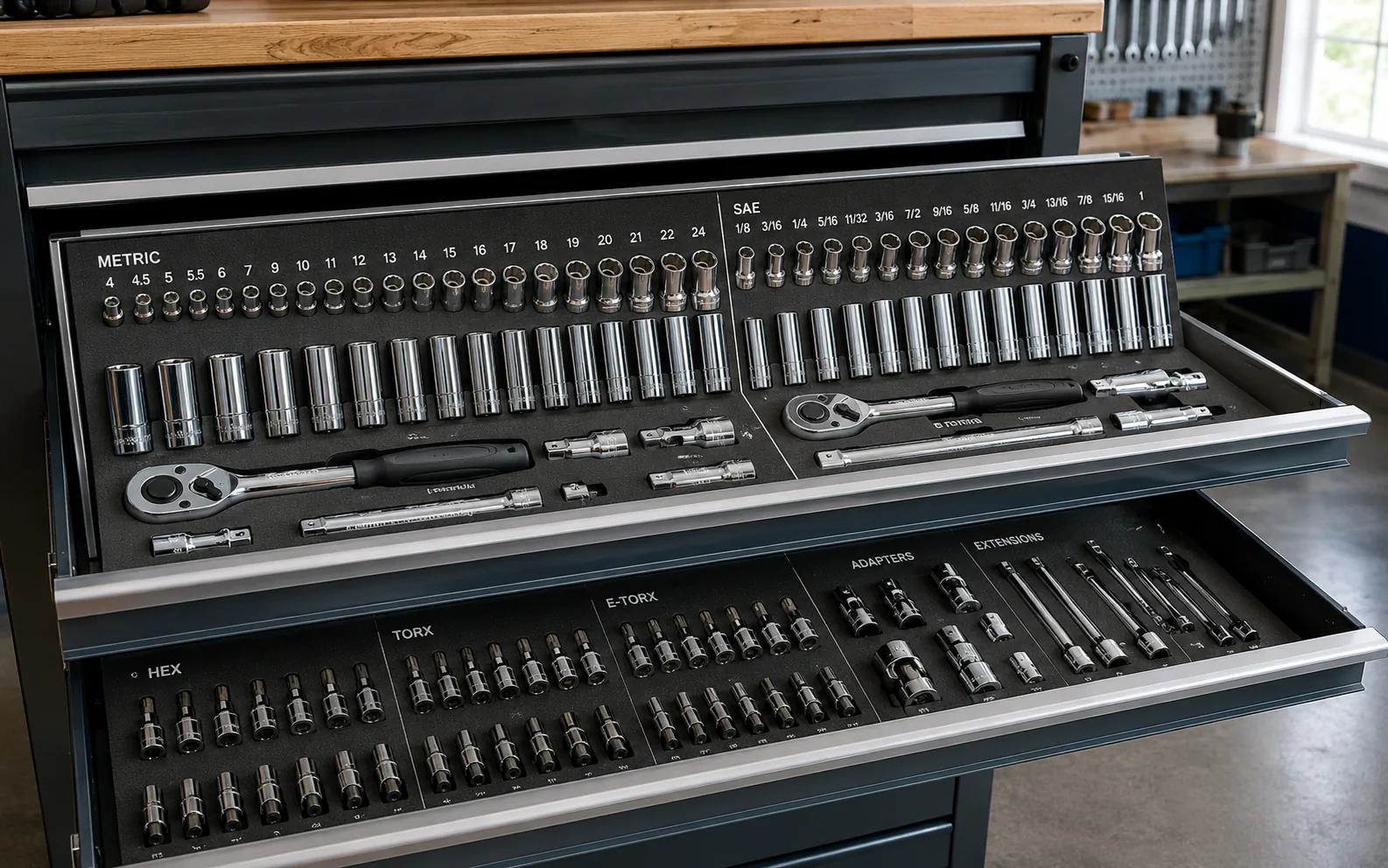
Need to know how to organize socket sets without losing parts? This guide shows you the best storage solutions, sorting methods, and labeling tips to keep your sockets in order and easy to find. Learn how to organize socket sets for good.
If you have ever spent more time looking for a 10mm socket than actually working on your car, you are not alone. A messy drawer or a pile of loose sockets can stop a simple job in its tracks. It can be frustrating to turn your garage upside down for a single tool. Most of us have been there. We think we have every piece, but they seem to vanish into thin air. The simple truth is that you need a solid plan to organize socket sets effectively. This is not just about cleaning; it is about saving time and protecting your tools. This guide will show you how to organize your sockets so you can find the right piece in seconds.
Why It Matters to Keep Things Tidy
Keeping your tools neat is not just for perfectionists. It is a practical step that makes every project easier. When you organize socket sets, you know exactly what you have. You can see if a piece is missing right away. This saves you from buying duplicates. It also keeps your tools in better shape. When sockets bang against each other in a drawer, they can get scratched or damaged. Good organization stops that. It also makes your workspace safer. You will not have loose sockets rolling around on the floor, waiting to be stepped on.
First Step: Sort Your Collection
Before you buy any fancy holders, you need to sort your tools. This is the foundation of the whole project. Gather all your sockets from toolboxes, bags, and that random drawer in the kitchen. Put them all in one place. This gives you a clear view of what you have. It also helps you see what you might be missing.
By Type
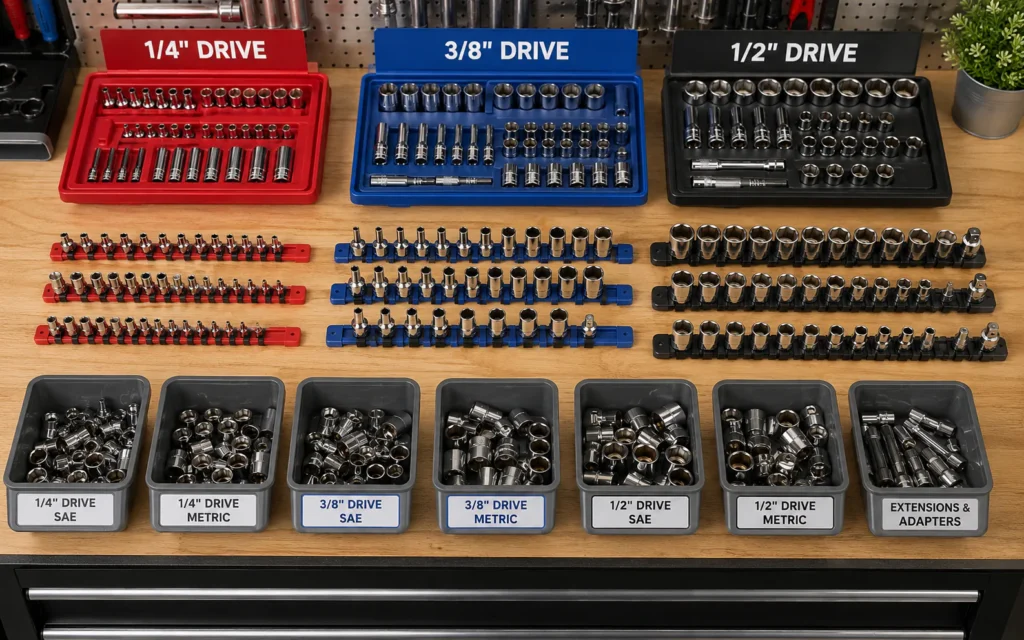
Start by sorting them by type. Look at the drive size. You likely have 1/4-inch, 3/8-inch, and 1/2-inch drive sockets. These are the sizes that connect to your ratchet. Separate them into piles based on the drive size. You can also separate deep sockets from shallow ones. Deep sockets are taller and used for recessed nuts. Shallow sockets are shorter and better for tight spaces. Keep these apart.
By Size and Measurement
Next, sort each pile by size. It helps to place them in order from small to large. Many people use a rail with clips or a pegboard for this. This makes the next steps much easier. A common issue is mixing standard (SAE) and metric sockets. SAE uses inches, and metric uses millimeters. It is wise to keep these completely separate. Mixing them up will cost you time when you are looking for the right fit.
Common Drive Sizes and Their Uses
| Drive Size | Common Projects | Typical Socket Sizes |
|---|---|---|
| 1/4 inch | Small electronics, small engine work, tight spaces | 4mm to 14mm, 3/16″ to 9/16″ |
| 3/8 inch | General auto repair, household fixes, DIY projects | 8mm to 19mm, 1/4″ to 3/4″ |
| 1/2 inch | Heavy-duty auto work, truck repairs, large machinery | 10mm to 32mm, 3/8″ to 1-1/4″ |
Storage Solutions to Organize Socket Sets
Once you have sorted your tools, you need a home for them. There are many storage products available. Some are cheap, and others are expensive. The best choice depends on your budget and how much space you have.
Socket Rails and Clips
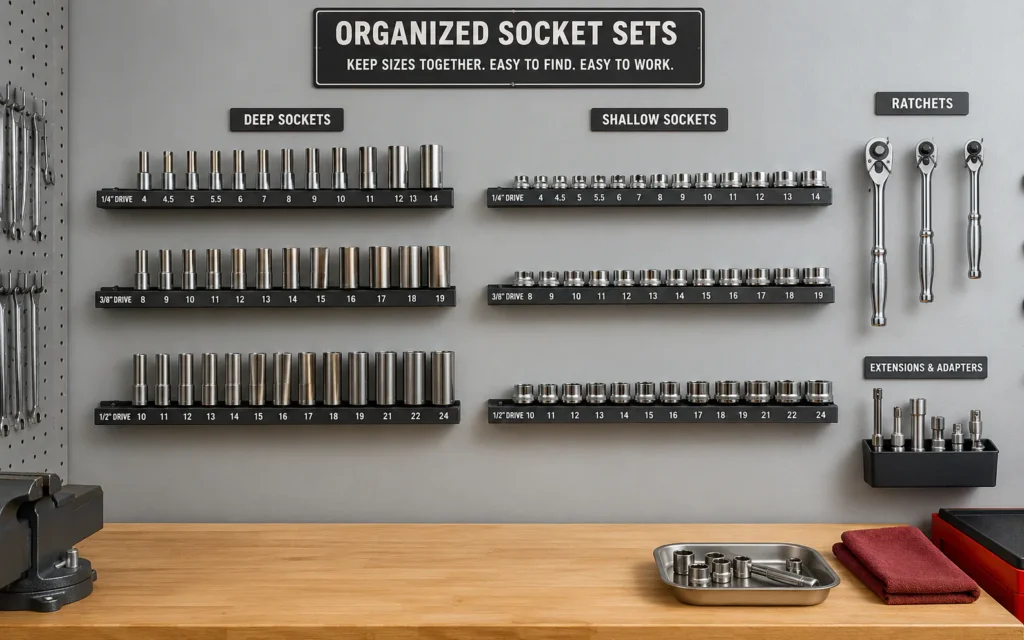
Socket rails are a very popular way to organize socket sets. They are plastic or metal bars with clips that hold each socket. You can place the sockets in order of size. You can also place them on the rail in the same direction. This makes it easy to see if one is missing. These rails are great because they are portable. You can take the whole rail to your car or workbench. They are also perfect for tool drawers. You can buy them in different lengths to fit your space.
Magnetic Holders
Magnetic holders are another great choice. These are strips with a magnet on the back. You stick the sockets to the strip. They stay in place because of the magnet. The big advantage of magnetic holders is that you can see the top of each socket. This makes finding the right size even easier. You can attach them to the side of your toolbox or the inside of a drawer. They are very helpful for quick access.
Pegboards
Pegboards are a classic workshop tool. They work great for larger sockets. You can use small pegs to hang each socket on the board. This takes your tools out of the drawers. You can see everything at a glance. It saves you from opening and closing drawers to find what you need. Pegboards are also cheap and easy to set up. Just make sure the pegs are strong enough to hold heavy sockets.
Foam Organizers
For people who want a perfect look, foam organizers are the top choice. You buy a foam sheet and cut out a spot for each socket. This is called shadowing your tools. This makes it very clear when a socket is missing. It also protects the sockets from damage because they do not move around. Foam organizers make your drawer look clean and professional.
Best Ways to Sort in the Drawer
If you use a toolbox, you need a plan for your drawers. Simply throwing sockets in a drawer is a bad idea. You will spend hours hunting for parts. The goal is to create a system that is fast and easy.
Use Drawer Dividers
Drawer dividers are a simple way to create sections. You can place them in the drawer to make separate compartments. Put your metric sockets in one compartment and your SAE sockets in another. You can also separate your 1/4-inch, 3/8-inch, and 1/2-inch sets. Dividers keep your tools from sliding around when you open or close the drawer.
Line Them Up
When you place your socket rails in the drawer, line them up. You can place the metric rails on the left and the SAE rails on the right. Or you can put the 1/4-inch drive on the top row and the larger ones on the bottom row. A consistent layout helps your memory. You will know where to reach every time. This is a simple way to organize socket sets in a small space.
Pros and Cons of Common Organizers
| Organizer Type | Pros | Cons |
|---|---|---|
| Socket Rails | Portable, fits in drawers, cheap, easy to use | Clips can break, sockets can fall off |
| Magnetic Holders | Easy to see sizes, holds tools securely, flexible | Can be expensive, loses magnetism over time |
| Pegboards | Visual display, cheap, saves drawer space | Sockets can fall off, takes wall space |
| Foam Organizers | Looks clean, protects tools, easy to spot missing ones | Takes time to set up, not portable |
Labeling and Identification
Labels help everyone find things fast. You can use a label maker or just a permanent marker. Mark the size on the rail or clip. This helps you put sockets back in the right spot. Some people use colored tape to mark their sockets. For example, you can use blue tape for metric and red tape for SAE. This is a great tip if you have poor lighting in your garage.
It is also very helpful to mark your socket sizes on the organizer itself. Many socket rails come with size numbers already on them. If they don’t, add your own. Write the size clearly on the base or the clip. This speeds up the process of finding the right tool.
“There is a time and place for everything. A tool in its place saves time and space.” – John Ruskin
How to Organize Socket Sets with a Portable Case
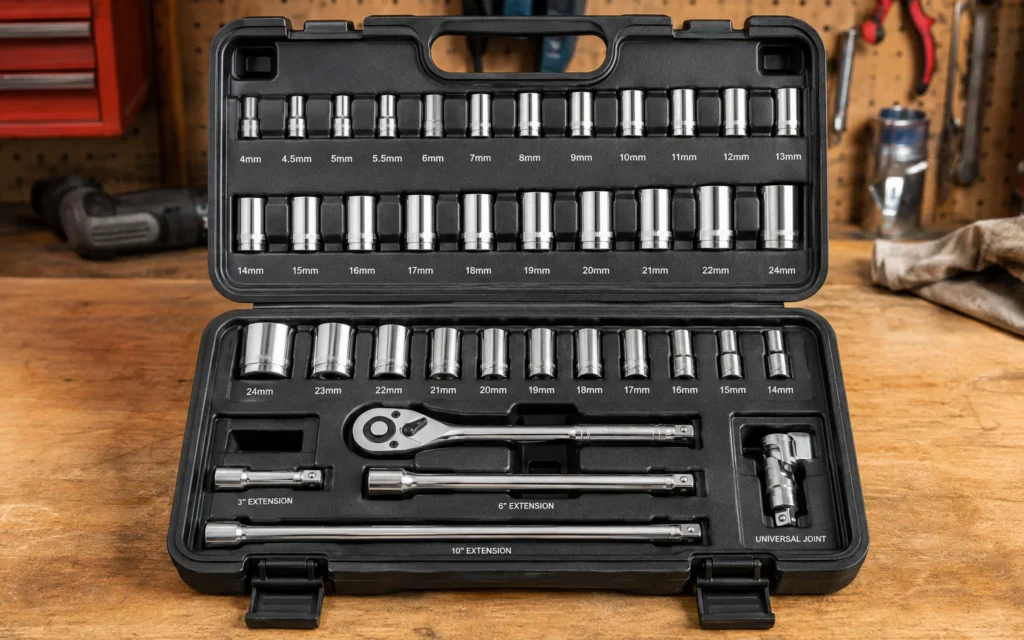
Many people buy socket sets in a plastic case. These cases are useful for taking tools to a job site. They have a specific spot for each socket. The best way to organize socket sets in these cases is to keep them in the case. If you take a socket out, put it back after you are done. It is that simple.
A common problem is that the foam in the case wears out. The sockets might start to fall out. You can fix this by gluing new foam into the case. You can also buy replacement foam inserts online. This keeps the case working well for a long time. Keeping the original case is a great way to organize socket sets without buying extra organizers.
Regular Cleaning and Maintenance
Your sockets get dirty. Grease, oil, and dust will build up. A dirty socket is hard to read. It is also harder to use. A clean socket fits better on a bolt. When you take a socket off the organizer, wipe it clean. This is a small habit that makes a big difference. You will be able to read the size easily. The socket will also last longer because you are removing dirt that can cause rust.
“It is better to be prepared than to be sorry.” – Aesop
Dealing with Duplicates and Missing Sockets
Over time, you will collect extra sockets. You might have bought a set and already had some. You need to decide what to do with the extras. You can keep them as backups. You can also give them away to a friend. Many people keep a “junk drawer” with extra tools. This is fine, but it defeats the purpose of organizing. A better idea is to put duplicates in a separate container. Label it clearly as “Extra Sockets.”
When you organize socket sets, you will often find missing ones. It is very common to lose a 10mm socket. If you see an empty clip on your rail, you know you are missing one. This helps you replace it quickly. You can buy a single socket from a hardware store. It is cheaper and smarter than buying a whole new set. Good organization helps you know exactly what is missing.
Tips to Organize Socket Sets in a Small Shop
Not everyone has a giant garage with huge tool cabinets. Many people work in small spaces. You can still organize socket sets very well. You just need to think vertically. Use wall space with a pegboard or magnetic strip. This frees up your workbench. You can also use a smaller toolbox with many drawers. A small cabinet can hold a lot if you use rails and holders.
Another tip is to use a zippered tool bag. You can put your socket rails right into the bag. This is a mobile solution for people who work in different places. It keeps the sockets organized while being easy to carry.
Digital Tracking for Large Sets
If you have a huge collection, you might consider a digital inventory. This is for mechanics with very large sets. You can take a photo of your rail or drawer. Keep the photo on your phone. When you are at the hardware store, you can check your photo. You will know what you need without driving home. This is a next-level way to organize socket sets. It ensures you never buy something you already have.
“For every minute spent organizing, an hour is earned.” – Benjamin Franklin
Step-by-Step Routine to Keep It Clean
Organizing is not a one-time job. It is a habit. You need to stick to it. Here is a simple routine to follow.
- Work on a Clean Surface: Start with a clean bench.
- Sort Your Sockets: Use the drive sizes and types method we discussed.
- Place Them on Rails: Put them in order from small to large.
- Label Everything: Make sure the size is visible.
- Put Tools Back: After a job, put the socket back on the rail.
If you do this, your system will last forever. It keeps you from losing tools. It also makes every project faster and more fun.
Common Mistakes to Avoid
There are some mistakes people make when they organize socket sets.
Not Sorting First
This is the biggest mistake. If you buy a nice foam organizer, but your sockets are mixed up, it won’t work. You must separate metric from SAE first. You must also separate the drive sizes. Sorting is the first and most important step.
Overcrowding the Drawer
It is easy to try to cram everything into one drawer. This makes it hard to see anything. It also makes it hard to reach the back of the drawer. A clean, less crowded drawer is better. It is faster and easier to work with.
Not Cleaning Sockets
Putting a dirty socket on a nice new rail is a bad idea. The dirt will fall into the clip. This will make it hard to put the socket on later. Clean your tools before you store them. It protects both your tools and your storage system.
Using Color for Quick Identification
Color is a fast way to find the right tool. You can buy color-coded sockets. You can also use colored tape or paint. For example, all 1/2-inch drive sockets are blue. All 3/8-inch drive sockets are red. You don’t have to read the label every time. You just see the color and grab the right size. This is a huge time saver.
How to Organize Socket Sets for the Weekend Warrior
For a weekend warrior, you don’t need a massive system. You just need a simple system that works. A socket rail for your 3/8-inch set is usually enough. Add a small magnetic holder for your 1/4-inch set. This covers 90% of your projects. A small set of drawer dividers in your toolbox will keep them from moving. This keeps everything clean and fast to access. Don’t overthink it. Keep it simple and easy to use. This will encourage you to put the tools back.
Conclusion
Learning how to organize socket sets is a practical skill that saves you time, money, and frustration. It helps you work faster and safer. Whether you choose simple rails, strong magnetic strips, or detailed foam cutouts, the best system is one you will use. Start by sorting your tools by drive size and type. Then pick a storage solution that fits your space and budget. Remember to clean your sockets before you put them away. With a little time and effort, you can build a system that works for years. So, take charge of your toolbox today. Organize socket sets once and for all. You will be amazed at how much smoother your next project goes.
Frequently Asked Questions
1. What is the best way to store socket sets in a drawer?
The best way is to use socket rails or magnetic holders. Place them in the drawer with the metric sockets on one side and the SAE sockets on the other. This makes it easy to find what you need.
2. How do you organize loose sockets?
First, sort them by drive size (1/4, 3/8, 1/2 inch). Then sort them by type (deep vs. shallow). Finally, separate metric and standard sizes. Place them on a rail or holder in size order.
3. What is the 10mm socket problem?
The 10mm socket is the most commonly used size in many cars. Because of this, it gets lost or misplaced more often than others. Good organization helps you find it quickly.
4. Is it better to keep sockets in a case or on a rail?
It depends on your needs. A case is good for portability. A rail is better for use in a tool drawer. A rail also takes up less space in a cabinet. For a workshop, rails are often the better choice.
5. How often should I clean my socket set?
You should clean them after every project. Wipe off grease and dirt. A clean socket is easier to read and fits better on a bolt. It will also last a lot longer.
Related posts
 Which Tool Kit Is Worth Buying? How to Choose the Right Set for Your Home
Wondering which tool kit is worth buying? Compare basic household sets, mechanic kits, and power tool combos to find the best tools for your budget and…
 Which Hand Tools Are Made in the USA? Reliable Brands and Buying Rules
Discover which hand tools are still made in the USA. Compare top domestic brands, tool categories, and learn how to verify origin labels before buying. Several…
 Why Do Campers Carry Multi Tools? Practical Uses in the Field
Why do Campers carry multi tools to handle gear repairs, campsite setup, food prep, and field fixes with minimal weight. Here is why one belongs in…