
What Tools Should I Keep In My Tool Bag
If you wonder what tools should I keep in my tool bag, start with a hammer, screwdrivers, pliers, tape measure, and a utility knife. This complete guide lists 20 essential items plus safety gear and storage tips for every DIYer and home owner.
I remember the first time I tried to hang a picture frame. No hammer. No level. Just a shoe and a lot of hope. That frame still tilts to this day. After years of fixing things around my own house and helping friends with their repairs, I learned one simple truth: the right tool bag makes every job easier. But the real question is, what tools should I keep in my tool bag? This guide answers that for you. I will walk you through every item that belongs inside a practical, everyday tool bag. No fancy stuff. Just real tools that solve real problems.
Let me be clear. This is not for a construction crew or a professional electrician. This is for you. The person who wants to fix a loose cabinet hinge, assemble a new bookshelf, or patch a small hole in the wall. You do not need forty tools. You need about fifteen to twenty quality pieces that work hard and last long.
“The best tool is the one you have with you when you need it.”
— Henry Petroski, engineer and author
That quote rings true every time a drawer handle falls off. If your tools sit in a garage cabinet, they help nobody. Keep them in a bag you can grab and carry to any room or even to a friend’s house. So let us build that bag together.
Start With the Right Tool Bag
Before we talk about what goes inside, we need a good home for those tools. A bad bag tears, spills your tools, or hurts your shoulder. A good bag saves you time and frustration.
Size Matters
Do not buy a huge bag. A medium bag, about 12 to 15 inches long, works best for home use. Too big, and you fill it with junk. Too small, and you leave out useful tools. Look for a bag that stands upright on its own. Soft-sided tool bags are popular, but a bag with a rigid bottom panel keeps its shape.
Material and Durability
Canvas or nylon? Both work, but look for double stitching and reinforced handles. A zipper closure is nice, but a wide open top with a flap is often faster to use. Many bags have outer pockets. Those pockets are perfect for things you reach for often, like a tape measure or a utility knife.
Also check the shoulder strap. A padded strap is a blessing when you carry your bag up and down stairs. And make sure the strap clips are metal, not plastic. Plastic breaks.
So before we fill it, remember: your bag is part of the answer to the question what tools should I keep in my tool bag because a torn bag leaves your tools scattered on the floor.
The Essential Hand Tools Everyone Needs
Now we get to the heart of the matter. These are the tools I use more than any other. If you only buy five items, buy these.
Hammer: Your Go-To Striking Tool
Get a 16-ounce claw hammer. Not heavier. Not lighter. A 16-ounce steel hammer with a smooth face and a curved claw works for nails, for pulling nails, and for light demolition. Fiberglass handles absorb shock better than wood. But a wood handle feels nice in your hand. Your choice. Avoid the cheap hammers with thin metal handles. They vibrate too much.
Screwdrivers: One Set Does It All
Skip the fifty-piece set. You need four screwdrivers. One flat head (3/16 inch), one Phillips #1, one Phillips #2, and one larger flat head (1/4 inch). That is 90 percent of the screws in your home. The Phillips #2 fits most drywall screws and cabinet screws. If you want to be fancy, buy a screwdriver with interchangeable bits. But I prefer separate drivers. They are harder to lose.
Pliers: Grip, Cut, and Twist
Three pliers belong in every bag. First, slip-joint pliers for gripping pipes and small parts. Second, needle-nose pliers for reaching into tight spaces or bending wire. Third, diagonal cutting pliers (dykes) for cutting zip ties, wire, or small nails. That trio handles almost anything. Look for pliers with rubber grips and a tight hinge.
Tape Measure and Level
Get a 16-foot tape measure. It is long enough for most rooms but still small for your bag. A magnetic tip helps when you measure metal studs or pipes. Also pick up a small 9-inch bubble level. You use it for hanging pictures, shelves, and mirrors. A level that is too big will not fit in a standard bag.
Utility Knife and Scissors
A retractable utility knife with snap-off blades is a workhorse. You will open boxes, cut carpet, trim drywall, and strip wire. Keep a pack of spare blades in your bag. For scissors, get a pair of all-purpose shears. They cut cardboard, fabric, tape, and even thin plastic. Do not use good kitchen scissors. Get cheap but sharp workshop scissors.
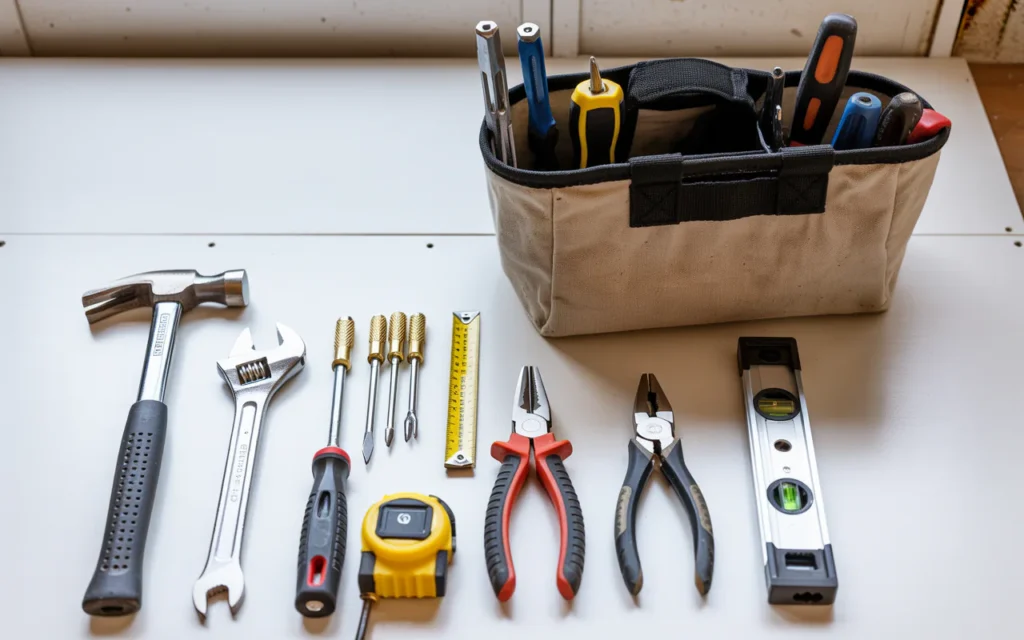
Table 1: Top 5 Must-Have Hand Tools
| Tool | Best Size/Type | Why You Need It |
|---|---|---|
| Hammer | 16 oz, curved claw | Drive and pull nails |
| Screwdrivers | #2 Phillips, 3/16″ flat | 90% of home screws |
| Pliers set | Slip-joint, needle-nose, cutter | Grip, twist, cut |
| Tape measure | 16 ft with magnetic tip | Measure anything |
| Utility knife | Retractable, snap-off blades | Open, cut, trim |
Now you might still ask, what tools should I keep in my tool bag besides these five? Good question. Let us add some wrenches and other helpers.
Wrenches and Sockets for Tight Spots
Nuts and bolts show up more often than you think. A loose toilet seat, a wobbly ceiling fan, or a bike repair all need wrenches.
Adjustable Wrench
Buy one 8-inch or 10-inch adjustable wrench. Crescent brand is fine, but any brand with a smooth adjustment wheel works. This tool replaces many fixed wrenches for occasional use. It grips bolt heads from 1/4 inch up to about 1 inch. Keep it clean and oiled so the jaw moves freely.
Combination Wrench Set
If you have space, add a small set of combination wrenches. They have an open end on one side and a box end on the other. A set from 3/8 inch to 3/4 inch covers most household bolts. Store them on a ring or in a roll so they do not clank around.
Socket Set Basics
A socket set is nice to have, but not essential for everyone. If you own a car or assemble a lot of furniture, a small 1/4-inch drive socket set with metric and standard sizes is very helpful. A set of ten sockets plus a ratchet handle takes little room. But if you never touch a bolt, skip this.
Power Tools Worth Adding
Power tools make jobs faster, but they also add weight and cost. I suggest you start with just one power tool. Then add more when you see the need.
Cordless Drill/Driver
This is the single most useful power tool for any home. A 12-volt or 18-volt drill with a clutch lets you drive screws without stripping them. Use it to assemble furniture, install blinds, or hang heavy mirrors. Look for a drill with a 1/2-inch keyless chuck and two speed settings. Also buy a set of drill bits (from 1/16 to 1/4 inch) and a set of screw driving bits (Phillips, flat, and square).
“A cordless drill is the first power tool any home owner should buy. It saves your wrists and your patience.”
— Bob Vila, home improvement expert
Your drill should come with a battery and a charger. Get a second battery if you can. Nothing stops a job faster than a dead battery.
Impact Driver (Optional)
An impact driver is like a drill’s stronger cousin. It drives long screws into wood without any effort. But it is heavier and louder. Most people do not need one for basic home repairs. Stick with a good drill for the first few years.
Table 2: Choosing Your First Power Tool
| Tool | Best Voltage | Best For | Weight |
|---|---|---|---|
| Cordless drill | 12V or 18V | Screws, small holes, assembly | 2–3 lbs |
| Impact driver | 18V | Long screws, deck building, lug nuts | 3–4 lbs |
| Sander (optional) | 12V | Smoothing wood, paint prep | 2 lbs |
Only add a power tool when you have answered what tools should I keep in my tool bag for hand tools first. Hand tools do the daily work. Power tools are for bigger projects.
Fasteners and Small Parts Storage
A tool bag with loose nails and screws is a mess. You need a small organizer box. Look for a plastic case with adjustable dividers. It should fit inside your bag or clip to the outside. Fill these compartments with:
- Assorted nails (1-inch, 1.5-inch, 2-inch)
- Wood screws (#6 and #8, 1/2 to 2 inches)
- Drywall anchors (plastic or metal)
- Zip ties (4-inch and 8-inch)
- A few washers and nuts
Also keep a small tube of super glue and a roll of electrical tape. These take almost no space but save you many trips to the hardware store.
I learned this lesson when I needed one tiny screw for a toy. I spent twenty minutes searching drawers. Now I keep a small parts case inside my tool bag. That single addition changed how I answer the question what tools should I keep in my tool bag. Fasteners are tools too.
Safety Gear You Should Not Skip
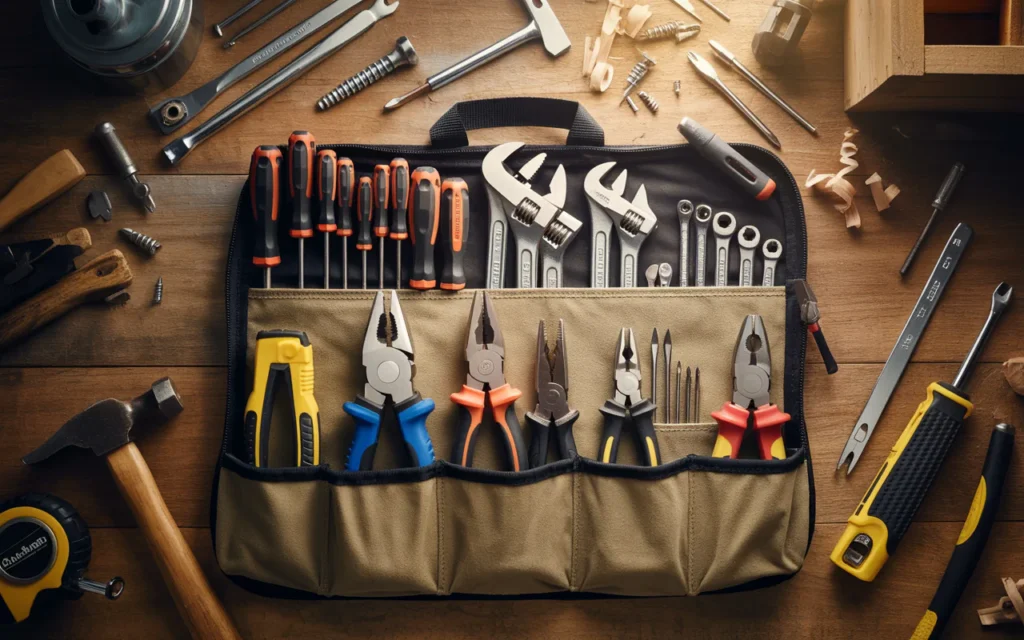
Tools can hurt you. I have smashed my thumb and cut my hand more than once. A few cheap safety items belong in every bag.
Glasses, Gloves, and Ear Protection
Safety glasses are not optional. When a nail flies or a wire snaps, your eyes are at risk. Buy a pair with anti-fog coating. Keep them in a cloth bag so they do not scratch.
Work gloves protect your hands from splinters, sharp edges, and hot surfaces. Get a pair with rubber dots on the palm for grip. They do not need to be thick. Thin, flexible gloves let you feel what you are doing.
Ear protection matters when you use power tools. A cheap pair of foam earplugs or over-ear muffs is fine. You will thank yourself after a day of drilling or hammering.
“Every time I skip safety glasses, I regret it. The one time you need them is the time you did not wear them.”
— My own father, a retired carpenter
Add a small first aid kit with bandages and antiseptic wipes. You can buy a mini kit that fits in a side pocket. Do not ignore this. I speak from experience.
Keeping Your Tool Bag Organized
A messy bag makes every job harder. You waste time digging for a screwdriver or a pair of pliers. Here are simple tricks to stay organized.
First, use the outer pockets. Put your most used tools there: tape measure, utility knife, level, and screwdrivers. Second, group similar tools together. Put all pliers in one bottom corner. Put all wrenches in another. Use small cloth pouches or even zip-top bags to separate small items like drill bits and screws.
Third, clean your bag once a month. Empty it on a table. Wipe off dust and dirt. Check for broken tools. Return any that wandered away. This habit also reminds you of what you actually carry. You might realize you never use that strange wrench. Take it out. Make room for something better.
Many people ask what tools should I keep in my tool bag but forget to maintain the bag itself. A clean, organized bag is a joy to use. A messy bag is a chore.
What About Specialty Tools?
You do not need plumbing snakes, tile cutters, or voltage testers for everyday jobs. Keep those in a separate box in your garage or basement. Your main tool bag is for quick fixes and common repairs. If you find yourself needing a specialty tool more than twice a year, then add it. Otherwise, borrow or rent it.
For example, a stud finder is useful but not daily. A pipe wrench is heavy and rarely used. Keep your bag light. Your back will thank you.
Frequently Asked Questions
How many tools should I keep in my tool bag?
Aim for 15 to 20 individual tools plus fasteners and safety gear. More than that makes the bag too heavy. Less than that leaves you missing important items. Quality over quantity matters most.
What is the best brand for basic hand tools?
Stanley, Craftsman, Husky, and Klein are all reliable. You do not need the most expensive brand. But avoid the very cheapest dollar store tools. They break fast. A mid-priced hammer or screwdriver lasts for years.
Can I use a backpack instead of a tool bag?
Yes. Many people prefer a tool backpack because it distributes weight evenly on both shoulders. Backpacks are great if you walk far or climb ladders. But traditional open-top tool bags give faster access. Choose what feels good for you.
How often should I replace tools?
Replace any tool that shows rust, cracks, or loose handles. A screwdriver with a worn tip strips screws. A hammer with a loose head is dangerous. Inspect your tools every six months. Good tools with care can last twenty years.
What tools should I keep in my tool bag for an apartment?
For an apartment, you need fewer tools. A hammer, a Phillips and flat screwdriver, a small adjustable wrench, a tape measure, and a utility knife cover most needs. Add a small level for hanging pictures. You do not need large power tools or pipe wrenches.
Is it worth buying a pre-filled tool bag?
Pre-filled bags are convenient but often include low-quality tools. You get a bag filled with cheap pliers and flimsy wrenches. You are better off buying an empty bag and picking your own tools one by one. That way you know each tool works well.
Should I include a flashlight?
Yes. A small LED flashlight or headlamp is very useful. Dark corners under sinks and behind appliances need light. Get one that uses AA or AAA batteries, or a rechargeable model. Keep extra batteries in your parts case.
How much weight can a typical tool bag hold?
Most medium tool bags hold up to 15 to 20 pounds comfortably. That is plenty for the tool list above. Weigh your bag after you pack it. If it feels too heavy, remove duplicates or move lesser-used tools to a separate box.
Conclusion
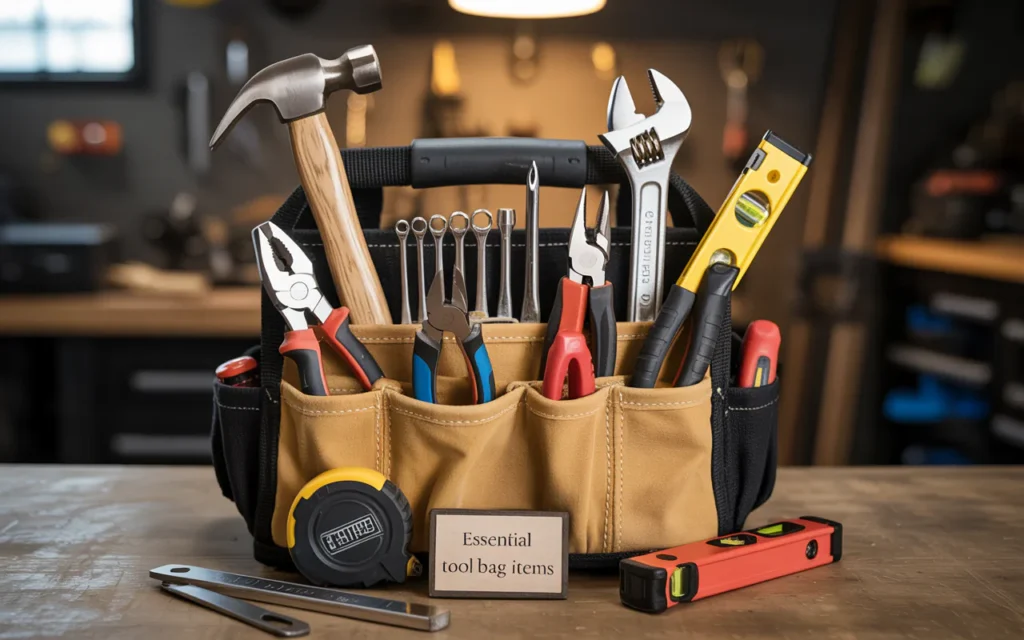
So after all this, the answer to what tools should I keep in my tool bag is simple. Start with a good bag. Add a hammer, four screwdrivers, three pliers, a tape measure, a level, a utility knife, scissors, and an adjustable wrench. Then decide on one power tool, ideally a cordless drill. Throw in a small organizer of nails and screws. Never forget safety glasses and gloves. Keep it clean and organized.
This list is not the longest or the most expensive. It is the most practical. I have used these tools for years. They fixed leaky faucets, wobbly chairs, broken toys, loose shelves, and countless other small disasters. You do not need a garage full of equipment. You need a bag you can carry to the problem.
Go to a hardware store. Hold some tools in your hand. Buy what feels solid. Pack your bag this weekend. The next time something breaks, you will be ready. And you will smile when your friends ask, “Can you help me fix this?” Because you will already have the answer in your hand.
Now go build something. Or fix something. Or just open a box without using your teeth. Your new tool bag is waiting.
Related posts
 Top Tool Bags for Mobile Contractors: 2026 Buyer Guide
Discover the top tool bags for mobile contractors in 2026. Compare durable totes, backpacks, and multi-pocket organizers to find the best fit for your gear. For…
 Top Tool Bags for Plumbers: 2026 Selection Guide
Discover the top tool bags for plumbers in 2026. We compare durable, multi-pocket storage solutions to help you organize your gear effectively on the job. Plumbing…
 Best Tool Bag for HVAC Technicians in 2026
Find the right tool bag for HVAC technicians with our 2026 guide. Compare top-rated bags, backpacks, and pouches to keep your gear organized and protected. As…