Choose the ideal multi tool kit by matching tools to your daily tasks, checking build quality, and comparing size, weight, and locking mechanisms before buying.
If you carry a bag, work with your hands, or simply like being prepared for whatever the day throws at you, a multi tool kit can quietly become one of the most useful things you own. It is that one item that sits in your pocket or on your belt and steps in whenever something needs fixing, cutting, tightening, or prying open. But here is the thing: not every multi tool is built the same way, and not every multi tool works equally well for every person. The person who spends their day in a workshop has very different needs from the hiker, the office worker, or the parent chasing two kids around the neighborhood.
To choose the ideal multi tool kit for everyday carry, you need to look at more than just the number of tools packed into a handle. You need to think about how those tools feel in your hand, how quickly you can access them, how much the whole thing weighs in your pocket by four in the afternoon, and whether the build quality is going to hold up over years of real use. This guide walks you through all of that in plain language, so by the time you finish reading, you will have a clear picture of exactly what to look for and what to skip.
What Is a Multi Tool Kit and Why Carry One Daily
A multi tool kit is a compact, folding device that combines several individual tools into one portable package. Pliers tend to be the centerpiece of most designs, with blades, screwdrivers, files, scissors, wire cutters, bottle openers, and other implements folding out from the handles. The idea is simple: instead of carrying a full toolbox, you carry one item that covers most everyday situations.
The appeal for everyday carry, often called EDC in enthusiast circles, is obvious. You get versatility without bulk. A well-chosen multi tool can help you tighten a loose screw on your glasses, open a package, cut a loose thread, strip a wire, or pry open a paint can lid. These are not dramatic survival situations; they are the small, slightly annoying moments that come up constantly in a normal day.
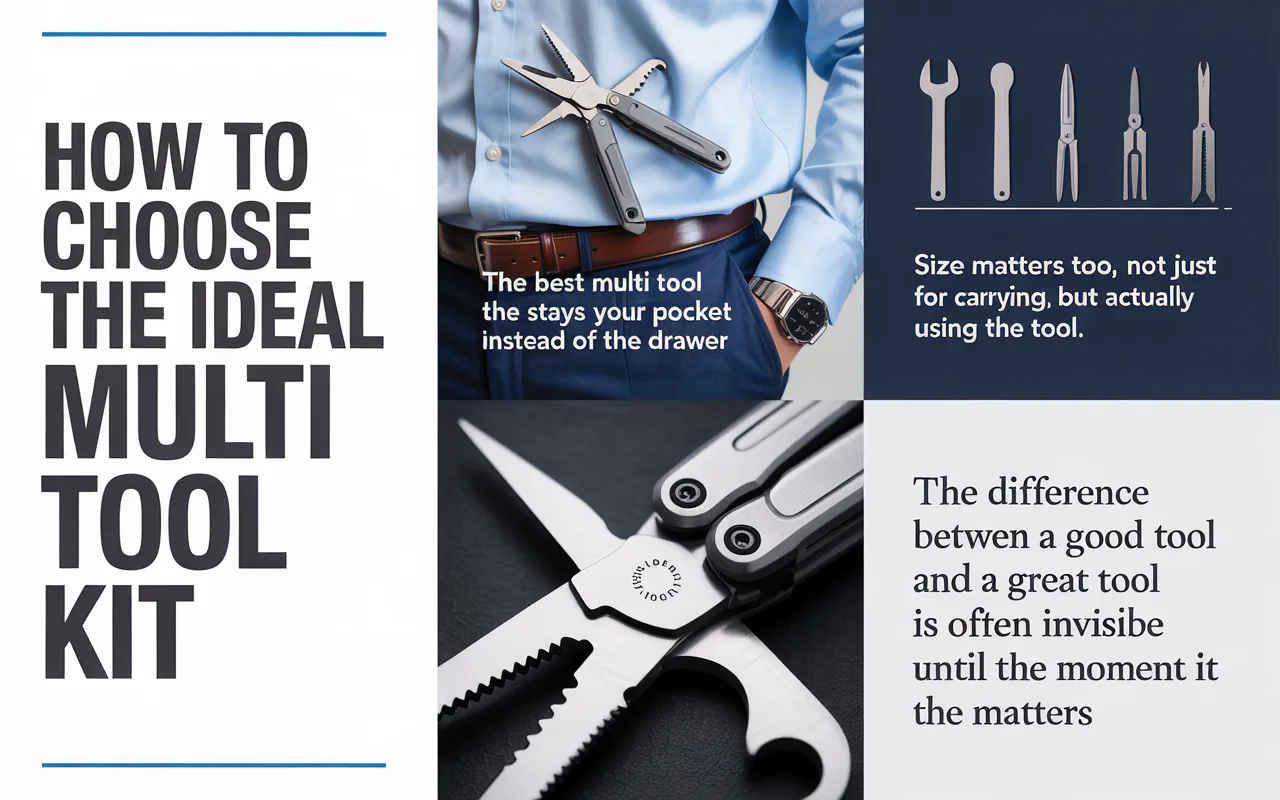
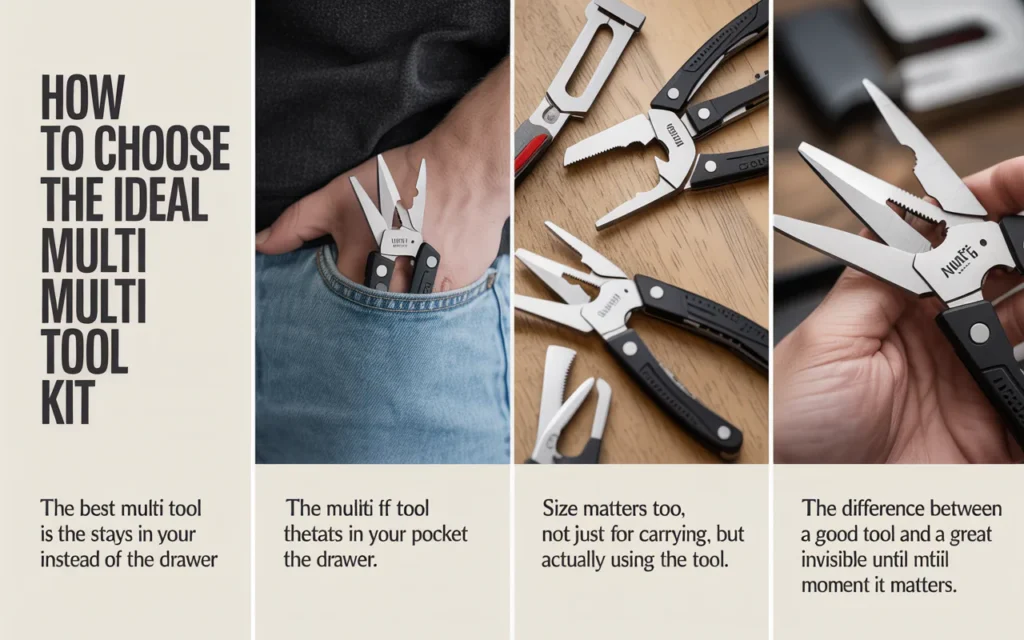
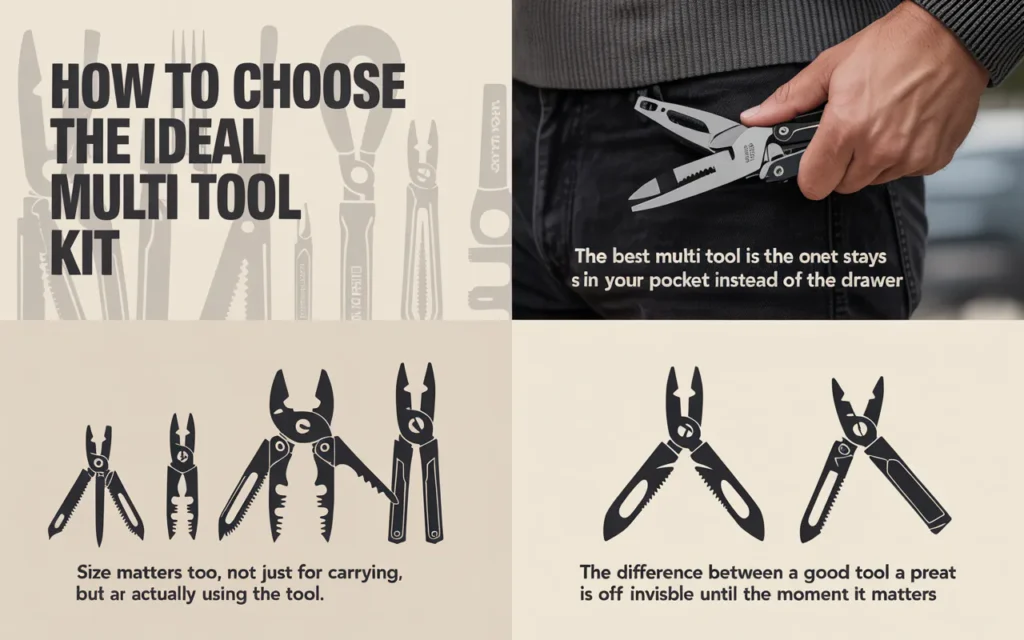
“A good tool is one you actually use. The best multi tool is the one that stays in your pocket instead of the drawer.” – Tim Leatherman, founder of Leatherman Tool Group
The everyday carry version of a multi tool is generally smaller and lighter than heavy-duty field tools. It is designed to be with you at all times, which means weight and pocket-friendliness matter just as much as function.
Key Factors to Consider When You Choose the Ideal Multi Tool Kit
Choosing the right multi tool for daily carry comes down to several factors that work together. Miss one and you might end up with something that technically has twenty-two tools but that you never actually take out of the house.
Size and Weight
This is the starting point for any everyday carry decision. A multi tool that is too heavy will drag your pants down, create an uncomfortable lump in your bag, and eventually get left behind. Most EDC multi tools fall into a range between roughly 2.5 ounces on the very light end and around 10 ounces for heavier, full-featured options. The sweet spot for most people who are not doing demanding work is somewhere between 3 and 6 ounces.
Size matters too, not just for carrying, but for actually using the tool. A very compact multi tool can feel cramped in larger hands when you are trying to use the pliers for more than a few seconds. On the other hand, a full-size model can be awkward to carry in a front pocket all day. Think about where you plan to carry it, whether on a belt sheath, in a front pocket, in a bag, or clipped to a keychain, and let that guide your size decision.
Size Category
Approximate Weight
Best Suited For
Keychain / Micro
1 to 2.5 oz
Light daily tasks, travel, backup tool
Compact / Pocket
3 to 5 oz
General everyday carry, office and light field use
Full-size
6 to 10 oz
Heavy tasks, workshop, outdoor work
Tool Selection and Accessibility
The number of tools packed into a multi tool is not as important as which tools are included and how easy they are to reach. Many budget multi tools advertise twenty or more functions, but several of those are rarely useful in practice. When you choose the ideal multi tool kit, prioritize the tools you genuinely use.
For most everyday carry users, the core essentials are pliers with wire cutters, a plain-edge blade, a Phillips head screwdriver, a flathead screwdriver, and a file. Beyond that, scissors are incredibly practical for daily tasks. Bottle openers, can openers, saws, and awls are useful for specific situations but less critical for a general urban everyday carry setup.
Equally important is how you access those tools. Some multi tools require you to open the handles first to reach the pliers, while others allow you to deploy individual tools directly from the outside of the closed handle, like a pocketknife. This outside-accessible design is called an outer-deployable or one-handed-opening design, and it makes a genuine difference when you need something quickly.
Build Quality and Materials
A multi tool is only as good as the materials it is made from. The best multi tools use 420HC stainless steel or 154CM steel for blades, both of which hold an edge reasonably well and resist corrosion. Handles are usually stainless steel, aluminum, or a combination. Stainless steel handles are heavier but extremely durable. Aluminum handles reduce weight but may not feel as premium.
Pay attention to how the tools feel when deployed. There should be no wobble or side-to-side play when a blade or screwdriver is locked open. Good locking mechanisms, either liner locks, frame locks, or proprietary locking systems, keep tools securely in place during use and are a mark of quality construction. Cheap multi tools often skip proper locks on the blades, which is both a functional and a safety issue.
Feature
What to Look For
Red Flag
Blade Steel
420HC or better
Unlabeled or “stainless” with no grade
Locking Mechanism
Liner, frame, or proprietary lock
No lock at all on the blade
Handle Material
Stainless steel or aircraft-grade aluminum
Plastic handles on full-size tools
Plier Head
Spring-loaded, replaceable jaws
No spring, jaw wobble
Finish
Brushed or bead-blasted, corrosion-resistant
Painted finish that chips easily
Ergonomics and Grip
A multi tool that looks great in photos but feels slippery or awkward in use is not going to serve you well. Hold the tool and simulate using the pliers for a minute. Does the grip dig into your palm? Are the handle edges sharp enough to cause discomfort? Can you open and close the pliers with one hand if needed?
Textured handles, even simple brushed or knurled patterns on stainless steel, improve grip considerably over smooth polished surfaces. Some tools include rubber or G10 inserts in the handles for a more secure hold in wet conditions, which matters more for outdoor and workshop users than for someone using a multi tool in a city setting.
Understanding Locking Mechanisms and Safety
One detail that many first-time buyers overlook is how the tools lock when open. This is important for safety, especially for the blade, but also for any tool where your hand could slip toward the cutting edge during use. A good locking mechanism keeps the blade or tool firmly in place so it cannot fold back onto your fingers unexpectedly.
There are a few main types you will encounter. The liner lock, borrowed from folding knife design, uses a thin steel liner inside the handle that snaps into place behind the blade when open. The frame lock works similarly but uses the handle itself rather than an inner liner. Some brands, like Leatherman, use their own locking system with a sliding or rotating lock that must be manually disengaged before the tool can fold closed. All of these approaches work well when properly executed.
“The difference between a good tool and a great tool is often invisible until the moment it matters.” – Chris Reeve, custom knife and tool maker
For everyday carry purposes, you want at minimum a locked blade. If the other tools, screwdrivers, files, saws, also lock, that is a bonus. Many well-regarded multi tools lock all implements, which is the gold standard.
Matching Your Multi Tool to Your Lifestyle
There is no single best multi tool for everyone. The right choice depends heavily on how you actually spend your days. Thinking about your specific situation will save you from buying something that looks impressive in reviews but does not fit your real life.
For the Urban Everyday Carry User
If you live and work in a city, commute by public transit, spend time in offices, cafes, and apartments, and occasionally need to fix small things or handle packages, you want something compact and polished. A tool in the 3 to 4 ounce range with a blade, scissors, a screwdriver or two, and a bottle opener will cover almost everything you encounter. Look for something with a pocket clip or a slim profile that does not print obviously through your pants.
For the Outdoor Enthusiast
Hikers, campers, and trail runners need something more capable without going too heavy. A mid-size tool with a saw, can opener, awl, and solid pliers matters more here than for urban use. Corrosion resistance becomes more important if you are frequently near water. Some outdoor-focused users prefer tools with dedicated bit drivers that let you swap screwdriver heads.
For the Workshop or Trade User
If you work with your hands professionally or do a lot of home repair, a full-size multi tool with robust pliers, a proper saw, multiple screwdriver bits, a wire stripper, and solid ergonomics is the right direction. Weight matters less here because you are likely keeping it on a belt sheath rather than a front pocket. Replaceable blades and plier jaws are a significant advantage at this level.
Price Ranges and What to Expect
The multi tool market spans a wide range of price points, and the difference between budget and premium options is quite real. You genuinely get what you pay for in this category more than almost any other everyday carry item.
Budget multi tools in the under 25 dollar range tend to use lower-grade steel, have no blade locks, and show play and wobble in the tools after minimal use. They can work in a pinch, but they are not something most people want to rely on daily.
Mid-range tools between 30 and 80 dollars offer significantly better build quality, proper locking, better steel, and more refined ergonomics. This is where most everyday carry users find the best balance of value and quality. Brands like Gerber, SOG, and Victorinox have strong offerings in this range.
Premium tools from 80 dollars and up, particularly from Leatherman and Benchmade, represent the best materials, tightest tolerances, and longest-lasting build quality available. Many come with lifetime warranties. If you plan to use a multi tool every day for years, spending more upfront often saves money in the long run.
Maintenance and Longevity
Once you choose the ideal multi tool kit and start using it daily, a small amount of regular maintenance will keep it performing well for years. Multi tools accumulate debris in the hinges and pivot points, especially if used outdoors or in workshop environments, and this buildup leads to stiff or difficult action over time.
Clean your multi tool periodically by opening all the tools and rinsing with warm water, then drying thoroughly. Apply a small amount of light machine oil or a purpose-made tool lubricant to the pivot points and wipe away any excess. The blade should be sharpened as needed using a simple pocket sharpener or a fine stone. If plier jaws become damaged, premium brands offer replacement jaw kits that extend the life of the tool significantly.
Storage matters too. Keeping a multi tool in a leather or nylon belt sheath rather than loose in a pocket with keys and coins prevents scratching and limits wear on the finish over time.
Legal Considerations for Everyday Carry
Before you commit to a multi tool for daily carry, check the local regulations where you live and work. Blade length laws vary considerably between cities, states, and countries. In some places, any blade over a certain length, often 2.5 to 3 inches, requires a permit or is simply not allowed in public. Certain workplaces, government buildings, schools, and transportation hubs have their own restrictions regardless of local law.
Most compact everyday carry multi tools are designed with these restrictions in mind and use blades under the common legal limits. Still, it is your responsibility to know the rules in your area. When traveling, particularly by air, any multi tool must go in checked baggage, not carry-on.
“Preparedness is not about paranoia. It is about having the right tool at the right moment, legally and practically.” – Andrew Skurka, outdoor educator and author
Frequently Asked Questions
What is the most important tool in a multi tool for everyday carry?
For most people, the pliers and the blade are the two most-used tools in a multi tool for everyday carry. The pliers handle gripping, bending, and pulling tasks that come up regularly, while the blade handles cutting tasks from opening packages to trimming threads. After those two, a Phillips head screwdriver and scissors round out the core set for general daily use.
How many tools do I actually need in an everyday carry multi tool?
More tools are not always better. For everyday carry in an urban or general setting, a multi tool with eight to twelve well-executed tools is usually more practical than one with twenty-two mediocre ones. Focus on quality and accessibility of the tools that matter to you rather than the raw count.
Is a heavier multi tool always more capable?
Not necessarily. Weight often reflects materials, particularly stainless steel handles, and size, but a compact tool with excellent steel and thoughtful design can outperform a heavier tool with inferior components. Some premium compact multi tools weigh under four ounces but perform better than budget full-size options at twice the weight.
Can I travel with a multi tool on an airplane?
Multi tools with blades must be placed in checked baggage when flying. They are not permitted in carry-on bags by TSA or most equivalent agencies worldwide. Tools without blades, such as some keychain tools, may be permitted in carry-on bags depending on their specific components, but the rules vary and it is always safest to pack any multi tool in checked luggage.
Leatherman is widely regarded as the gold standard for multi tools and offers products across a wide range of sizes and price points. Gerber provides excellent value in the mid-range. Victorinox, known for Swiss Army knives, also makes strong multi tools with excellent build quality. Benchmade produces premium options aimed at serious everyday carry users. Each of these brands backs their products with strong warranty policies.
How do I keep the blade sharp on a multi tool?
Most multi tool blades respond well to a simple ceramic rod or a pocket-size diamond sharpener. Run the blade along the sharpener at a consistent angle, usually around 20 degrees, using light strokes. Strop on a leather belt or piece of cardboard to align the edge afterward. Do not wait until the blade is completely dull; touching it up every few weeks during regular use keeps it consistently sharp with minimal effort.
Are there multi tools designed specifically for women?
Some brands offer multi tools in smaller sizes and lighter weights that appeal broadly to users with smaller hands or those who prefer compact carry options. The design principles are the same, and the best approach is to handle different models and find what fits comfortably in your hand rather than shopping by a labeled category.
Conclusion
Taking the time to choose the ideal multi tool kit for your specific needs is worth every minute. The right tool becomes something you reach for naturally, day after day, in the small moments that make up a normal life. It is not just about being prepared in a dramatic sense; it is about having the right thing on hand when the mundane situation calls for it.
Start with your lifestyle. Think about where you spend your days and what kinds of tasks come up most often. Let that define your size preference, your tool priority list, and your budget. Then look for quality construction, proper locking mechanisms, and a design that feels comfortable in your hand. Read real user reviews, handle options in a store if possible, and do not get distracted by inflated tool counts on the packaging.
A genuinely good multi tool, chosen thoughtfully, can last decades with minimal care. It becomes less of a gadget and more of a reliable daily companion that quietly makes your life a little easier and a lot more prepared. That kind of value is hard to put a number on, but it starts with making the right choice from the beginning.
Discover the top tool bags for apprentices and trainees in 2026. Compare durable, portable, and organized storage solutions to keep your gear ready for the job.…
Discover the top tool bags for DIY homeowners in 2026. Compare durable organizers, backpacks, and storage solutions to keep your home repair gear ready. Keeping your…
Discover the top tool bags for apprentices and trainees in 2026. Compare durable, portable, and organized storage solutions to help you start your trade right. Starting…

 Top Tool Bags for Apprentices and Trainees in 2026
 Top Tool Bags for DIY Homeowners in 2026
 Top Tool Bags for Apprentices and Trainees 2026