
Can I Use A Home Tool Kit For Car Repairs
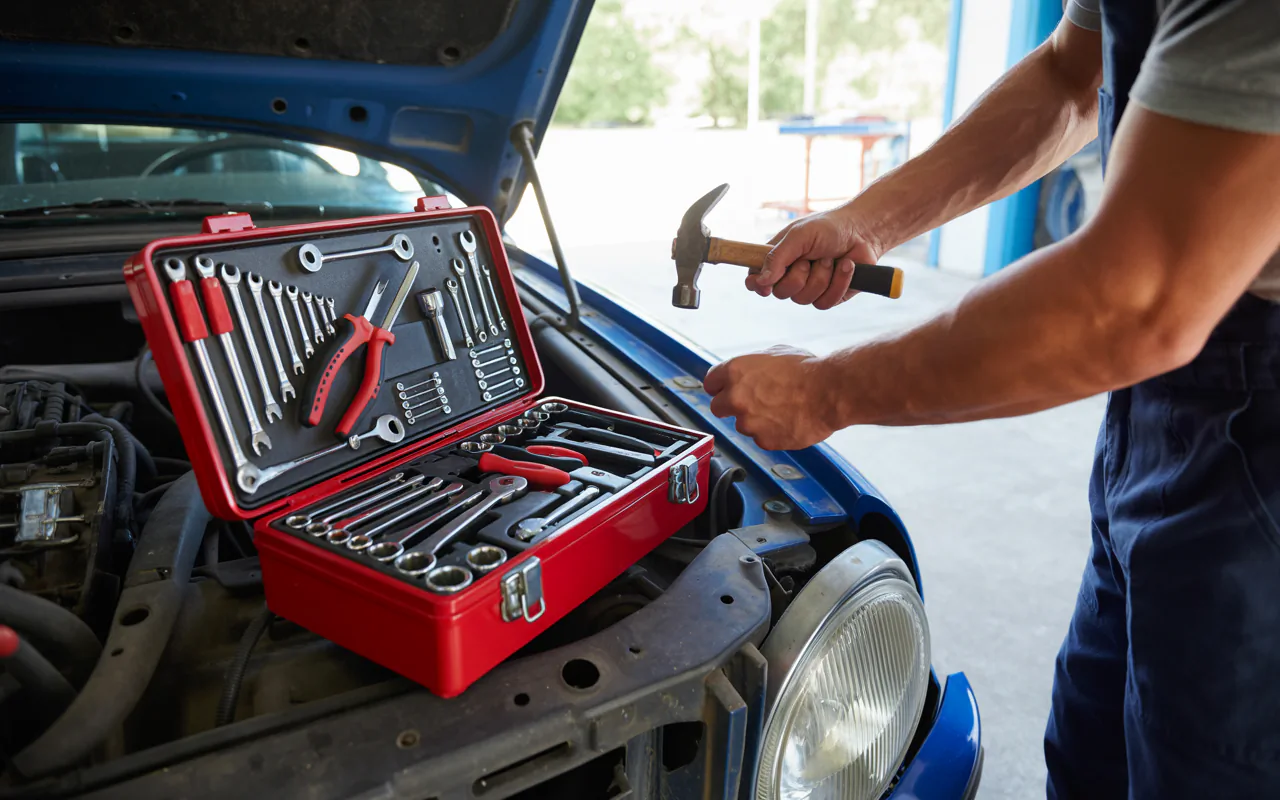
Wondering, “Can I use a home tool kit for car repairs?” Yes, you often can for basic tasks like oil changes, battery swaps, and light bulb replacements. But bigger jobs may need specialty tools. Learn what works safely.
You pop the hood, see a loose bolt, and think: “I have a toolbox in the closet. Can I use a home tool kit for car repairs?” It is a fair question. Many people start their DIY car care exactly this way. The short answer is yes, but with some honest limits. A basic home tool kit works great for simple fixes. For bigger engine or brake work, you may need more.
I have fixed my own cars for over ten years. I started with a small kit from a hardware store. That kit helped me change air filters, tighten battery cables, and replace side mirrors. But I also learned the hard way that a cheap plier or a wrong-sized socket can strip a bolt. Then a five minute job turns into a two hour headache.
Let me walk you through exactly what a home tool kit can and cannot do for your car. You will learn which repairs are safe, which tools you already have, and when to stop and call a pro. This guide follows real experience, not just theory. By the end, you will know if your home kit is ready for the driveway or if you need to add a few key pieces.
“The right tool for the right job is half the work done.” – Henry Ford
Henry Ford knew a thing or two about cars. His point is simple: using the wrong tool often creates more problems. So let us match your home tools to real car tasks.
What Is Typically Inside a Home Tool Kit?
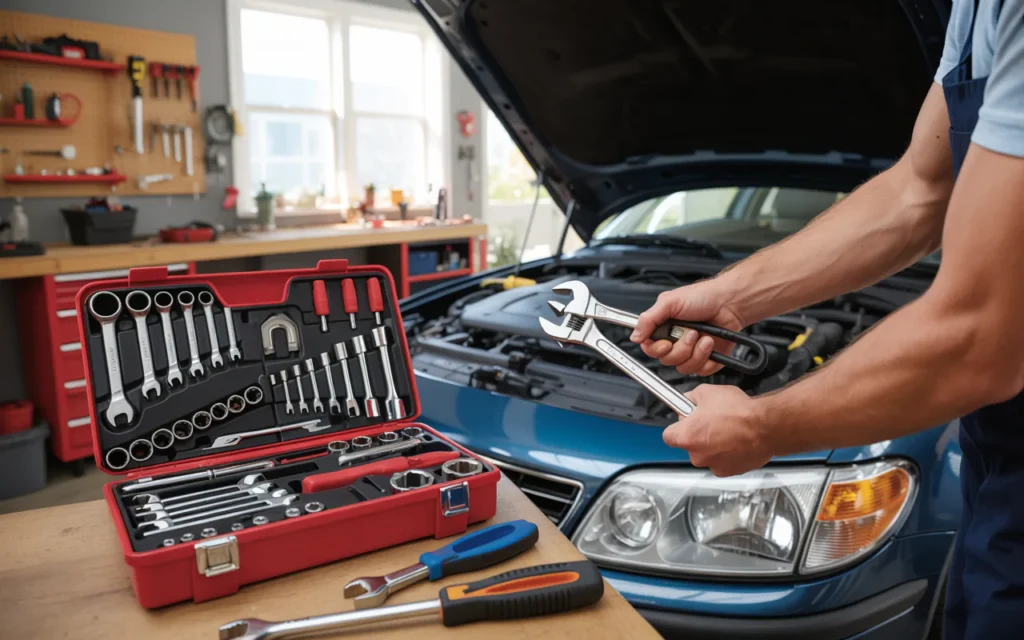
Before we answer “Can I use a home tool kit for car repairs” fully, let us look at what most home kits contain. A standard home repair kit usually includes:
| Common Home Tool Kit Items | Typical Quality |
|---|---|
| Claw hammer | Medium |
| Phillips and flathead screwdrivers | Low to medium |
| Adjustable wrench | Low |
| Slip-joint pliers | Low |
| Tape measure | Low |
| Utility knife | Medium |
| Small vice grips (sometimes) | Low |
Some better kits add a socket set with 10 to 20 pieces. Many do not. Most home kits lack deep sockets, breaker bars, torque wrenches, or automotive-specific tools like oil filter wrenches.
So if your kit only has a hammer and a small screwdriver, you cannot do much car repair. But if your kit includes a basic ratchet and a set of standard and metric sockets, you can start with small jobs.
Why Metric Sizes Matter for Modern Cars
Almost every car made after 1990 uses metric bolts and nuts. That means 10mm, 12mm, 13mm, 14mm, 15mm, 17mm, and 19mm sockets are your best friends. A home tool kit with only standard (inch) sizes will not help much. Check your kit. If you see mostly 3/8”, 7/16”, 1/2”, those are for household plumbing and furniture, not cars.
5 Car Repairs You Can Do With a Basic Home Tool Kit
Let me share real tasks where Can I use a home tool kit for car repairs gets a clear “yes.” These are beginner friendly and low risk.
1. Replacing Air Filter
Your engine air filter is usually in a plastic box on top or side of the engine. You need a Phillips screwdriver or a small flathead. Most home kits have these. Open the clips or screws, lift the old filter, drop in the new one. Done. No heavy lifting. No special skills.
2. Changing Battery Terminals or Cleaning Corrosion
A loose or corroded battery cable stops your car from starting. You need a wrench or a small socket. Most home kits have an adjustable wrench or a 10mm socket. Loosen the nut, clean the post with a wire brush (not in most home kits, but you can use sandpaper or an old toothbrush), then reconnect. Easy.
3. Replacing Interior Light Bulbs
Dome lights, trunk lights, or glove box lights often need a small flathead screwdriver to pop the plastic cover. Home kits have this. Just be gentle. Plastic gets brittle in older cars.
4. Tightening Loose Bolts on Body Parts
A loose side mirror, a wobbly license plate frame, or a rattling heat shield. These use small bolts or nuts. A basic socket or wrench from your home kit works fine.
5. Removing Plastic Clips (Push Pins)
Many cars use plastic push pins to hold bumper covers, fender liners, and splash shields. You can remove these with a flathead screwdriver. Pry gently under the head. Most home kits include this tool.
“Experience is the name everyone gives to their mistakes.” – Oscar Wilde
I once used a dull flathead screwdriver from my home kit to pry a plastic clip. I slipped and scratched my paint. That mistake taught me to wrap the screwdriver tip with a rag. Little things matter.
Table: Home Tool Kit vs. Car Specific Tool Set
| Feature | Home Tool Kit | Basic Car Tool Set |
|---|---|---|
| Metric sockets | Rarely | Yes (8mm to 19mm) |
| Deep sockets | No | Yes |
| Ratchet with fine teeth | No | Yes |
| Torx bits | No | Sometimes |
| Spark plug socket | No | Yes |
| Oil filter wrench | No | Yes |
| Breaker bar | No | Yes |
This table shows the gap. A home kit helps for tiny jobs. A car kit gives you confidence for more.
5 Car Repairs Where a Home Tool Kit Falls Short
Now the honest answer to Can I use a home tool kit for car repairs for bigger jobs. Here are five repairs where most home kits fail.
1. Brake Pad Replacement
Brakes need a caliper compression tool or a large C clamp. Home kits do not have these. You also need a socket set that includes 13mm to 21mm sizes. And you need a torque wrench to tighten bolts correctly. A home kit has none of these. Skipping the torque wrench can lead to loose caliper bolts. That is dangerous.
2. Oil Change
You need an oil filter wrench. Most home kits do not have one. You also need a drain pan (not a tool), a funnel, and often a socket to remove the drain plug. Many home kits have a socket for the drain plug (usually 14mm or 17mm). But without the filter wrench, you cannot remove the old filter. So you get stuck halfway.
3. Spark Plug Replacement
Spark plugs need a thin walled, deep socket with a rubber insert. Home kits have standard sockets that are too thick. They can crack the ceramic insulator. You also need a gap gauge (very cheap, but not in home kits) and anti seize compound. So a home kit alone is not enough.
4. Suspension or Strut Work
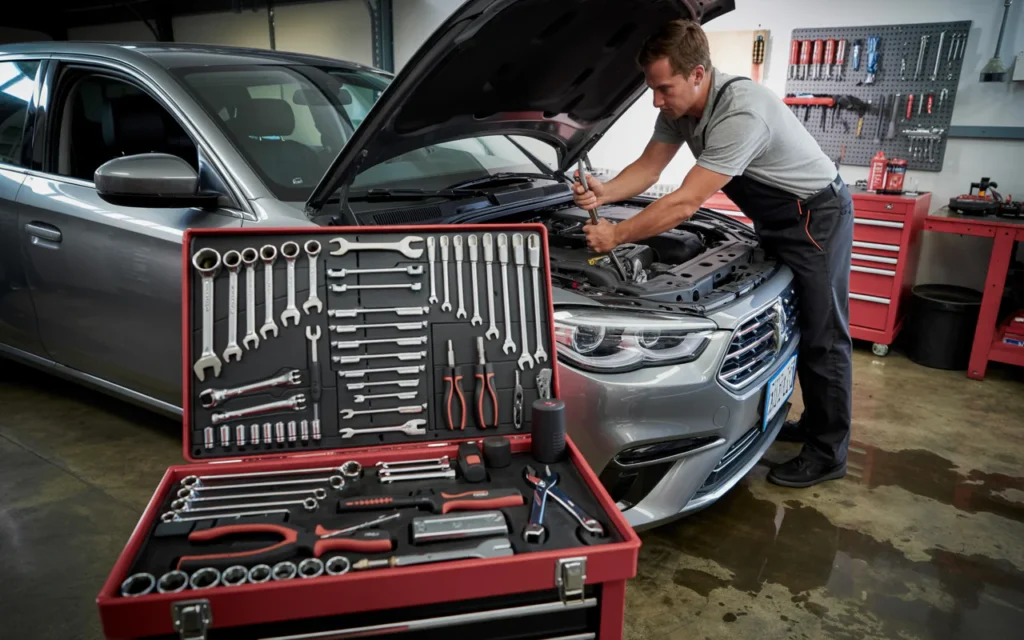
These jobs need breaker bars, ball joint separators, and large wrenches up to 24mm. A home kit has nothing close. Plus, suspension bolts are often torqued to 100+ foot pounds. A home ratchet cannot handle that force. It will break or round the bolt.
5. Alternator or Starter Replacement
These parts sit low or deep in the engine bay. You need extensions, universal joints, and often a long ratchet. Home kits rarely have these. You also need a multimeter to test if the alternator is bad. Most home kits do not include a multimeter.
“Do what you can, with what you have, where you are.” – Theodore Roosevelt
This quote fits DIY car repair perfectly. Use your home kit for what it can do. Do not force it to do what it cannot. That is how bolts strip and people get hurt.
How to Upgrade Your Home Tool Kit for Car Repairs (Under $50)
If you like working on your car, you do not need to buy a whole new set. Just add a few low cost items to your home kit. Then the answer to Can I use a home tool kit for car repairs changes from “sometimes” to “often.”
Add These 5 Tools to Your Home Kit:
- Metric socket set (8mm to 19mm) – $15 to $20 at any hardware store. Get a 3/8” drive ratchet with it.
- Oil filter wrench – $5 to $10. Strap type or claw type both work.
- Torque wrench – $25 (basic beam type). This saves your engine and suspension bolts from over tightening.
- Set of screwdrivers with magnetic tips – $10. Better than the cheap ones in home kits.
- Penetrating oil (like PB Blaster or WD-40) – $5. Spray rusty bolts before trying to turn them.
With these five additions, your home tool kit becomes a very capable car repair kit for most routine maintenance.
Safety First: When Not to Use a Home Tool Kit
Let me be direct. Can I use a home tool kit for car repairs also means knowing when safety says no. Do not use a home kit for:
- Brake work without a torque wrench and proper sockets.
- Steering or suspension parts without a breaker bar and jack stands.
- Any bolt that is rusted solid without penetrating oil and the correct six point socket (home kits often have 12 point sockets that slip).
Also, never get under a car using only the jack from your trunk or a home kit scissor jack. That is not safe. Use proper jack stands. They cost $30 and save your life.
Frequently Asked Questions
Q1: Can I use a home tool kit for car repairs like changing a tire?
Yes, but only for the lug nuts. Most home kits do not have a lug wrench (also called a tire iron). Your car’s trunk has one. Use that. Do not use a home ratchet on lug nuts. They need higher torque.
Q2: Can I use a home tool kit for car repairs if I have no mechanical experience?
Yes, for very simple jobs like replacing wiper blades, air filters, or light bulbs. Watch a YouTube video first. Start small. Do not open anything that holds oil, coolant, or brake fluid until you learn more.
Q3: Will using a home tool kit void my car warranty?
No. Working on your car does not void the warranty unless you break something. The Magnuson Moss Warranty Act protects you. But keep receipts for any parts you replace. And do not modify emissions or safety systems.
Q4: What is the one tool missing from every home kit for car repairs?
A torque wrench. Home kits never include it. But many car bolts need exact tightness. Too loose and parts fall off. Too tight and bolts snap. Buy a basic torque wrench for $25. It pays for itself the first time you avoid a broken bolt.
Q5: Can I use a home tool kit for car repairs on a diesel truck?
Mostly no. Diesel trucks use larger bolts (up to 24mm or more) and higher torque. A home kit is too small. You need a heavy duty tool set.
Q6: Can I use a home tool kit for car repairs in an emergency on the road?
Sometimes. If you have a basic ratchet and a few metric sockets, you can tighten a loose belt tensioner or a battery cable. But for roadside emergencies, a dedicated car emergency kit is better. That kit includes jumper cables, a flashlight, and a multi bit screwdriver.
Conclusion: Yes, But Know Your Limits
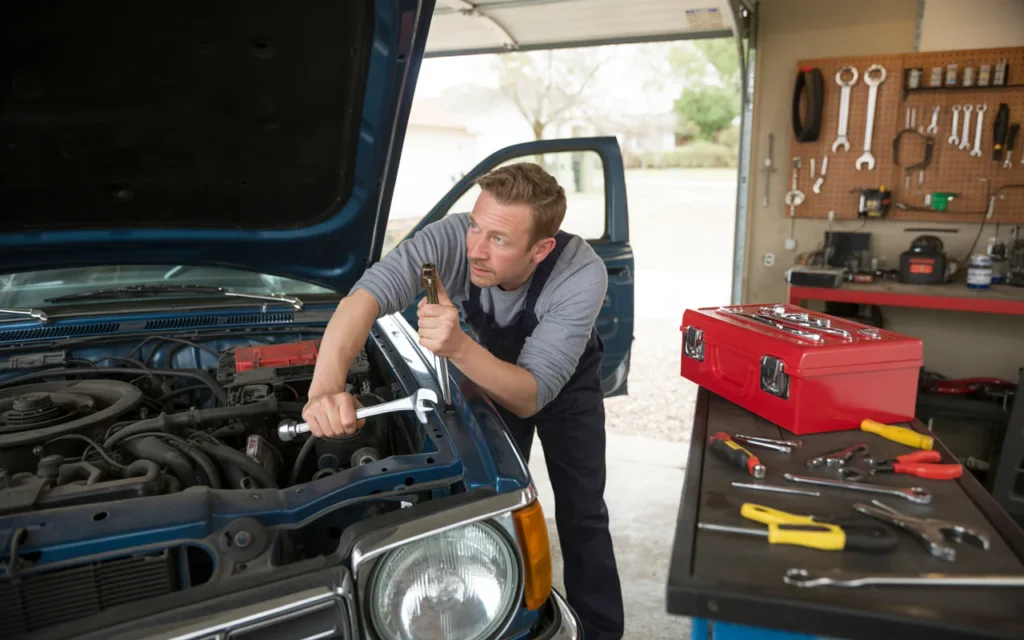
So let us return to the main question: Can I use a home tool kit for car repairs? The honest answer is yes for small, non safety critical jobs. Change your air filter. Replace a side mirror. Tighten a heat shield. Clean battery terminals. Swap interior bulbs.
But for brakes, suspension, engine internals, or steering, a home kit is not enough. You need metric sockets, a torque wrench, penetrating oil, and sometimes specialty tools. The good news is you can add these to your home kit for under $50. Then your home kit grows with your skill.
Start small. Watch a video for each new job. Buy tools as you need them, not before. And never force a tool to do a job it was not made for. That is how injuries happen.
Your home tool kit is a great starting point. Respect its limits. Learn one repair at a time. Soon you will save money and feel proud fixing your own car. Just keep a real mechanic’s number handy for the big jobs. That is not failure. That is smart driving.
Related posts
 Top Starter Mechanic Tool Kits for Apprentices: Essential Sets for Your Trade
Explore top starter mechanic tool kits for apprentices. Compare sets for mechanics, electricians, and other trades to find your essential tools. Starting an apprenticeship is an…
 Automotive Tool Kits vs. Mechanic Tool Sets: What’s the Difference?
Understand the key differences between automotive tool kits vs. mechanic tool sets. Learn which is best for your car maintenance needs. When looking for tools to…
 Top Automotive Tool Kits for Garage Workshops: A Buyer’s Guide
Find the top automotive tool kits for garage workshop. Compare versatile sets for car maintenance, home repairs, and DIY projects to choose the best fit. Setting…