
How Should I Pack My Tool Bag To Distribute Weight Properly
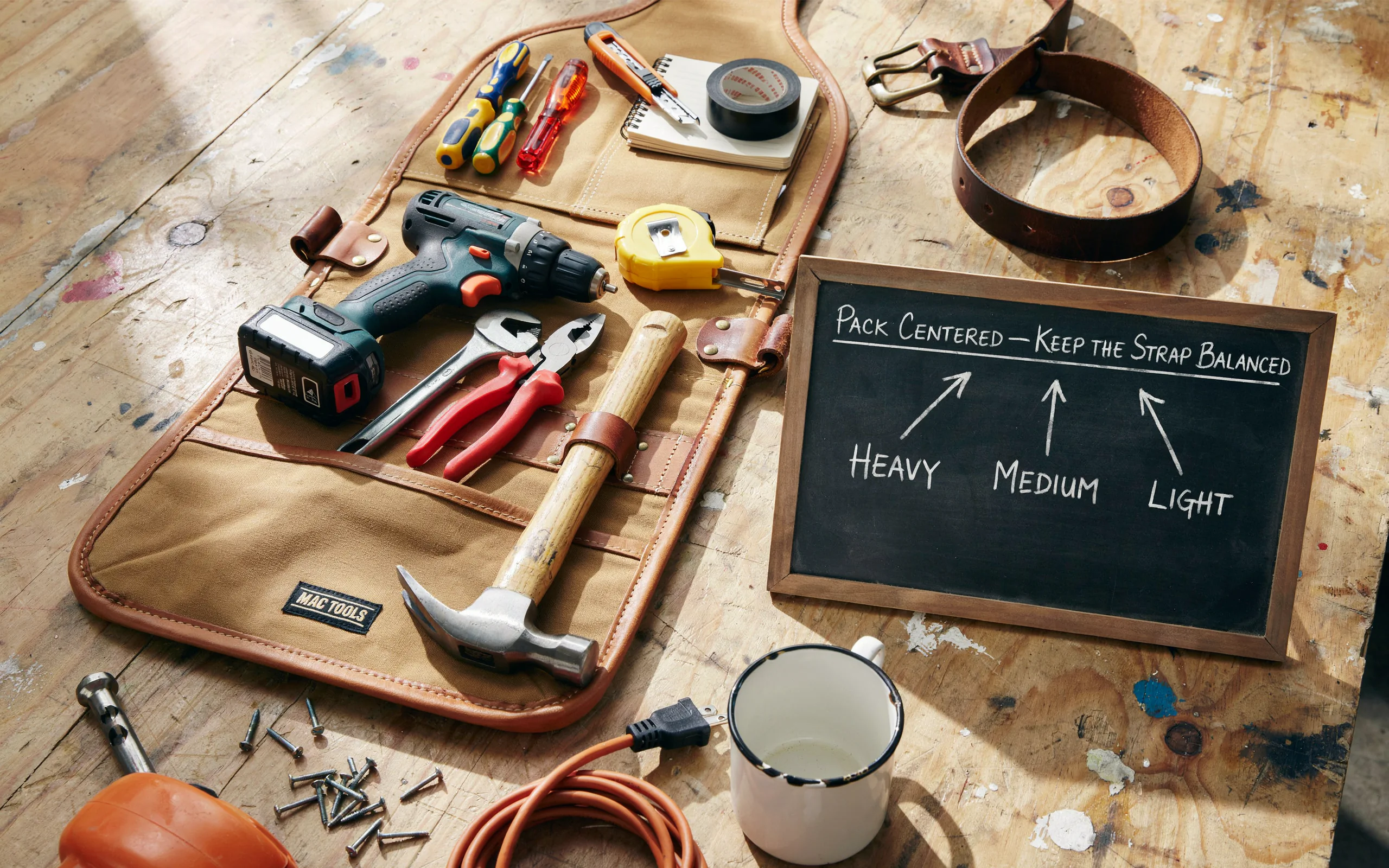
If you carry tools daily, you know the strain. Here is how I pack my tool bag to distribute weight properly and save my back, shoulders, and time on every job.
Every tradesperson knows the feeling. You pick up your tool bag in the morning, and it already feels heavier than it should. By lunch, your shoulder aches. By the end of the day, your back is screaming. The problem is rarely the total weight of your tools. The real issue is how you pack them.
I have spent years carrying heavy bags to job sites. I have tried every type of bag, pouch, and backpack available. Through trial and error, I learned that how I pack my tool bag to distribute weight properly makes all the difference between a good day and a painful one.
This guide shares everything I have learned about packing tools the right way. You will discover simple strategies to balance your load, protect your body, and work more efficiently. Whether you are an electrician, plumber, carpenter, or general handyman, these tips will change how you carry your gear.
Why Proper Weight Distribution Matters
Carrying an unbalanced tool bag is not just uncomfortable. It is dangerous. When weight sits unevenly, your body compensates in ways that lead to strain and injury.
The Physical Toll of Bad Packing
Your spine is designed to carry weight evenly. When you pack heavy items on one side, your muscles work harder to keep you upright. This constant pulling leads to muscle fatigue, joint pain, and long-term issues like sciatica or herniated discs.
I used to throw everything into my bag without thinking. Heavy hammers sat on top. Small screws and bits fell to the bottom. My bag leaned to one side, and I leaned with it. My chiropractor finally told me that how I pack my tool bag to distribute weight properly could save me years of back problems.
Impact on Work Efficiency
Poor weight distribution also slows you down. You waste energy fighting your own bag. You take more breaks. You feel tired faster.
When your bag is balanced, you move freely. You carry it with less effort. You arrive at each job ready to work instead of already worn out.
“The body is a tool, just like any other. You have to maintain it, or it will break down on the job.” – Mike Rowe, television host and trades advocate
Understanding Tool Bag Types and Their Impact
The bag you choose affects how well you can balance the load. Different designs work better for different types of work.
Backpack Style Tool Bags
Backpacks offer the best weight distribution if packed correctly. The weight sits close to your spine and spreads across both shoulders. This design matches how the body naturally carries heavy loads.
For backpack bags, how I pack my tool bag to distribute weight properly means placing heavier items near your back and lighter items toward the outer pockets.
Tote Style Tool Bags
Open-top tote bags are popular because they offer quick access to tools. However, they are harder to balance. The weight sits lower and can swing as you walk. You need to pack these bags carefully to keep the center of gravity low and centered.
Rolling Tool Bags
Rolling bags take the weight off your body completely. But they still need proper packing. An unbalanced rolling bag tips over easily and becomes hard to pull. Even with wheels, you benefit from understanding how I pack my tool bag to distribute weight properly.
Aprons and Pouches
For small jobs, aprons and pouches keep essential tools close. But they concentrate weight on your hips or shoulders. Rotate between carrying methods to avoid overworking specific muscle groups.
The Tools You Actually Need
Before you pack, assess what you carry. Most of us carry too much. Extra weight is your enemy.
Audit Your Tool Collection
Take everything out of your bag. Lay it all on the floor. Ask yourself honestly:
- When did I last use this tool?
- Does this tool belong in my main bag or a secondary kit?
- Can I leave this in my truck or workshop?
I reduced my daily carry by nearly 30% after doing this audit. Those tools I never used were just dead weight. Removing them made it easier for me to pack my tool bag to distribute weight properly.
Create a Daily Carry List
Your daily carry should include only tools you use on most jobs. Specialty tools can stay in a separate box. This keeps your main bag lighter and more manageable.
Consider Tool Weight
When choosing between similar tools, consider weight. A lighter hammer or drill can save you pounds over the course of a day.
Common Tools by Weight Category
| Heavy Tools (Over 2 lbs) | Medium Tools (1-2 lbs) | Light Tools (Under 1 lb) |
|---|---|---|
| Hammer | Drill/driver | Screwdrivers |
| Large wrenches | Multi-meter | Pliers |
| Pipe wrenches | Level | Tape measures |
| Sledge hammer | Reciprocating saw | Utility knives |
| Large pliers | Flashlight | Bits and drivers |
| Battery packs | Small pry bar | Pencils and markers |
This table helps you identify which tools go where. Heaviest items form the foundation of your balanced pack.
Step-by-Step Guide: How I Pack My Tool Bag to Distribute Weight Properly
Now let us get to the practical part. Here is exactly how I pack my tool bag to distribute weight properly on every job.
Step 1: Start with a Clean Slate
Open your bag completely. Remove all dust, debris, and old receipts. A clean bag lets you see the interior compartments clearly. You can better plan where each tool goes.
Check for torn pockets or broken zippers. Damaged compartments make proper packing harder. Repair or replace your bag if needed.
Step 2: Know Your Bag’s Layout
Every tool bag has a different interior design. Some have hard bottoms. Others have soft bases. Some have multiple divided sections.
Study your bag. Identify the main compartment, side pockets, front pockets, and hidden sleeves. Know which areas are close to your body and which hang away from you.
Step 3: Place Heavy Items Low and Center
The golden rule of tool packing: heaviest items go in the bottom center of the bag. This lowers your center of gravity and keeps the bag from tipping.
For backpack bags, heavy items sit against the back panel at the bottom. For totes, they rest in the middle of the floor. I place my hammer, drill, and heavy wrenches in this position first.
Step 4: Build Upward with Lighter Tools
After placing heavy tools, layer medium-weight items above them. The top of your bag should hold only the lightest tools.
This method ensures the weight stays low. When I pack my tool bag to distribute weight properly, I always think about keeping that center of gravity low. A low center of gravity means better stability and less strain on your body.
Step 5: Balance Side to Side
Open your bag and look down. Imagine a line running down the middle. The weight should be equal on both sides.
If you place a heavy drill on the right side, balance it with a heavy battery or tool on the left. This even distribution prevents your bag from pulling you to one side.
Step 6: Use Pockets Strategically
Side pockets are not for heavy tools. They sit away from your body’s center, creating leverage that pulls you off balance.
Reserve side pockets for lightweight items like pencils, tape measures, small pliers, or bits. The bulk of your weight should stay in the main compartment.
Step 7: Secure Loose Items
Small tools shift during walking. This shifting changes your bag’s balance unexpectedly. Use pouches, elastic loops, or small bags to secure loose items.
I use zippered pouches for screws, bits, and small parts. These pouches stay in place and prevent rattling. When I pack my tool bag to distribute weight properly, securing loose items is a key part of the process.
Step 8: Test the Balance
Before leaving, put your bag on and walk around. Feel how it sits on your body. Does it pull you to one side? Do you lean forward or backward?
Adjust as needed. A balanced bag should feel like an extension of your body, not a burden fighting against you.
The Low-Down-High Rule for Packing
This simple rule has transformed my daily carry. It is the foundation for how I pack my tool bag to distribute weight properly.
The Rule Explained
The Low-Down-High Rule states:
- Low: Heavy items go in the bottom third of your bag
- Down: These heavy items sit closest to your body or the center line
- High: Light items go in the top third and outer pockets
This rule keeps the weight where it causes the least strain. A low center of gravity is easier for your body to control.
Why This Works
Think about carrying a large water jug. Carry it high on your shoulder, and you fight to keep it stable. Carry it low near your hip, and it feels easier to manage.
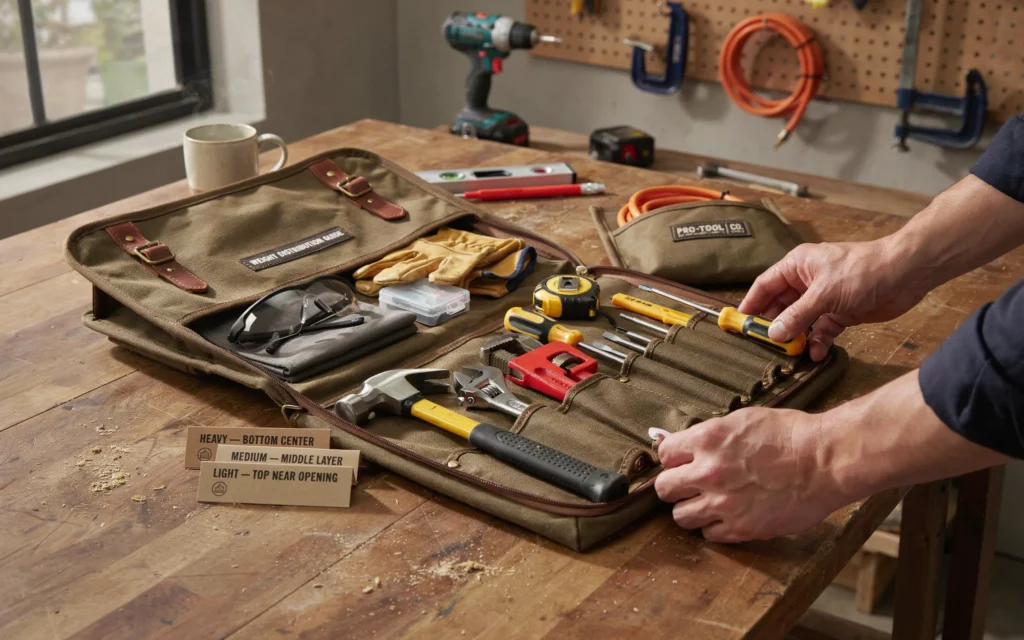
The same physics apply to your tool bag. By placing heavy tools low, you reduce the leverage they have over your body. You use less energy to stay balanced.
“Work smarter, not harder. That applies to how you carry your tools just as much as how you use them.” – Norm Abram, carpenter and television host
Weight Distribution and Body Mechanics
Understanding basic body mechanics helps you pack better. Your body has natural ways of handling weight.
How Your Spine Handles Weight
Your spine has natural curves that absorb shock. When weight is balanced evenly, these curves work as designed. Uneven weight forces your spine out of alignment.
When I pack my tool bag to distribute weight properly, I think about keeping my spine in its natural position. A balanced bag lets my spine stay straight while I walk.
Shoulder and Hip Alignment
Your shoulders and hips are designed to work together. When your bag is balanced, your shoulders stay level. Your hips remain square.
An unbalanced bag makes you hike one shoulder up or twist your hips. These compensations cause muscle strain over time. Simple changes in packing prevent these issues.
The Role of Core Muscles
Good packing helps your core muscles do their job. Your core stabilizes your body during movement. When weight is balanced, your core can work efficiently.
Unbalanced weight makes your core work overtime to compensate. This extra effort leads to fatigue and potential injury.
Common Packing Mistakes to Avoid
I made all these mistakes myself. Learn from my experience.
Mistake 1: Overstuffing Side Pockets
Side pockets are convenient. They are also the worst place for heavy tools. The leverage from side pockets pulls your bag sideways and strains your shoulder.
Mistake 2: Placing Heavy Items on Top
Many people pack heavy tools on top for easy access. This raises your center of gravity. A high center of gravity makes the bag feel heavier and less stable.
Mistake 3: Leaving Empty Space
Tools shift in empty space. This shifting changes your bag’s balance throughout the day. Fill empty space with rolled towels or soft items to keep tools in place.
Mistake 4: Ignoring Bag Weight Distribution
Some workers focus only on the bag’s weight and neglect its distribution. Total weight matters, but distribution matters just as much. Two bags of equal weight feel completely different based on how they are packed.
Mistake 5: Not Adjusting for Different Jobs
Every job requires different tools. Your pack should change accordingly. Take out tools you won’t need and add only what the specific job requires.
Tool Bag Care and Maintenance
Your bag works hard. Treat it well, and it will protect your tools for years.
Clean Your Bag Regularly
Dirt and debris build up in pockets and seams. This extra material adds weight and can damage zippers. Empty your bag weekly and shake out debris.
Check Zippers and Straps
Zippers and straps take constant stress. Check them monthly for wear. Replace worn parts before they fail completely.
Store Your Bag Properly
At the end of the day, empty heavy tools from your bag. Store them in a proper tool chest or cabinet. This takes constant pressure off your bag’s seams and straps.
Rotate Bags If Possible
If you carry daily, consider having two bags. Rotate between them. This gives each bag time to rest and extends their useful life.
When to Upgrade Your Tool Bag
Sometimes packing problems are really bag problems. Here are signs you need a new bag.
Signs You Need a New Bag
- The bag feels uncomfortable even when properly packed
- Zippers frequently catch or fail
- The bottom sags or drags on the ground
- Shoulder straps dig into your neck
- The bag is too small for your daily tools
Features to Look For
When shopping for a new bag, look for:
- Padded shoulder straps or backpack design
- Hard bottom that holds its shape
- Multiple internal compartments
- Padded back panel for backpacks
- Sturdy handle for carrying
Material Matters
Canvas and nylon are common materials. Canvas is durable but heavier. Nylon is lighter and water-resistant. Choose based on your work environment.
Safety Considerations
Your daily carry affects your safety in multiple ways.
Carrying Safely
Always lift with your legs, not your back. Bend at the knees and keep your back straight. Position the bag close to your body before lifting.
Walking with Your Bag
Walk with your head up and shoulders back. Let your bag rest as close to your body as possible. For shoulder bags, switch sides periodically to distribute the load.
Emergency Situations
In an emergency, you need to move quickly. A balanced bag lets you run or climb without worrying about falling. Proper packing is a safety measure.
“Safety is not a gadget but a state of mind.” – Eleanor Everet, safety advocate
Advanced Packing Strategies
Once you master the basics, try these advanced techniques.
The Modular Approach
Group your tools into modules based on task. Electrical tools in one pouch. Plumbing tools in another. Change modules based on your job. This keeps your bag lighter and helps you pack your tool bag to distribute weight properly every time.
The Frequency Method
Place your most-used tools in the most accessible spots. These are usually medium-weight items that sit near the top of the bag. Less-used tools go deeper or in less accessible pockets.
The Balance Buddy System
If you work with a partner, share tools. Split heavy items between two bags. Each person carries a lighter, more balanced load.
Day-to-Day Packing Routine
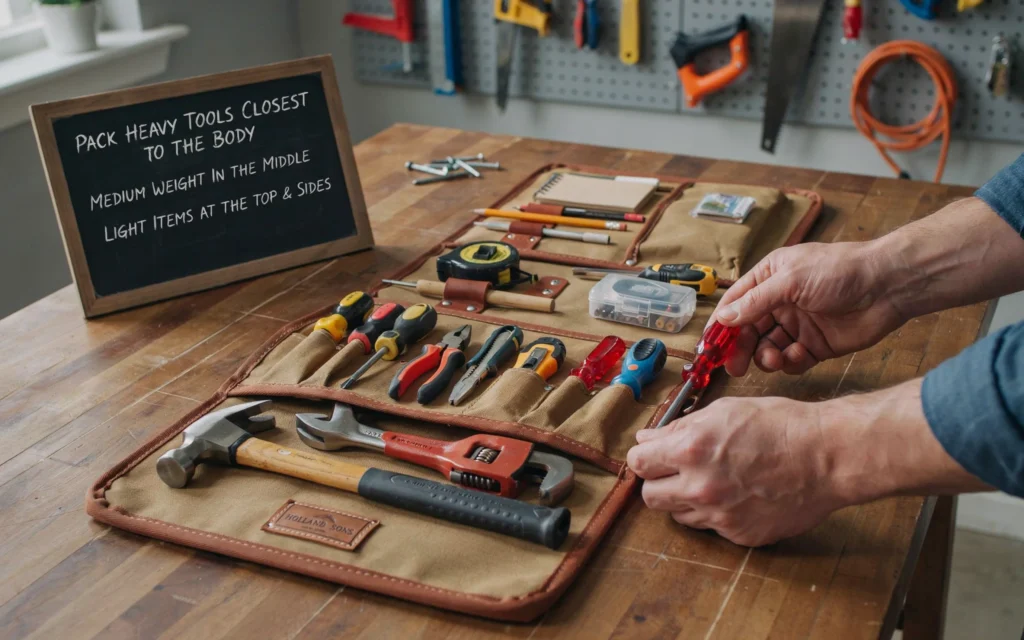
Turn good packing into a habit. Here is my morning routine.
Morning Checklist
- Empty any leftover tools from yesterday
- Check the day’s job requirements
- Select only tools needed for that job
- Place heavy tools in bottom center first
- Add medium tools next
- Add light tools in top pockets
- Secure small items in pouches
- Test the bag’s balance
- Adjust as needed
End-of-Day Routine
- Remove all tools from bag
- Wipe down dirty tools
- Store tools in proper place
- Clean debris from bag
- Prepare for next day if possible
Team Training and Best Practices
If you supervise others, teach them proper packing methods.
Training Your Crew
Show your team how I pack my tool bag to distribute weight properly. Demonstrate the Low-Down-High Rule. Explain the reasoning behind each step.
Standardizing Packing Procedures
Create a standard packing order for your team. This consistency helps new workers learn faster. It also ensures everyone works safely.
Monitoring and Feedback
Watch your team’s packing habits. Offer friendly corrections when needed. Encourage workers to share what works for them.
Real-World Success Stories
Here are stories from workers who changed their packing habits.
Sarah’s Shoulder Pain
Sarah is an electrician who carried a heavy tote bag. She developed chronic shoulder pain. After learning proper packing, she switched to a backpack style bag and followed the low-down-high rule. Her shoulder pain disappeared in three weeks.
James’ Efficiency Boost
James is a carpenter who wasted time searching for tools. He reorganized his bag using the frequency method. His most-used tools became easy to reach. He estimated saving 30 minutes per day on tool searches.
Maria’s Back Recovery
Maria is a plumber with back issues. Her doctor told her to change how she carries her tools. She reduced her daily carry by 20% and packed remaining tools properly. Her back pain became manageable within a month.
Ergonomic Principles for Tool Carrying
Basic ergonomics apply directly to tool packing.
Center of Gravity
Your body’s center of gravity is around your navel. Keep your bag’s center of gravity as close to your body’s center as possible. This reduces the moment arm that strains your muscles.
Load Stability
A stable load is easier to carry than a shifting one. Secure all items so they don’t move. This stability reduces micro-adjustments your body must make.
Posture Awareness
Check your posture when carrying your bag. Are you leaning? Is one shoulder higher than the other? A balanced bag should let you stand naturally.
The Daily Carry System
Create a system that works for your specific trade.
Electrician’s Pack
Electricians need multimeters, strippers, pliers, drivers, and testing equipment. Heavy items like large wire spools go low and center. Testing equipment sits in padded pockets.
Plumber’s Pack
Plumbers carry wrenches, cutters, plungers, and soldering equipment. The heaviest wrenches sit at the bottom. Medium cutters go in the middle. Light plungers rest at the top.
Carpenter’s Pack
Carpenters carry hammers, squares, levels, chisels, and measuring tools. The heavy hammer goes bottom center. Levels and squares sit in side sleeves for protection.
General Handyman’s Pack
Handymen carry a mix of all tools. Sort by weight and pack accordingly. Heavy drills and saws go low. Hand tools sit in the middle. Measuring and marking tools go in top pockets.
Comparing Different Types of Tool Bags
Tool Bag Types and Their Packing Needs
| Bag Type | Best For | Weight Distribution | Packing Strategy |
|---|---|---|---|
| Backpack | Heavy loads, walking distances | Excellent if packed correctly | Heavy tools near back panel |
| Tote | Quick access, vehicle-based work | Good with careful packing | Heavy tools in center bottom |
| Rolling cart | Very heavy loads, workshops | Excellent for stability | Heavy tools low and centered |
| Apron/pouch | Light loads, specific tasks | Fair, weight on hips/shoulders | Limit to essential tools only |
Children and Tool Safety
If you work from home and have children, keep tool bags secured. A balanced bag can still tip over if pulled. Store bags out of reach when not in use.
Emotional and Mental Benefits
Proper packing reduces stress. An organized bag means less frustration. You start each day feeling prepared and professional.
When I pack my tool bag to distribute weight properly, I feel more confident. I know my tools are ready. I know my body will feel better at the end of the day. This peace of mind is valuable.
Long-Term Health Considerations
Your back and joints need to last your entire career. How you carry tools today affects your body tomorrow.
Joint Preservation
Shoulder and knee joints take the biggest hit from unbalanced loads. Proper packing reduces this stress. Preserve your joints for the long haul.
Muscle Balance
Overworking one side of your body leads to muscle imbalances. These imbalances cause posture problems and chronic pain. Balanced packing prevents these issues.
Career Longevity
Many tradespeople retire early due to physical issues. Proper packing helps you work longer and enjoy your career more.
Frequently Asked Questions
What is the best way to organize tools in a bag?
Place heavy tools in the bottom center. Layer medium tools above them. Put light tools in top and outer pockets. This keeps the center of gravity low and stable.
Does the type of tool bag matter?
Yes, backpack style bags offer the best weight distribution. Tote bags work well but need more careful packing. Choose based on your daily tasks.
How often should I clean my tool bag?
Clean your bag weekly. Shake out debris and check for wear. A clean bag is easier to pack properly.
Can I pack heavy tools in side pockets?
It is better to avoid side pockets for heavy tools. They create leverage that pulls you off balance. Reserve side pockets for lightweight items.
How do I know if my bag is too heavy?
If you struggle to lift your bag, it is too heavy. Reduce your daily carry. Keep your bag under 15% of your body weight for comfort.
What should I do if my bag still feels heavy after proper packing?
Consider upgrading to a rolling bag. Reduce your daily carry further. Split your tools between multiple bags.
Conclusion
Learning how I pack my tool bag to distribute weight properly changed my work life. It saved my back and my energy. It made me faster and more efficient on every job.
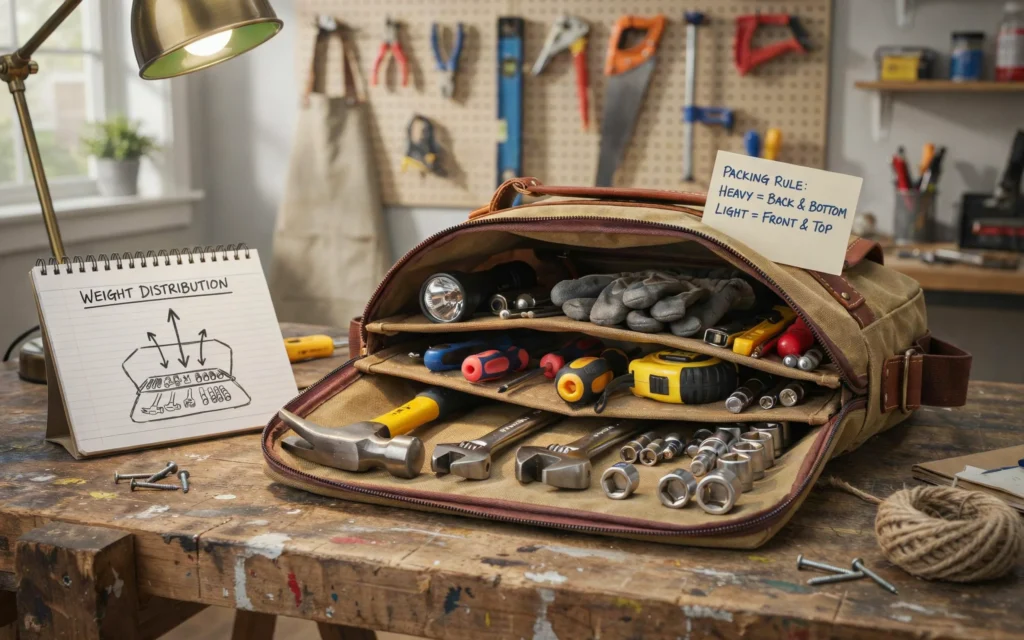
The principles are simple. Heavy items go low and centered. Medium items sit above them. Light items fill the top and outer pockets. Secure everything to prevent shifting. Choose the right bag for your work.
Take time this week to audit your tool bag. Remove items you rarely use. Repack using the guidelines in this article. Your body will thank you at the end of each day.
Remember that good packing is a habit. It takes practice. But once you experience the difference, you will never go back to throwing tools in your bag without thinking.
Your tools are your livelihood. Protect them by packing properly. Protect your body by balancing your load. Work smarter, feel better, and enjoy your career for years to come.
Related posts
 Top Tool Bags for Mobile Contractors: 2026 Buyer Guide
Discover the top tool bags for mobile contractors in 2026. Compare durable totes, backpacks, and multi-pocket organizers to find the best fit for your gear. For…
 Top Tool Bags for Plumbers: 2026 Selection Guide
Discover the top tool bags for plumbers in 2026. We compare durable, multi-pocket storage solutions to help you organize your gear effectively on the job. Plumbing…
 Best Tool Bag for HVAC Technicians in 2026
Find the right tool bag for HVAC technicians with our 2026 guide. Compare top-rated bags, backpacks, and pouches to keep your gear organized and protected. As…