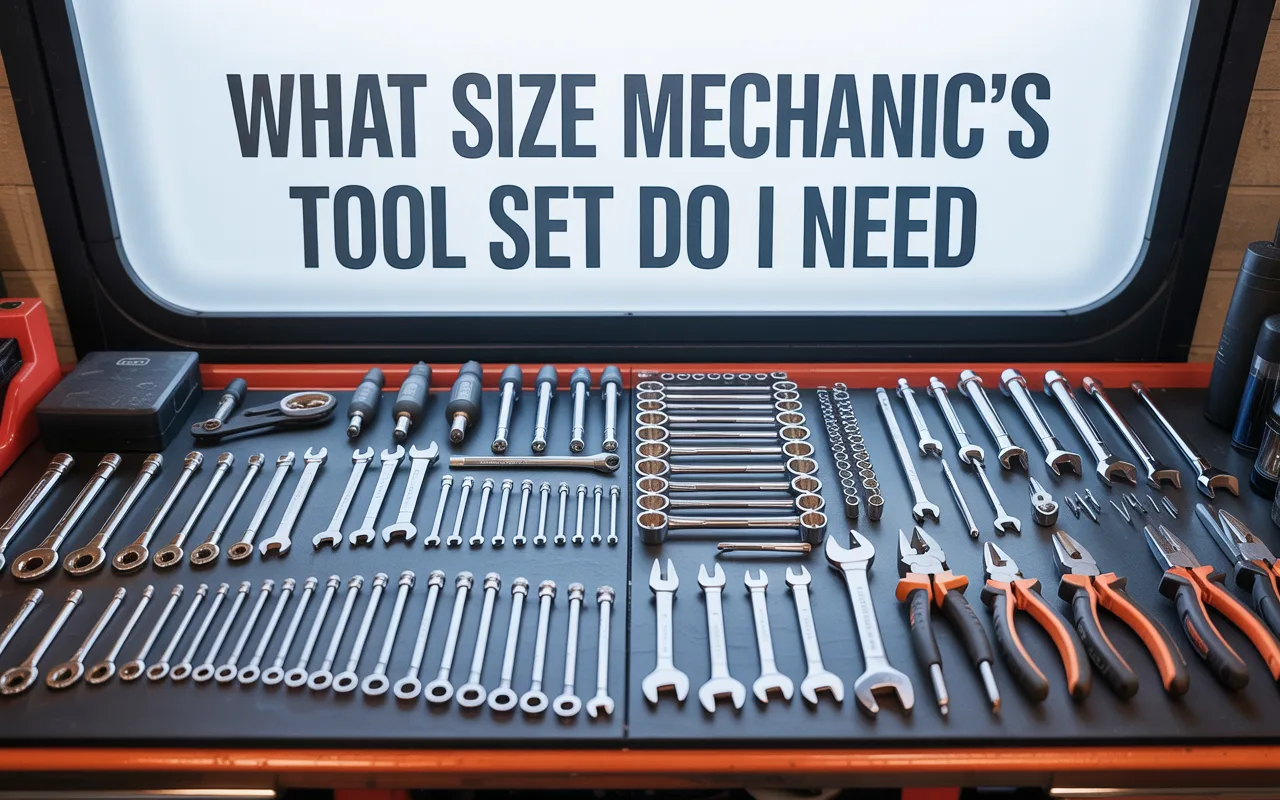
Trying to figure out what size mechanic’s tool set do I need? This guide breaks down set sizes from small to pro. Find your perfect match without wasting money.
So you are ready to buy some tools. You open a website or walk into a store and see sets with 50 pieces, others with 300 pieces. Some cost fifty dollars, some cost five hundred. It is easy to get confused. You just want to know what size mechanic’s tool set do I need to get the job done.
I have been in this spot myself. I have bought small sets and big sets. I have learned that bigger is not always better. But too small can leave you stuck in the middle of a repair. This article will help you pick the right size based on your real needs. We will talk about cars, bikes, home repairs, and even heavy trucks. Let us find the perfect fit for you.
Start With Your Type of Work
Before you count how many pieces are in the box, stop and think. What will you actually fix? The answer to what size mechanic’s tool set do I need changes based on your projects.
If you only need to tighten a loose screw on a cabinet, a huge set is silly. If you plan to rebuild an engine, a tiny set will fail you. Your work type is the boss here. Let us break it down by common user types.
The Weekend Home User
You might have a car, a bicycle, and some furniture that needs assembly. You are not fixing things every day. You just want to be ready for small jobs. You need enough to change a battery, tighten a wobbly chair, or swap out a bathroom faucet.
For you, a smaller set works great. Look for a set with basic sockets and wrenches. You do not need every size ever made. You need the common ones.
The DIY Car Enthusiast
Maybe you change your own oil. Perhaps you swap out brake pads or replace a dead alternator. You work on your own vehicles to save money. You enjoy learning how things work.
Your needs are bigger. You will run into different bolt sizes. You might need deeper sockets to reach nuts on long studs. You also need more drive sizes to handle both tight spaces and big suspension bolts. Your tool set needs to cover more ground.
The Professional Mechanic
This is your job. You use tools eight hours a day, five or six days a week. You need tools that last. You need every size possible because cars are all different. You also need specialized tools like wobble extensions or specific socket types.
If this is you, you already know the answer to what size mechanic’s tool set do I need. It is the biggest, most complete set you can afford, plus more. You will buy separate pieces over time too.
The Farmer or Heavy Equipment Owner
Tractors, trucks, and old machinery often have bigger bolts. Standard car tools might be too small. You need larger drive sizes and bigger wrenches. Rust and dirt are also common. Tools need to be tough.
For this, you need a set that includes larger sockets. A 1/2-inch drive set is your best friend. You might even need a 3/4-inch drive for really big stuff.
Understanding Tool Set Sizes by Piece Count
Okay, so you have an idea of your work type. Now let us look at the numbers. Tool sets are often sold by “piece count.” This tells you how many items are in the box. But be careful. Some sets count every little Allen wrench as a piece. That can make the number look bigger than it really is.
Here is a simple table to help you understand what different set sizes usually include.
| Set Size | What You Usually Get | Best For |
|---|---|---|
| 50-100 Pieces | Basic socket set (SAE & Metric), small wrench set, screwdriver bits. | Simple home tasks, furniture assembly, very light car work. |
| 150-250 Pieces | Standard and deep sockets, combination wrenches, hex keys, pliers, extensions, and a few screwdrivers. | Regular DIY car maintenance (brakes, oil changes), home repairs, hobbyists. |
| 300+ Pieces | Multiple drive sizes (1/4″, 3/8″, 1/2″), wide range of socket sizes, ratchets, wobble extensions, specialized bits, and often a case. | Serious DIYers, advanced car work, and professionals starting their careers. |
This table gives you a quick map. A 50-piece set is fine for a college student with a bike and a desk. A 250-piece set is great for someone with a sedan in the driveway. A 350-piece set is for the person building a project car.
Why “Drive Size” Matters More Than You Think
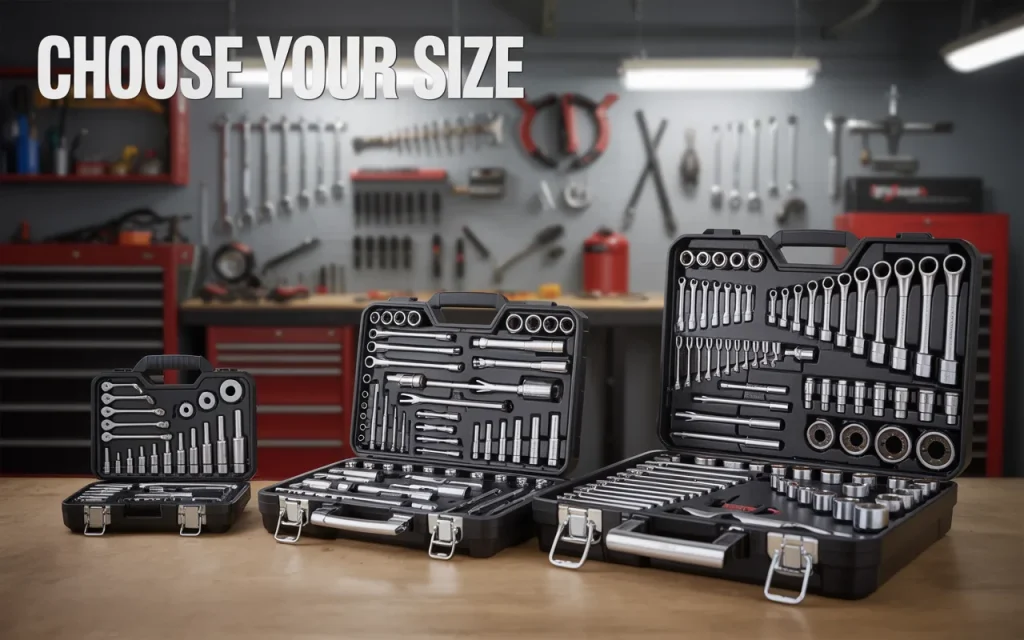
When asking what size mechanic’s tool set do I need, do not just look at the total pieces. Look at the drive sizes. The drive is the square part that attaches the socket to the ratchet.
1/4-inch drive: This is for small stuff. Think dashboard screws, small bolts on lawnmowers, or interior work. It fits in tight spots. It is delicate. If you use it on a big bolt, you will break it.
3/8-inch drive: This is the middle child. It is the most useful size for most car work. It is strong enough for many engine bolts and suspension parts, but small enough to fit in decent spaces. Most of your work will likely use this drive.
1/2-inch drive: This is for big jobs. Think axle nuts, suspension bolts, or lug nuts on your wheels. It is big and strong. You can put a long pipe on the handle for extra force (called a breaker bar). You need this for serious work.
A good set will have all three drives. If the set only has one drive size, it is probably too limited. Make sure your chosen set covers small, medium, and large jobs with the right drives.
Deep vs. Shallow Sockets: A Key Detail
When you look at sets, you will see two types of sockets. One is short, one is long. They both matter.
Shallow sockets are for most jobs. You use them when the bolt is easy to reach. They are short, so they fit under the hood where space is tight.
Deep sockets are for bolts with long threads. Think of a stud sticking out of an engine. The nut screws onto it. A shallow socket might not reach all the way down. A deep socket slides over the whole stud and grabs the nut. You also use deep sockets for spark plugs.
A good answer to what size mechanic’s tool set do I need includes both types. If a set only has shallow sockets, you will get stuck later. Look for sets that say “standard and deep” in the description.
“I always tell my students, don’t buy a set just because it has a high number. Look at the types of sockets. If it doesn’t have deep sockets in the most common sizes, it’s not a complete set for car work.” – Robert Gray, Automotive Technology Instructor
This is real advice from a teacher. He sees beginners waste money on flashy sets that miss important tools. Do not make that mistake.
SAE vs. Metric: Which One Do You Need?
This is a big question. SAE (Society of Automotive Engineers) sizes are in inches. Think 1/4, 5/16, 3/8. Metric sizes are in millimeters. Think 8mm, 10mm, 12mm, 14mm.
If you work on: American cars made before the 1980s, you likely need SAE.
If you work on: Any car made after the 1980s, you mostly need Metric. Even American cars switched to metric bolts decades ago.
If you work on: European cars or Japanese cars, you 100% need Metric.
If you work on: Older motorcycles or lawnmowers, you might need both.
When deciding what size mechanic’s tool set do I need, get a set with both SAE and Metric. This is the safest bet. You will have the inch sizes for odd jobs and old stuff. You will have the metric sizes for modern cars and bikes. A set that offers both gives you the most value for your money.
Watch Out for the “Missing Sizes”
Some cheaper sets skip certain sizes to save money. They might give you 8mm, 10mm, 12mm, but skip 11mm. Guess what size some Honda bolts use? 11mm. Or they might skip the 15mm or 18mm.
Look at the size list before you buy. Make sure the common sizes are there. For metric, the 10mm, 12mm, 14mm, and 17mm are used a lot. If those are missing, keep looking.
Storage and Organization
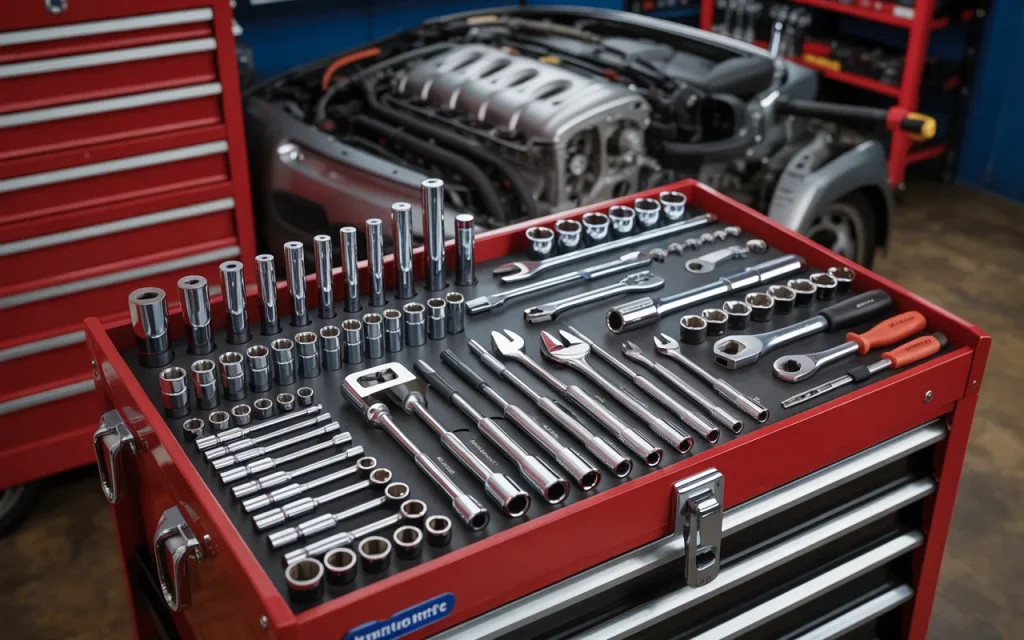
A tool set comes in a box or a case. Do not ignore this. If the case is bad, your tools will end up loose in a drawer. Then you lose the 10mm socket forever.
Plastic molded cases are great. Each tool has its own spot. You can see if something is missing. They stack neatly. Most mid-range sets come in these.
Metal tool boxes are for bigger sets or for people who add tools later. They have drawers. They are heavy and last a long time. But they cost more.
If you are just starting, a good plastic case is perfect. It keeps everything organized. You grab the case, take it to the car, and work. When you are done, everything goes back in its spot. This saves time and frustration.
When you ask what size mechanic’s tool set do I need, think about storage space too. A 300-piece set in a big metal box takes up a lot of room in your garage. Make sure you have a place to put it.
Quality vs. Quantity: A Balancing Act
You have a budget. I get it. We all do. Here is the tricky part. You can buy a 500-piece set for cheap. Or you can buy a 150-piece set from a better brand for the same price.
Which is better? Usually, the better brand wins.
Cheap tools can break. Sockets can crack. Ratchets can slip. Wrenches can bend. If you break a tool in the middle of a job, you are stuck. You also risk rounding off a bolt head. That turns a simple job into a nightmare.
Good tools might cost more per piece. But they last. The ratchet mechanism feels smooth. The chrome finish resists rust. They fit bolts correctly.
My advice? Do not buy the absolute cheapest set you find. Look for a brand that has a good warranty. Many mid-range brands (like Craftsman, GearWrench, or Tekton) offer great value. They are not the cheapest, but they are not the most expensive either. They give you good quality without breaking the bank.
“I learned the hard way that buying cheap tools is false economy. You end up buying them twice. Or you pay a mechanic to fix the bolt you stripped. Invest in the best you can reasonably afford.” – Mark Stevens, Fleet Maintenance Supervisor
Mark has managed tools for a whole fleet of trucks. He knows that quality saves money over time. A broken tool costs you time and progress.
Here is another simple table to help you compare quality levels.
| Quality Level | Price Point | What to Expect | Good For |
|---|---|---|---|
| Budget / Entry | Low | Basic function, may lack chrome finish, ratchets might feel rough. Occasional home use. | |
| Mid-Range / Pro-sumer | Medium | Smooth ratchets, good chrome, wide size range, strong warranty. Regular DIY, serious home mechanics. | |
| Professional | High | Very smooth action, finest materials, excellent finish, lifetime warranty. Daily pro use, demanding jobs. |
Finding the right balance is key to answering what size mechanic’s tool set do I need. You want enough tools to do the work. You want them to be good enough to last.
Special Tools and Add-Ons
A tool set is your starting point. It gives you the basics. Over time, you will need special tools. Do not expect a set to include everything.
Torque Wrench: Most sets do not include a torque wrench. But you need one. It lets you tighten bolts to the exact specification. This is critical for engine parts and wheel lug nuts. You will buy this separately.
Screwdrivers and Pliers: Some big sets include these. Some do not. If your set lacks them, buy a separate screwdriver set and a set of pliers (like slip-joint, needle-nose, and groove-joint pliers).
Extensions and Universal Joints: These let you reach bolts in awkward spots. A good mechanic’s set will include several extensions and probably a swivel socket or universal joint.
When you ask what size mechanic’s tool set do I need, think of it as your foundation. You build on it later. A solid 200-piece set with good ratchets and a full range of sockets is a perfect foundation. You add the specialty items as projects demand them.
My Personal Recommendation for Most People
If I had to pick one answer for the average person, here it is. If you do your own car maintenance (oil, brakes, basic repairs) and fix things around the house, look for this:
- A set with 200 to 250 pieces.
- Includes both SAE and Metric sizes.
- Includes 1/4-inch, 3/8-inch, and 1/2-inch drive ratchets.
- Includes both shallow and deep sockets for the common sizes.
- Comes in a organized plastic storage case.
- From a mid-range brand with a good warranty.
This size gives you everything you need for most jobs. It does not have a ton of junk you will never use. It is a complete starter set that will serve you for many years.
If your budget is tight, drop down to a 150-piece set. But try to keep the three drive sizes and both socket depths. That is the core of a useful tool collection.
If money is not an issue, go for a 300+ piece set from a known brand. You will have more sizes and more tools, which is always nice.
Frequently Asked Questions
Is a 200-piece tool set enough for a beginner?
Yes, a 200-piece set is usually perfect. It gives you a wide range of sockets, wrenches, and bits. It covers most jobs a beginner will face, like oil changes, brake pad swaps, and home repairs. Just make sure it has both SAE and metric sizes.
What is the most common socket size I will use?
For modern cars, the 10mm socket is the most common. You will use it constantly. Other common metric sizes are 12mm, 14mm, 17mm, and 19mm. For SAE, common sizes are 3/8, 7/16, 1/2, and 9/16.
Should I buy SAE or metric tools?
If you work on anything built after 1980, you need metric. Most cars today use metric bolts. However, buying a set with both is safest. You will have metric for your car and SAE for older equipment or odd jobs around the house.
Can I use 3/8-inch sockets on a 1/2-inch ratchet?
No, you need an adapter. The drive sizes must match. You can buy small adapters that let you use a 3/8 socket on a 1/2 drive, but it is better to have the correct ratchet for each drive size.
How much should I spend on a good mechanic’s set?
For a decent 200-piece set, expect to spend between $150 and $300. This gets you good quality from a trusted brand. You can spend less, but the quality might suffer. You can spend much more for professional tools, but that is often overkill for home use.
Conclusion
Finding the answer to what size mechanic’s tool set do I need does not have to be hard. Look at the work you actually do. If you are just starting out with car repairs and home projects, aim for a 200 to 250-piece set that includes multiple drive sizes, both shallow and deep sockets, and both SAE and metric measurements.
Do not get tricked by huge piece counts if the set lacks important features. Quality matters more than quantity. A solid mid-range set will last you for decades if you take care of it. It will save you money on repairs and give you the confidence to fix things yourself.
Start with a good foundation. Learn how to use your tools. Add specialty tools as you need them. That is the smart path. Now you know exactly what to look for, so go find that perfect set and get to work.