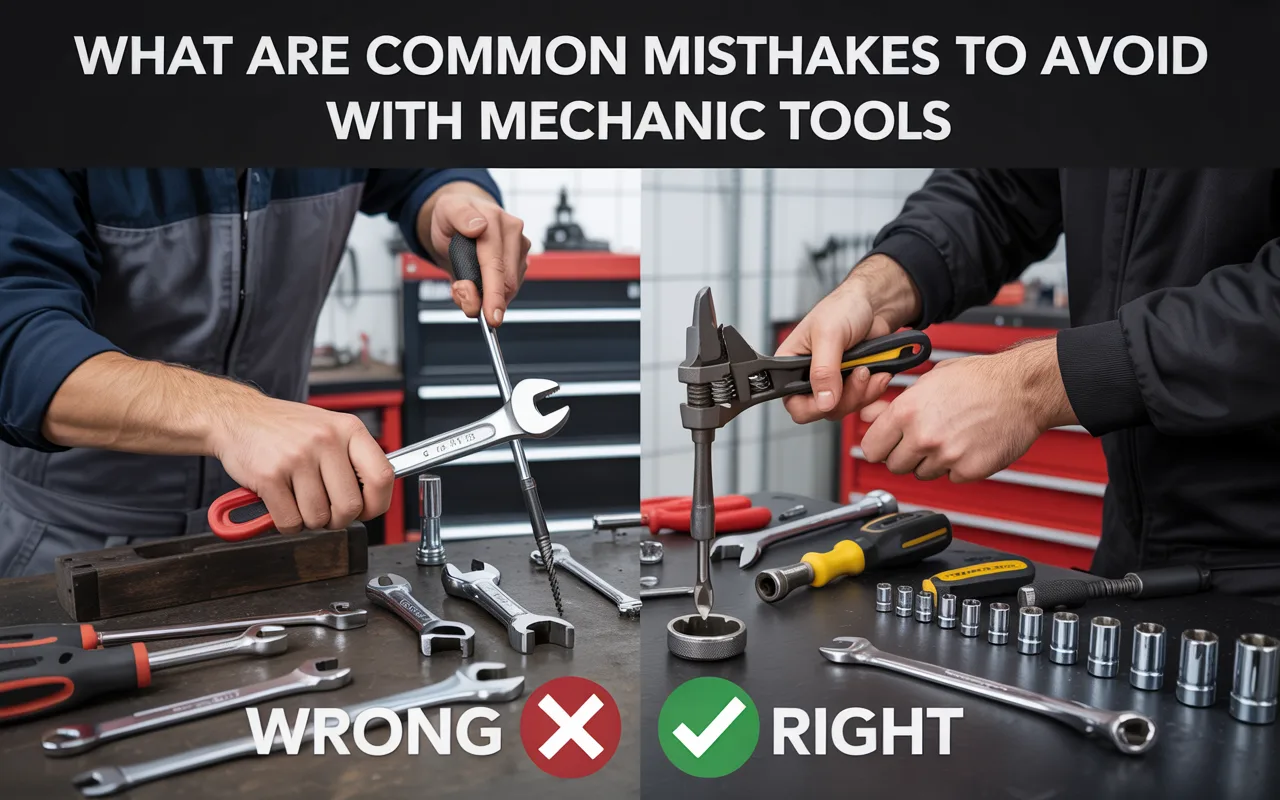
If you are wondering what are common mistakes to avoid with mechanic tools, the answer includes using the wrong tool for the job, ignoring safety gear, poor storage, and neglecting regular cleaning. This guide helps you work smarter, safer, and protect your valuable equipment.
There is a certain pride that comes with fixing your own car or working on a project in the garage. Holding a ratchet, feeling the weight of a good socket set, and solving a mechanical problem with your own two hands is deeply satisfying. But if you have spent any time turning wrenches, you know that things can go wrong quickly. A stripped bolt, a broken tool, or a nasty cut can turn a fun afternoon into a frustrating and expensive mess.
Over the years, I have learned that success in the garage is not just about having the most expensive toolbox. It is about how you treat your tools and how you approach the job. Most of the headaches we face come from a few simple errors. If you are looking to improve your skills and protect your investment, you need to know what are common mistakes to avoid with mechanic tools. This is the foundation of good work. It keeps you safe, saves you money, and ensures your tools are ready when you need them.
Let us walk through the most frequent problems I see. We will talk about why they happen and how you can avoid them so you can keep your projects moving forward without the setbacks.
The High Cost of Tool Abuse: Why We Need to Pay Attention
Before we get into the specific mistakes, let us talk about why this matters. Tools are not just pieces of metal. They are an extension of your skill. When you misuse a tool, you are not just risking the tool itself. You are risking the part you are working on, your time, and your safety.
I remember my first year working on cars. I was in a hurry to change a stubborn alternator. I grabbed a cheap wrench that was slightly the wrong size. I thought I could force it. The wrench slipped, my knuckles smashed against the engine block, and I spent the next 20 minutes trying to get the rounded-off bolt out with a pair of vice grips. I learned a hard lesson that day. If you want to work efficiently, you have to respect the tools in your hand.
Understanding what are common mistakes to avoid with mechanic tools helps you build a mindset of patience and precision. It transforms you from someone who just owns tools into someone who knows how to use them correctly.
Using the Wrong Tool for the Job (And Forcing the Issue)
This is perhaps the biggest trap for beginners and even experienced mechanics when they are in a rush. Using a screwdriver as a pry bar, using a standard wrench on a rounded bolt, or using pliers when you need a socket.
The Slippery Slope of “It Fits Kind Of”
One of the most dangerous habits is using a tool that almost fits. If you use a 13-millimeter socket on a 1/2-inch bolt because you are too lazy to walk to the toolbox, you are asking for trouble. The tool will not grip the fastener properly. When you apply force, it will slip. This leads to two problems. First, you risk injury when your hand flies off the fastener and hits a sharp metal edge. Second, you damage the fastener. A rounded bolt head is ten times harder to remove than a good one.
| Mistake | Why It Happens | The Result |
|---|---|---|
| Using the wrong socket size | Laziness or lack of organization | Rounded bolts, slipped tools, skinned knuckles |
| Using pliers instead of a wrench | Trying to cut corners | Damaged fastener heads, loss of grip, tool damage |
Misusing Ratchets and Breaker Bars
Another common error involves torque. A ratchet is designed to turn fasteners, not to break them loose. If a bolt is seized, you need a breaker bar. A breaker bar has no moving parts inside. It can handle the high stress of loosening a stuck bolt. If you use a ratchet for this, you risk breaking the internal gear mechanism. That is a quick way to ruin a good ratchet.
“The right tool for the right job is not just a saying; it is the first rule of mechanical work. When you force a tool to do what it was not made for, you are betting your safety against a few seconds of convenience.”
— Tom Boyd, Certified Master Mechanic
Neglecting Safety Equipment
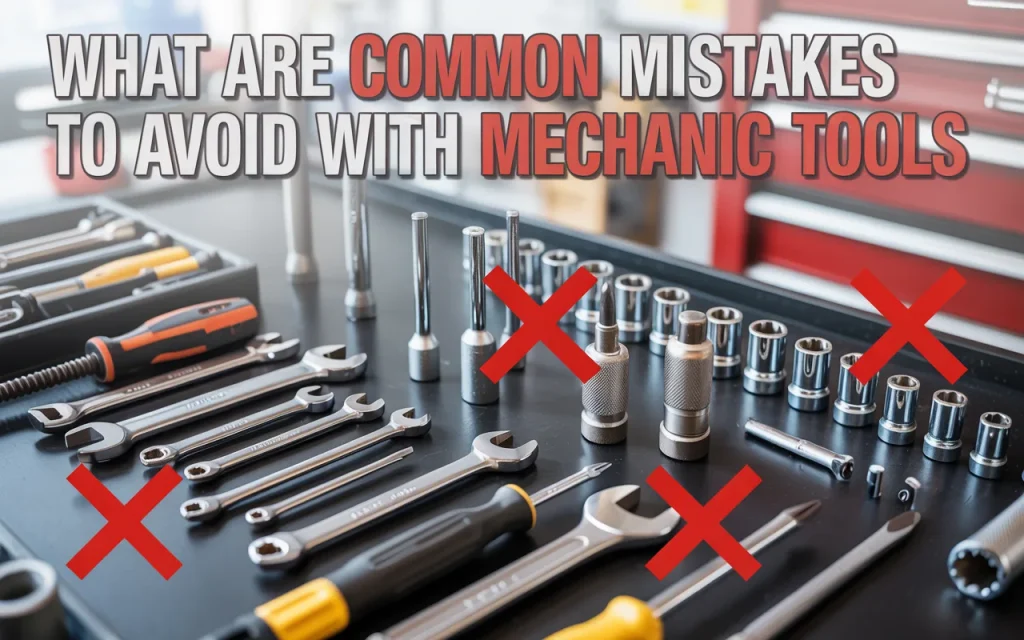
When we talk about what are common mistakes to avoid with mechanic tools, we cannot skip safety. Many people think safety glasses and gloves are for “other people.” But your eyes and hands are your most important tools.
Why Safety Glasses Are Non-Negotiable
I have had rust fall from an undercarriage straight into my eye. I have had a socket shatter when I was using a cheap impact adapter. If you are working under a car, dirt, dust, and metal shavings are constantly falling. Wearing safety glasses is not a sign of weakness. It is a sign that you want to keep working on cars for a long time. It takes two seconds to put them on, but it takes a hospital visit to remove a piece of metal from your eye.
The Importance of Proper Gloves
Gloves do more than keep your hands clean. They protect you from cuts, burns, and chemical exposure. Old coolant, brake cleaner, and grease are not great for your skin. More importantly, gloves give you a better grip. When your hands are sweaty or greasy, a tool can slip. A good pair of mechanic gloves helps you maintain control.
| Safety Tool | Common Mistake | Why It Matters |
|---|---|---|
| Safety Glasses | Not wearing them | Prevents eye injury from debris, rust, or tool failure |
| Mechanic Gloves | Wearing loose or no gloves | Improves grip, prevents cuts, and protects from chemicals |
Poor Tool Storage and Organization
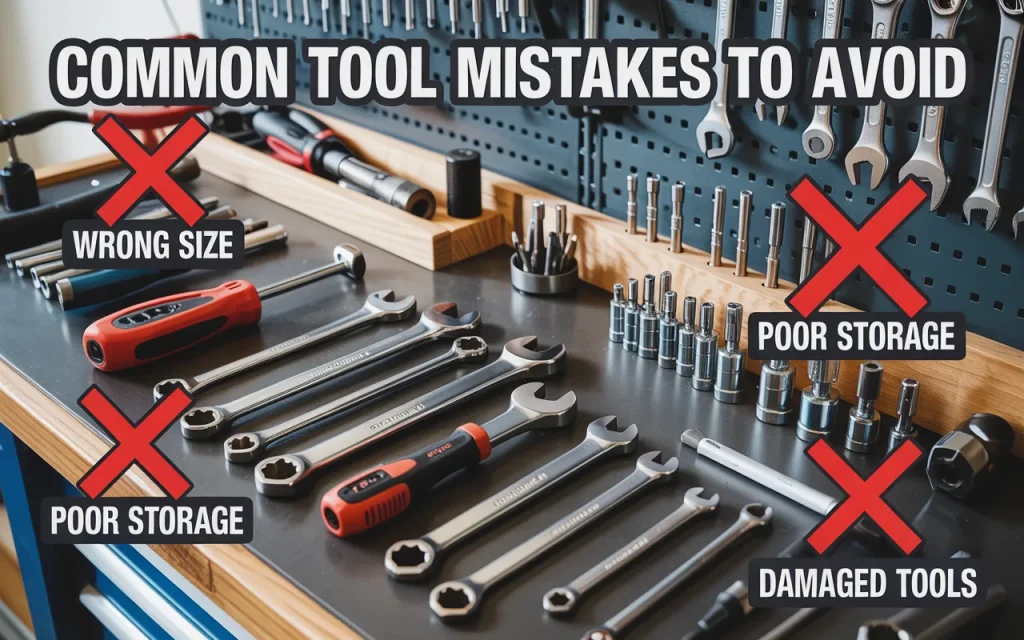
I have seen garages where tools are piled in a bucket or scattered across a workbench. Not only does this waste time, but it also destroys tools. When tools are thrown together, they rub against each other. This causes rust and dulls cutting edges.
The Problem with “Out of Sight, Out of Mind”
If you do not have a specific place for each tool, you will waste hours looking for a 10-millimeter socket. Everyone knows the frustration of losing that one socket. But more importantly, when tools are not organized, you are more likely to use the wrong one because it is the only one you can find.
Investing in a proper toolbox with foam inserts or a shadow board is a good idea. When every tool has a home, you know immediately when something is missing. You also keep your tools clean because they are not banging against each other.
Storage and Moisture
Rust is the enemy. If you leave your tools in a damp basement or an unsealed garage, they will start to corrode. This is especially true for precision tools like torque wrenches and micrometers. A little bit of oil on your tools before you put them away goes a long way. Keeping a silica gel pack in your toolbox can also help absorb moisture.
“A disorganized toolbox is a map to failure. If you cannot find your tool in three seconds, you are wasting mental energy that should be focused on the repair.”
— Sarah Chen, Automotive Educator and Shop Owner
Incorrect Use of Torque Wrenches
A torque wrench is one of the most precise tools in your arsenal. It is also one of the most commonly misused. If you want to know what are common mistakes to avoid with mechanic tools, the misuse of torque wrenches is near the top of the list.
Storing a Torque Wrench Incorrectly
Torque wrenches are calibrated tools. They have internal springs. If you leave the wrench set to a high torque value when you store it, you put constant tension on those springs. Over time, this causes the calibration to drift. Your wrench will no longer be accurate. You should always dial the torque wrench back to its lowest setting (but not zero) before putting it away.
Not Resetting the Tool
Another mistake is forgetting to reset the wrench after use. If you leave it set to 100 foot-pounds and put it back in the drawer, the spring is compressed for months. This ruins the accuracy. Treat your torque wrench with care. Use it only for final tightening, not for breaking bolts loose.
Using Extensions Incorrectly
Using a long extension bar on a torque wrench can change the torque applied to the fastener if you are not careful. If the extension is not supported, it can cause angular error. For critical jobs like cylinder heads or engine internals, you need to follow the tool manufacturer’s guidelines. Hold the torque wrench in the center of the grip to maintain accuracy.
Ignoring Maintenance and Cleaning
Tools do not last forever, but they can last for generations if you take care of them. One of the most common mistakes is simply neglecting to clean them after use.
The Dirt Factor
If you put a socket back into the drawer covered in grease and dirt, that dirt acts like sandpaper. It wears down the anvil of your ratchet and the square drive of the socket. Over time, this creates slop in the connection. A loose connection leads to slipping and rounding fasteners. A quick wipe with a rag after each use takes ten seconds but adds years to the life of your tool.
Rust Prevention
If you live in a humid area or work on cars in the rain, rust is a constant battle. Do not leave your tools outside overnight. Do not leave them lying in a puddle of water. A light coat of WD-40 or a similar lubricant on the chrome surfaces helps prevent oxidation. For your impact sockets, which are often black oxide, keeping them lightly oiled is essential to prevent them from turning into rusty lumps.
Using Power Tools Incorrectly
Impact wrenches, drills, and grinders are amazing time-savers. But they can cause massive damage if used incorrectly.
The Impact Wrench Problem
An impact wrench is designed for removing bolts, not for installing them. One of the biggest mistakes I see is people using an impact wrench to tighten lug nuts. If you do this without a torque stick or a careful hand, you can easily over-torque the nuts. This stretches the studs and makes it nearly impossible to remove the wheel later on the side of the road. Always use a torque wrench for final tightening.
Angle Grinder Safety
Angle grinders are dangerous if you are not paying attention. A common mistake is removing the safety guard. I know it gets in the way sometimes, but it is there to protect your face and chest if the disc explodes. Another mistake is using the wrong wheel for the material. Using a cutting wheel for grinding puts sideways pressure on a wheel that is not designed for it, causing it to shatter.
“Power tools give us speed, but they take away the feel. You have to replace physical feedback with discipline. Otherwise, you will break something expensive in half a second.”
— James “Jimmy” O’Connor, Heavy Equipment Technician
Buying Cheap Tools (And Not Knowing When to Splurge)
We all love a good deal. There is nothing wrong with buying budget tools for certain tasks. However, the mistake comes when you do not know where to spend your money.
Where Quality Matters Most
You do not need a $500 ratchet for a job you do once a year. But you should invest in high-quality tools for things you use every day. Your main ratchet, your set of combination wrenches, your torque wrench, and your screwdrivers are worth spending money on. Cheap screwdrivers will strip the heads of screws. Cheap ratchets will break when you need them most. Cheap sockets can split or round off fasteners.
The Tool Truck Trap
On the other side, avoid going into debt for a brand name. You do not need to spend $10,000 on a toolbox to be a good mechanic. The best approach is to buy a mix. Buy reliable mid-tier tools for general use. When you find that you use a specific tool so much that it wears out, then upgrade to a premium brand. This way, you build a collection that matches your actual needs.
Rushing the Job and Improper Technique
Many mistakes happen because of impatience. We want the job done quickly so we can drive the car. But rushing leads to sloppy technique.
Stripping Bolts and Cross-Threading
One of the most frustrating things you can do is cross-thread a bolt. This usually happens when you try to start a bolt with a power tool or when you are forcing it by hand. The correct technique is to start the bolt with your fingers. Turn it counterclockwise until you feel a click. This aligns the threads. Then, turn it clockwise by hand for at least two full turns. Only then should you use a ratchet or wrench.
Not Using the Right Leverage
Another technique mistake is using a wrench or ratchet at a bad angle. If you are not pulling straight, you are more likely to round the bolt. Always make sure your tool is seated fully on the fastener. Use extensions and universal joints to get a straight line of pull whenever possible.
Failing to Read Instructions
I know, reading the manual feels like a waste of time. But it is one of the best habits you can develop. Whether it is the manual for your new torque wrench or the repair manual for your car, the information is there to help you.
Tool Manuals
When you buy a new tool, read the manual. Understand its limits. What is the maximum torque for that ratchet? How do you calibrate that micrometer? Knowing this prevents you from damaging the tool on the first use.
Vehicle Repair Information
Before you start a repair, look up the torque specifications. Know which bolts are reverse-threaded. Understand the sequence for tightening cylinder heads. Guessing on these details is a sure way to cause a leak or a broken part.
Frequently Asked Questions
Q1: What is the most common mistake beginners make with sockets?
The most common mistake is using a standard socket on an impact wrench. This is dangerous because standard sockets can shatter under the vibration and torque of an impact gun. Always use impact-rated sockets (usually black) with impact tools.
Q2: How often should I clean my mechanic tools?
You should wipe down your tools after every use. For a deep cleaning, it is good to go through your toolbox once a month to check for rust, clean off built-up grease, and lubricate moving parts like ratchet gears and plier joints.
Q3: Is it bad to use a cheater pipe on a ratchet?
Yes, generally. Ratchets are designed for specific torque limits. Using a long pipe (cheater pipe) for leverage puts immense stress on the internal gear mechanism. For high leverage needs, use a breaker bar, which is designed to handle that force.
Q4: What are common mistakes to avoid with mechanic tools regarding storage?
The biggest storage mistakes are leaving tools in damp areas, throwing them loosely in a drawer where they bang together, and storing torque wrenches with the spring under tension. A clean, dry, and organized toolbox prevents rust and maintains accuracy.
Q5: Can using the wrong size screwdriver damage the screw?
Absolutely. If you use a screwdriver that is too small, it will slip and chew up the head of the screw. If it is too large, it will not fit properly. Using the correct size, whether Phillips, flathead, or Torx, ensures you apply full torque without damaging the fastener.
Conclusion
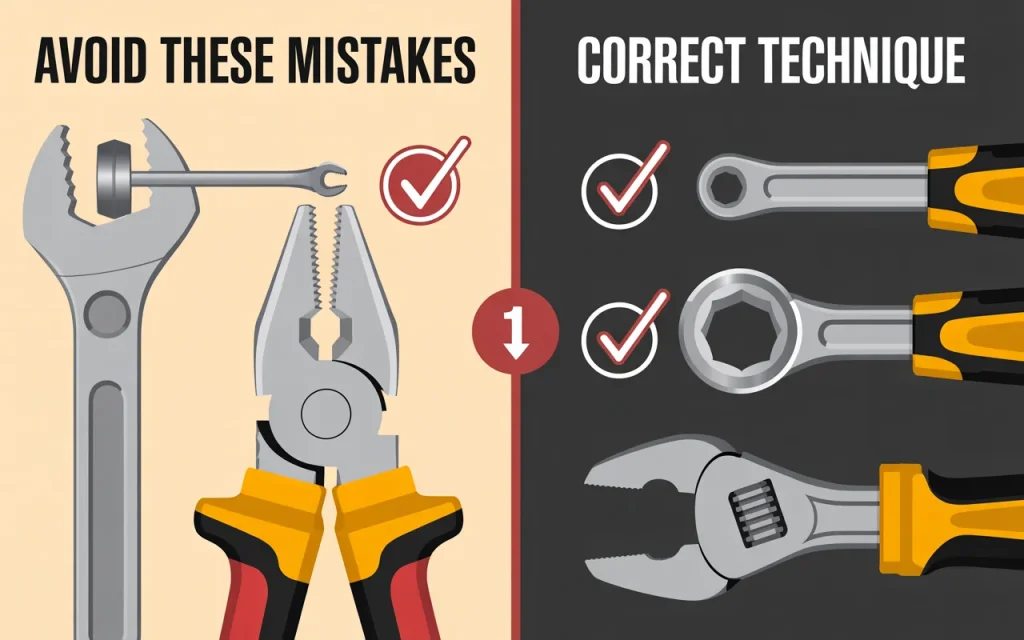
Looking back at my own experiences in the garage, I realize that most of my biggest frustrations came from simple, avoidable errors. I was either in too much of a hurry, or I simply did not respect the tools in my hand. Asking yourself what are common mistakes to avoid with mechanic tools is a great way to start treating your equipment with the respect it deserves.
By using the correct tool for the job, wearing your safety gear, keeping your workspace organized, and maintaining your tools after use, you make your work easier, safer, and more enjoyable. A good tool is an investment. When you take care of it, it takes care of you. It allows you to fix things, save money, and build confidence in your own abilities.
The next time you walk into your garage, take a moment. Check your organization. Wipe down that ratchet. Put on your safety glasses. Work with patience and purpose. Your tools will last longer, your knuckles will stay safer, and you will finish each project with a sense of pride instead of frustration. Happy wrenching.